
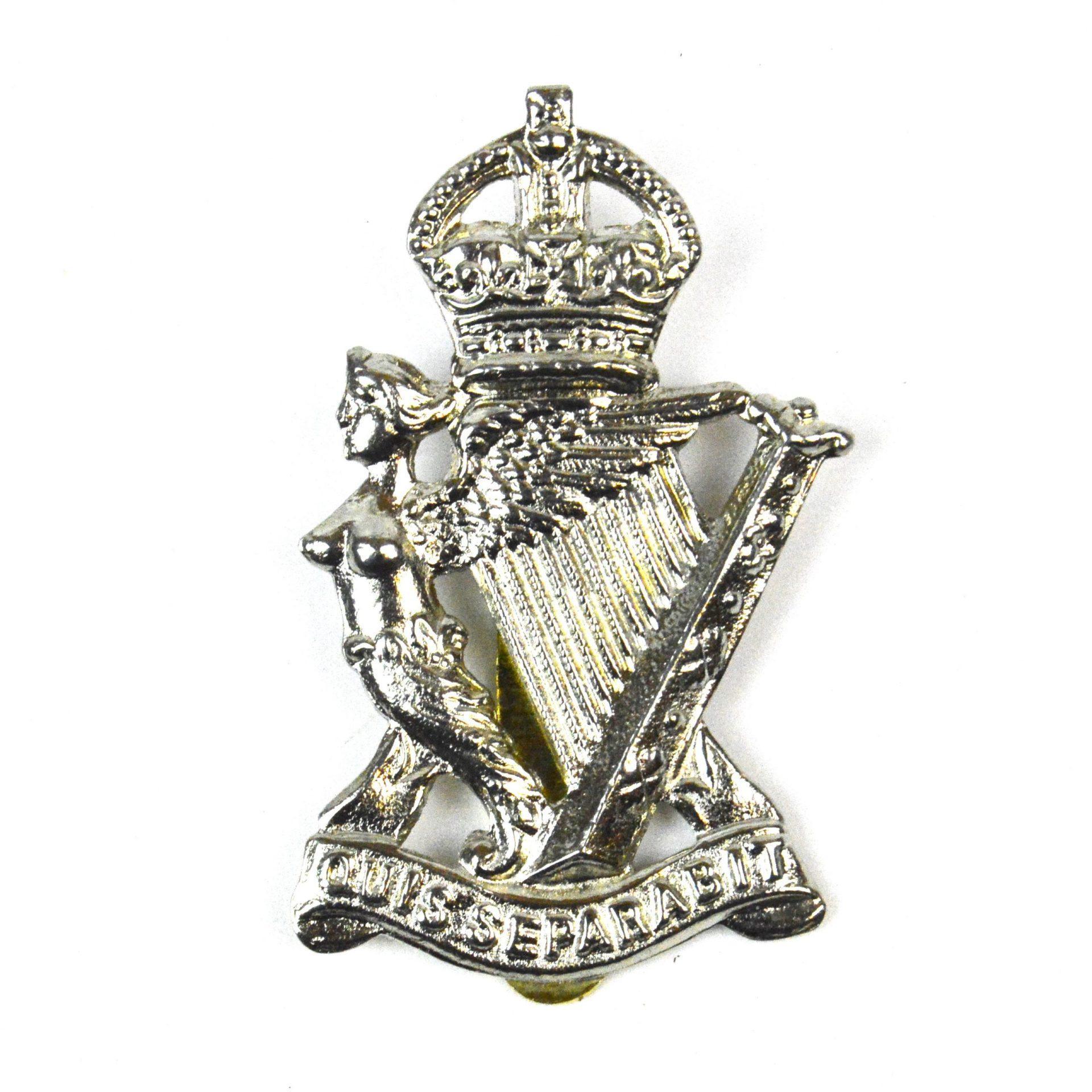
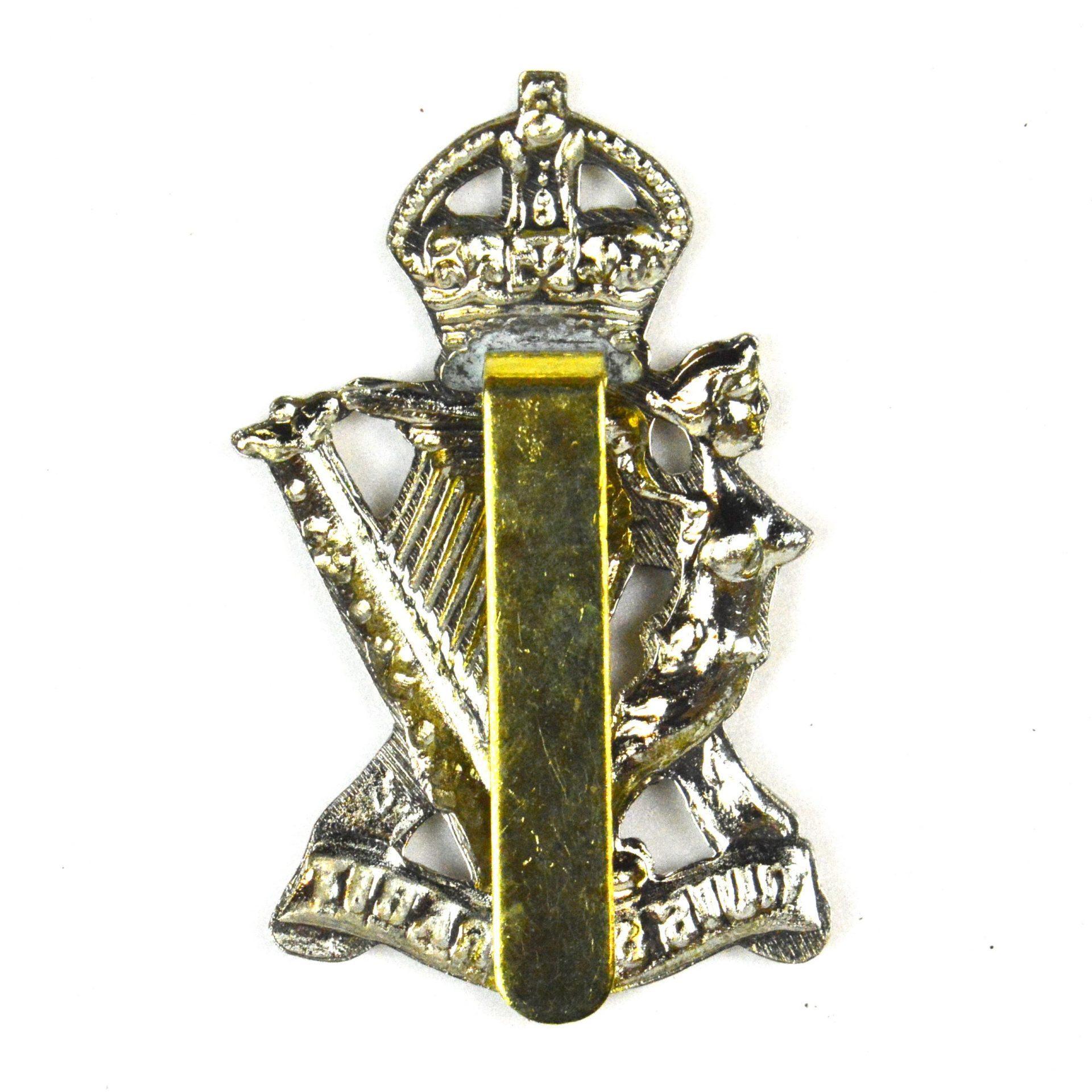
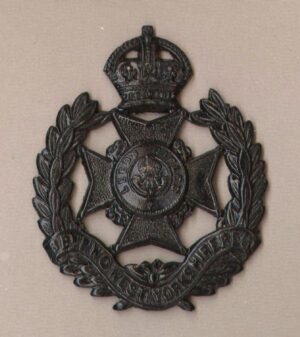
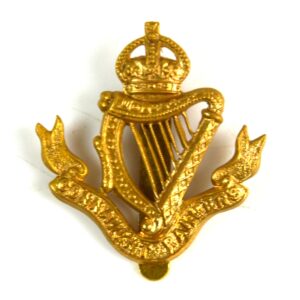
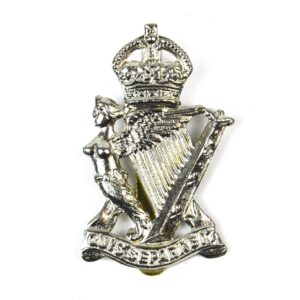
Royal Ulster Rifles cap badge produced as a restrike of the pattern worn between 1921 and 1952 by the Royal Ulster Rifles of the British Army. This British Army rifle regiment cap badge displays the recognised regimental insignia in clear relief, incorporating a winged angel harp facing left as the central device, surmounted by an Imperial King’s Crown, with a lower scroll bearing the regimental motto “Quis Separabit” (Latin: “Who Shall Separate Us?”). The composition is identical in design to the badge worn under the regiment’s predecessor designation, the Royal Irish Rifles, the regimental name having changed in 1921, with no alteration to the badge device. The composition reflects the regiment’s heraldic traditions and the historic associations of its two predecessor units.
The regiment was formed on 1 July 1881 through the Cardwell and Childers Reforms as the Royal Irish Rifles, through the amalgamation of the 83rd (County of Dublin) Regiment of Foot and the 86th (Royal County Down) Regiment of Foot — a pairing notable for being most unusual, if not unique, in that two standard line infantry regiments were redesignated as rifles at the point of their amalgamation. The angel harp device and the motto “Quis Separabit” were both derived from the junior 86th predecessor regiment, with both elements drawn from the Order of St Patrick and said to have been conferred by William III; the harp is also the symbol of Leinster, the province from which the 86th drew its recruits following its relocation to Ireland. The badge was produced in blackened metal from 1881, revised to its present form in 1901, and from 1913 standardised in white metal with the King’s Crown in the form worn throughout the First World War and Second World War. Following the decision to formally acknowledge the regiment’s Ulster base and Northern Irish associations rather than its original Dublin connection, the regiment was redesignated the Royal Ulster Rifles on 1 January 1921 in anticipation of the formation of the Irish Free State, with the badge pattern carried forward entirely unchanged. The King’s Crown pattern remained in use until the accession of Queen Elizabeth II in 1952, when a Queen’s Crown pattern was introduced. The regiment was subsequently amalgamated into the North Irish Brigade in 1958 and, in July 1968, merged with the Royal Irish Fusiliers and the Royal Inniskilling Fusiliers to form the Royal Irish Rangers.
Manufactured in white metal consistent with the post-1913 production standard for this badge, this restrike example provides a sharply defined representation of the Royal Ulster Rifles headdress badge pattern as worn through both world wars and the Korean War. Royal Ulster Rifles King’s Crown cap badges are collected as examples of First and Second World War British Army rifle regiment militaria, regimental insignia of the Irish regiments of the line, and historic uniform hardware of the Northern Irish regiments of the British Army.
Dimensions Approx. 54mm x 35mm
Condition Very good
Reviews
There are no reviews yet.