- Introduction to the Lee-Enfield
- History and Development
- Origins: The Lee-Metford
- The SMLE Mark I (1904)
- The SMLE Mark III and Mark III* (1907–1918)
- The No. 4 Rifle (1941)
- The No. 5 Jungle Carbine (1944)
- Post-War Service
- Technical Specifications
- Identifying Lee-Enfield Marks and Variants
- Markings
- Common Variants for Collectors
- Collecting Lee-Enfields
- What to Look For
- Price Guide
- Legal Position in the UK
- The Lee-Enfield in Combat
- Further Reading
- The Lee-Enfield in Combat: First-Hand Accounts
- Sniper Variants and Telescopic Sights
- Commonwealth Production and Variants
- Post-War Service and Conversions
- Collecting the Lee-Enfield: Building a Representative Collection
- The Lee-Enfield Community
Introduction to the Lee-Enfield
The Lee-Enfield SMLE (Short Magazine Lee-Enfield) is arguably the most important British military firearm of the 20th century. Adopted in 1904 as the Rifle, Short, Magazine, Lee-Enfield Mark I, it served the British and Commonwealth forces through two world wars, numerous colonial conflicts, and continued in front-line service with some nations well into the 1960s. More than 17 million Lee-Enfields of all marks were produced, making it one of the most manufactured bolt-action rifles in history. [1]
For collectors, the Lee-Enfield represents an accessible and fascinating area of study. Examples range from common wartime-production rifles available for a few hundred pounds to rare early marks and presentation pieces commanding thousands. The rifle’s long service life, wide geographic distribution, and extensive production history mean that no two collections are alike — and there is always something new to discover.
History and Development
Origins: The Lee-Metford
The Lee-Enfield’s direct ancestor was the Lee-Metford rifle, adopted by the British Army in 1888. This combined James Paris Lee’s detachable box magazine and bolt action with William Ellis Metford’s rifling pattern. The Lee-Metford served in the Boer Wars but was rapidly superseded: Metford’s shallow rifling could not withstand the erosive effects of cordite propellant, which replaced black powder in British ammunition from 1892. [2]
The solution was to re-barrel the Lee-Metford with deeper, more durable Enfield rifling (designed at the Royal Small Arms Factory, Enfield). This produced the Magazine Lee-Enfield (MLE) in 1895, which saw extensive service in the Boer Wars of 1899–1902.
The SMLE Mark I (1904)
Lessons learned in South Africa — where Boer marksmen with long-barrelled Mauser rifles outranged British troops — led to a radical redesign. The resulting Short Magazine Lee-Enfield Mark I was shorter than the MLE (25.2 inches barrel vs 30.2 inches), lighter, and designed to be issued to both infantry and cavalry, replacing separate long and short rifles. This was revolutionary: most armies maintained different weapons for different arms of service. [1]
Conservative elements in the British establishment initially opposed the SMLE. The shorter barrel was criticised for reduced accuracy at long range, and the charger-loading system was initially imperfect. However, combat experience would vindicate the design decisively.
The SMLE Mark III and Mark III* (1907–1918)
The definitive World War I Lee-Enfield. The Mark III introduced a smoother charger guide, improved sights, and refinements throughout. By 1914, the British regular soldier was trained to deliver 15 aimed rounds per minute — the “mad minute” — and German troops at Mons reportedly believed they were facing machine guns. [2]
The wartime Mark III* (1915) was a simplified version for mass production: the magazine cut-off, windage adjustment on the rear sight, and the volley sight were deleted. Millions were produced by the Royal Small Arms Factory at Enfield, BSA (Birmingham Small Arms), and the London Small Arms Company, among others.
The No. 4 Rifle (1941)
Designed in the 1930s but not adopted until 1941 (due to the expense of retooling), the No. 4 Mark I was a modernised Lee-Enfield designed for easier mass production. It featured a heavier barrel, aperture rear sight (replacing the open sight of the SMLE), and simplified manufacturing tolerances. It was produced in enormous numbers in Britain (Fazakerley, Maltby, BSA), Canada (Long Branch), and the United States (Savage Arms). [1]
The No. 4 served through World War II and the Korean War. A sniper variant, the No. 4 Mark I (T), fitted with a No. 32 telescopic sight, saw distinguished service and is one of the most collected Lee-Enfield variants today.
The No. 5 Jungle Carbine (1944)
A shortened, lightened version of the No. 4 designed for jungle warfare in the Far East. It features a shortened barrel with a flash hider, a lightened receiver, and a rubber buttpad. The “Jungle Carbine” saw service in Burma, Malaya, and Kenya. It is popular with collectors for its compact size and dramatic appearance, though it gained a (possibly undeserved) reputation for “wandering zero” — a tendency for the point of impact to shift. [2]
Post-War Service
The Lee-Enfield continued in front-line British service until replaced by the L1A1 SLR (FN FAL) in the late 1950s. However, it remained in service with Commonwealth nations for decades longer: Indian, Pakistani, and Bangladeshi forces used Ishapore-manufactured variants (including a 7.62mm NATO conversion) well into the 21st century. Australian forces used the SMLE through the Korean War, and Canadian forces issued the No. 4 until the 1960s. [1]
Technical Specifications
| Feature | SMLE No. 1 Mk III | No. 4 Mk I |
|---|---|---|
| Calibre | .303 British | .303 British |
| Action | Bolt action, rear-locking | Bolt action, rear-locking |
| Magazine capacity | 10 rounds (detachable box) | 10 rounds (detachable box) |
| Barrel length | 25.2 inches (640mm) | 25.2 inches (640mm) |
| Overall length | 44.6 inches (1,130mm) | 44.4 inches (1,128mm) |
| Weight (unloaded) | 8 lb 10 oz (3.9 kg) | 9 lb 1 oz (4.1 kg) |
| Muzzle velocity | 2,441 fps (744 m/s) | 2,441 fps (744 m/s) |
| Effective range | 550 yards (503m) | 600 yards (550m) |
| Sights | Open V-notch rear, blade front | Aperture rear, blade front |
Identifying Lee-Enfield Marks and Variants
Markings
Lee-Enfields bear extensive markings that tell their story. The most important are found on the receiver (knox form), the barrel, and the butt socket. Key markings include: [1]
- Manufacturer and year: Stamped on the receiver ring. “ENFIELD 1917” indicates production at the Royal Small Arms Factory in 1917.
- Mark designation: “SHT.LE. III*” (Short Lee-Enfield Mark III Star) or “No.4 MK.I” on later variants.
- Serial number: On the receiver, bolt, and forestock. Matching numbers across components indicate an unaltered rifle.
- Broad arrow and crossed-pennants: British government ownership marks. The broad arrow alone is a general government mark; crossed pennants indicate military acceptance.
- FTR: “Factory Through Repair” — indicates the rifle has been refurbished. FTR rifles are common and typically show mixed-date components.
Common Variants for Collectors
- SMLE No. 1 Mk III — the classic World War I rifle. Australian-made examples (Lithgow) are particularly sought after.
- SMLE No. 1 Mk III* — the simplified wartime version.
- No. 4 Mk I and Mk I* — the World War II standard. Savage (US), Long Branch (Canada), and British-made examples all have their followings.
- No. 4 Mk I (T) / Mk I* (T) — sniper variants with No. 32 scope. Highly prized; £2,000–£5,000+ depending on completeness and condition.
- No. 5 Mk I — the Jungle Carbine. Compact and distinctive. Beware “fakes” — post-war commercial conversions of No. 4 rifles to resemble No. 5s are common.
- Ishapore 2A/2A1 — Indian-made variant rechambered to 7.62x51mm NATO. Interesting historical variant.
Collecting Lee-Enfields
What to Look For
The most desirable rifles are those in original, unaltered condition with matching serial numbers throughout. Look for: [2]
- Matching numbers on receiver, bolt, barrel, and forestock
- Original wood furniture (not refinished or replaced)
- Clear, legible markings
- Bore condition — a bright bore with sharp rifling is ideal
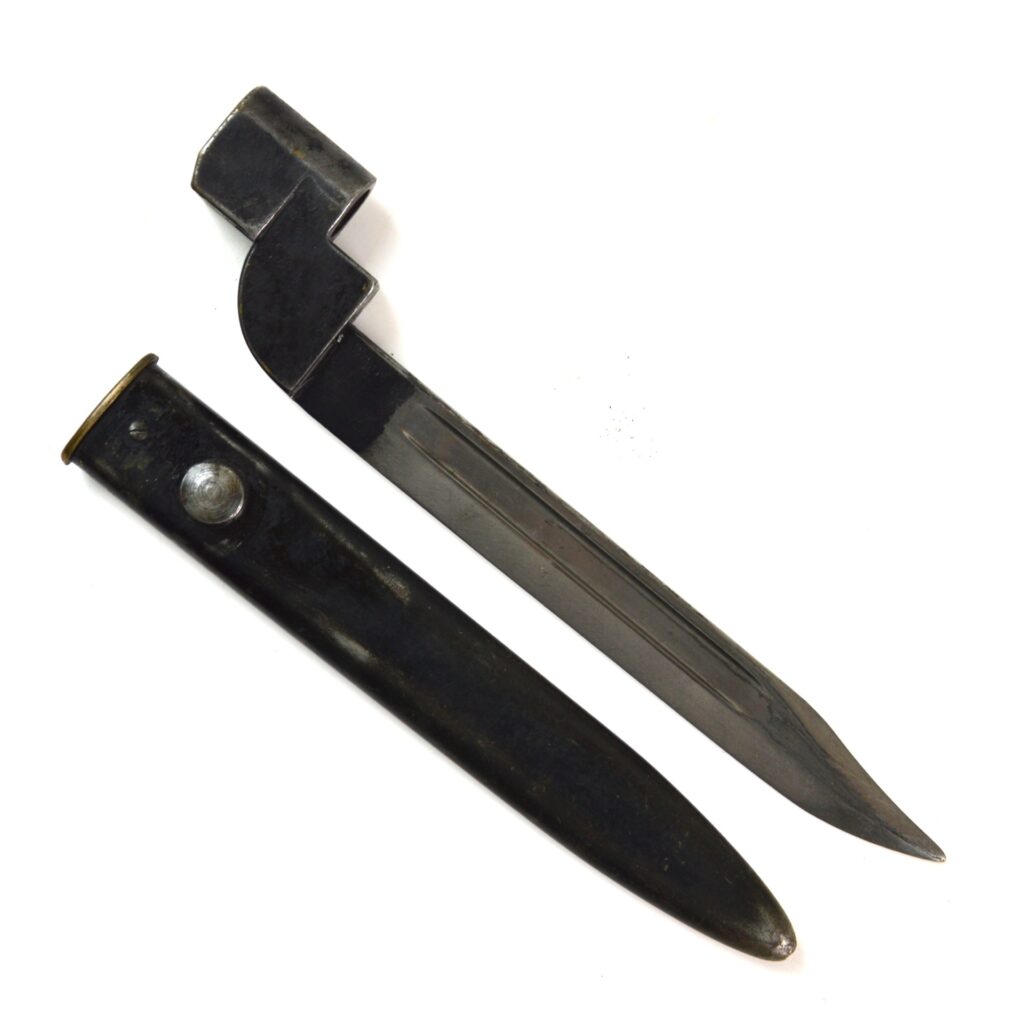
- Correct bayonet and accessories
- Documentation or provenance linking the rifle to a specific unit or campaign
Price Guide
| Variant | Average Condition | Excellent/Matching |
|---|---|---|
| SMLE Mk III (WW1) | £400 – £700 | £800 – £1,200 |
| SMLE Mk III* (WW1) | £350 – £600 | £700 – £1,000 |
| No. 4 Mk I (British) | £300 – £500 | £600 – £900 |
| No. 4 Mk I (Savage/Long Branch) | £350 – £600 | £700 – £1,100 |
| No. 4 Mk I (T) sniper | £2,000 – £3,500 | £4,000 – £6,000+ |
| No. 5 Jungle Carbine | £500 – £800 | £900 – £1,400 |
| Lee-Metford (1888–1895) | £600 – £1,000 | £1,200 – £2,000 |
Legal Position in the UK
In the United Kingdom, Lee-Enfield rifles fall into two categories. Rifles manufactured before 1 September 1939 are classified as antique firearms under the Firearms Act 1968 (as amended) and can be possessed without a firearms certificate, provided they are kept as a curiosity or ornament and no compatible ammunition is held. Rifles manufactured after this date require either a firearms certificate (if live-firing) or must be deactivated to current Home Office standards. [1]
Always verify the current legal position before purchasing. Deactivated rifles must carry a valid deactivation certificate from a Proof House (London or Birmingham). The legal status of firearms in the UK is subject to change — check with your local police firearms licensing department if in doubt.
The Lee-Enfield in Combat
The Lee-Enfield’s reputation was forged in combat. At Mons in August 1914, the BEF’s rapid rifle fire devastated German infantry columns. On the Somme, at Passchendaele, at El Alamein, at Monte Cassino, at Imphal — wherever British and Commonwealth soldiers fought, the Lee-Enfield was there. Its robust design, 10-round magazine (twice the capacity of the German Mauser), and smooth bolt action made it the finest bolt-action combat rifle of its era. [2]
Veterans consistently praised its reliability in adverse conditions. The rear-locking bolt, while theoretically less strong than the Mauser’s front-locking design, proved perfectly adequate for the .303 cartridge and allowed a faster, smoother cycling action that was key to achieving high rates of aimed fire.
Further Reading
Serious collectors should consult Ian Skennerton’s definitive multi-volume works on the Lee-Enfield, which provide exhaustive documentation of marks, variants, and serial number ranges. Martin Pegler’s The Lee-Enfield Rifle (Osprey Publishing) offers an accessible overview with excellent photographs. Online resources include the Lee-Enfield Rifle Association and numerous specialist forums where knowledge is shared and rifles discussed. [1]
The Lee-Enfield in Combat: First-Hand Accounts
The Lee-Enfield’s reputation was forged in combat, and first-hand accounts from soldiers who carried it provide vivid testimony to its qualities. At the Battle of Mons in August 1914, the rapid and accurate fire of the British Expeditionary Force’s regular soldiers — all trained to the “mad minute” standard of 15 aimed rounds per minute — was so devastating that advancing German troops reportedly believed they were facing massed machine-gun fire. Private Frank Richards of the 2nd Battalion, Royal Welsh Fusiliers, later described how his section “simply shot them down like rabbits” as the Germans advanced in close order. [3]
In the trenches of the Western Front, the SMLE proved its worth in the most demanding conditions. Its bolt action, though less precisly machined than the German Mauser, was actually better suited to the mud and filth of trench warfare — the generous tolerances that purists criticised allowed the action to function when clogged with dirt that would have jammed a tighter mechanism. Soldiers quickly learned that the Lee-Enfield could be relied upon to fire even after being dropped in the mud, dragged through barbed wire, or submerged in shell-hole water — provided it received basic maintenance. [3]
Sniper Variants and Telescopic Sights
The Lee-Enfield served as the basis for British sniping rifles throughout both World Wars. In the First World War, selected SMLE Mk III* rifles were fitted with telescopic sights — most commonly the Periscopic Prism Company (P.P. Co.) Mk I or the Aldis Brothers sights. These sniper rifles were assembled by the workshops of the Ordnance Department, selecting rifles that demonstrated above-average accuracy during test firing. They were not factory-built to a sniper specification — rather, they were chosen from production rifles for their superior barrel quality. [2]
In the Second World War, the No. 4 Mk I (T) became the standard British sniper rifle. Selected from production No. 4 rifles by the Holland & Holland sporting rifle company (among others), these were fitted with the No. 32 Mk I telescopic sight — a 3x magnification scope that proved highly effective for the typical engagement ranges on the European battlefield. Each rifle was individually matched to its scope and packed in a wooden transit chest with the scope, mount, and accessories. These sniper sets, when complete and matching, are among the most valuable Lee-Enfield variants: a complete No. 4 (T) set in good condition can sell for £3,000–£6,000, compared to £300–£600 for a standard No. 4. [2]
Commonwealth Production and Variants
The Lee-Enfield was manufactured not only in the United Kingdom but across the British Empire. Major production facilities included:
- Royal Small Arms Factory, Enfield Lock — the primary UK production site, operating from the 1850s until closure in 1988
- Birmingham Small Arms Company (BSA) — produced Lee-Enfield variants under contract throughout both World Wars
- Ishapore Rifle Factory, India — produced SMLE and later variants for the Indian Army; continued production into the 1980s with the 7.62mm NATO conversion (the 2A1)
- Lithgow Small Arms Factory, Australia — produced SMLE Mk III* rifles for the Australian military from 1912; Australian-made Lithgow SMLEs are a popular collecting speciality
- Long Branch Arsenal, Canada — produced No. 4 Mk I* rifles during WWII, distinguished by a simplified bolt release mechanism
- Savage Arms, United States — produced No. 4 Mk I* rifles under Lend-Lease contract; marked “U.S. PROPERTY” on the receiver
Each production facility introduced minor variations — different markings, manufacturing shortcuts, or local modifications — that give Commonwealth-produced Lee-Enfields their own distinct collecting identity. A specialist collection focusing on a single model across all production facilities can illustrate both the global reach of the British Empire and the industrial mobilisation required for two World Wars. [2]
Post-War Service and Conversions
The Lee-Enfield did not retire with the end of the Second World War. It remained the standard British service rifle until replaced by the L1A1 SLR (a variant of the FN FAL) from 1957 onward. Many thousands of Lee-Enfields were subsequently sold to allies, converted for other purposes, or placed in long-term storage. [2]
Notable post-war conversions include:
- L42A1 sniper rifle — a No. 4 (T) converted to 7.62mm NATO calibre; served with the British Army and Royal Marines until the 1990s. These are highly sought after by collectors.
- Ishapore 2A1 — an Indian-produced variant chambered in 7.62mm NATO, manufactured until the 1980s; visually identical to the SMLE Mk III* but in the larger calibre.
- Various sporting conversions — thousands of surplus Lee-Enfields were “sporterised” by removing military woodwork and fitting commercial stocks. These have minimal collector value compared to unaltered military examples.
The Lee-Enfield continues in limited military service today. Reports from Afghanistan confirmed that Taliban fighters and tribal militias still used Lee-Enfields — more than a century after the design first entered service. In 2010, a British soldier was reportedly engaged by a Lee-Enfield at a range the original designers would have been proud of. The design’s longevity is a remarkable testament to James Paris Lee’s original concept and the Enfield factory’s engineering refinement. [3]
Collecting the Lee-Enfield: Building a Representative Collection
A representative Lee-Enfield collection might include the following core variants, listed with approximate current UK market values for deactivated examples in good condition:
| Variant | Period | Approx. Value (Deactivated) |
|---|---|---|
| Magazine Lee-Metford Mk II | 1890s | £800–£1,500 |
| Magazine Lee-Enfield Mk I | 1895–1907 | £600–£1,200 |
| SMLE Mk I | 1903–1907 | £500–£900 |
| SMLE Mk III* | 1907–1945 | £400–£800 |
| No. 4 Mk I | 1941–1945 | £350–£700 |
| No. 5 Mk I “Jungle Carbine” | 1944–1947 | £500–£1,000 |
| No. 4 Mk I (T) Sniper (complete set) | 1942–1945 | £3,000–£6,000 |
| L42A1 Sniper | 1970s–1990s | £4,000–£8,000 |
When building a Lee-Enfield collection, condition is paramount. Look for matching serial numbers across all major components (receiver, bolt, magazine, and — where applicable — forestock and handguard). Military rifles were routinely rebuilt with mismatched parts during service, so a fully matching example commands a significant premium. Original woodwork in good condition also adds substantially to value. [3]
The Lee-Enfield Community
The Lee-Enfield has one of the most active and knowledgeable collecting communities of any military firearm. Online forums such as the Lee-Enfield Rifle Association (LERA) and the various national collectors’ groups provide a wealth of research data, identification assistance, and technical knowledge. Members regularly share photographs of unusual markings, discuss new research findings, and help newcomers identify their rifles. For anyone serious about collecting Lee-Enfields, joining LERA and participating in the online community is strongly recommended — the collective knowledge available through these groups far exceeds what any single reference book can provide. [3]
Annual rifle meetings and collector gatherings — such as those organised by LERA and the Historical Breechloading Smallarms Association (HBSA) — provide opportunities to handle and compare examples, discuss technical points, and buy or trade with fellow enthusiasts. These events are invaluable for building the hands-on experience that distinguishes the expert collector from the casual buyer. [3]
Ultimately, the Lee-Enfield is more than a firearm — it is an artefact of the British Empire at its zenith and decline, of two World Wars, and of the ordinary soldiers who carried it from the North-West Frontier to the beaches of Normandy. Every scratch, stamp, and proof mark on a Lee-Enfield tells part of a story that spans continents, conflicts, and generations. For the discerning collector, it remains one of the most historically significant and rewarding military firearms to study and collect. [3]
Frequently Asked Questions
How many Lee-Enfield rifles were made?
Over 17 million Lee-Enfield rifles were manufactured across all variants, making it one of the most produced bolt-action rifles in history. Production took place at Enfield, BSA, Lithgow (Australia), Ishapore (India), Long Branch (Canada), and Savage Arms (USA).
What is a Lee-Enfield worth?
Deactivated values: SMLE Mk III* £400–£800, No. 4 Mk I £350–£700, No. 5 Jungle Carbine £500–£1,000, complete No. 4 (T) sniper set £3,000–£6,000, L42A1 sniper £4,000–£8,000. Matching serial numbers and original woodwork command significant premiums.
What made the Lee-Enfield so good?
Three factors: its fast, smooth bolt-action (enabling 15+ aimed rounds per minute in trained hands), its 10-round magazine (double the Mauser capacity), and its robust tolerance of battlefield conditions — the generous action tolerances that purists criticised actually made it more reliable in mud and dirt.
Is the Lee-Enfield still in use?
Yes, in limited service. Reports from Afghanistan confirmed Taliban fighters still used Lee-Enfields. The design has been in continuous service somewhere in the world for over a century — a remarkable testament to its fundamental soundness.

Related Items in Our Collection8 items