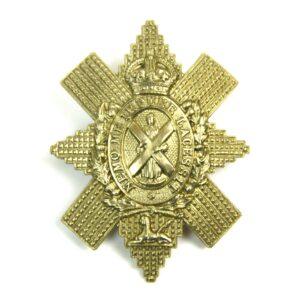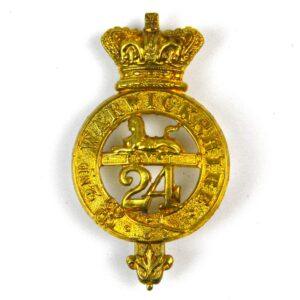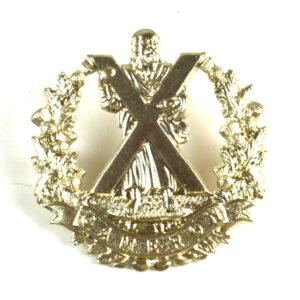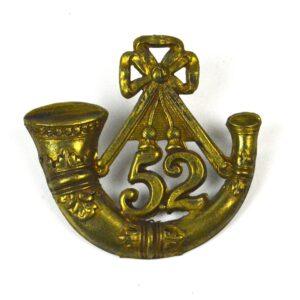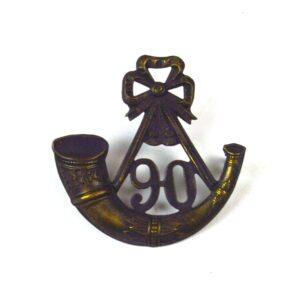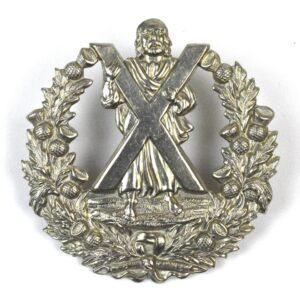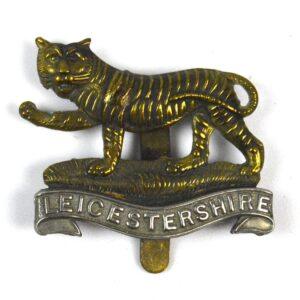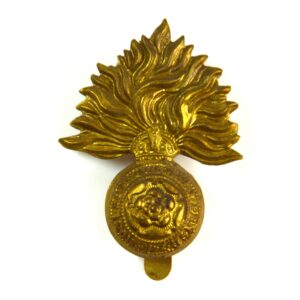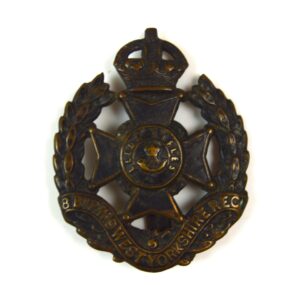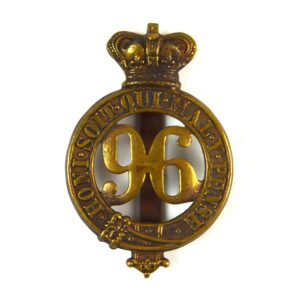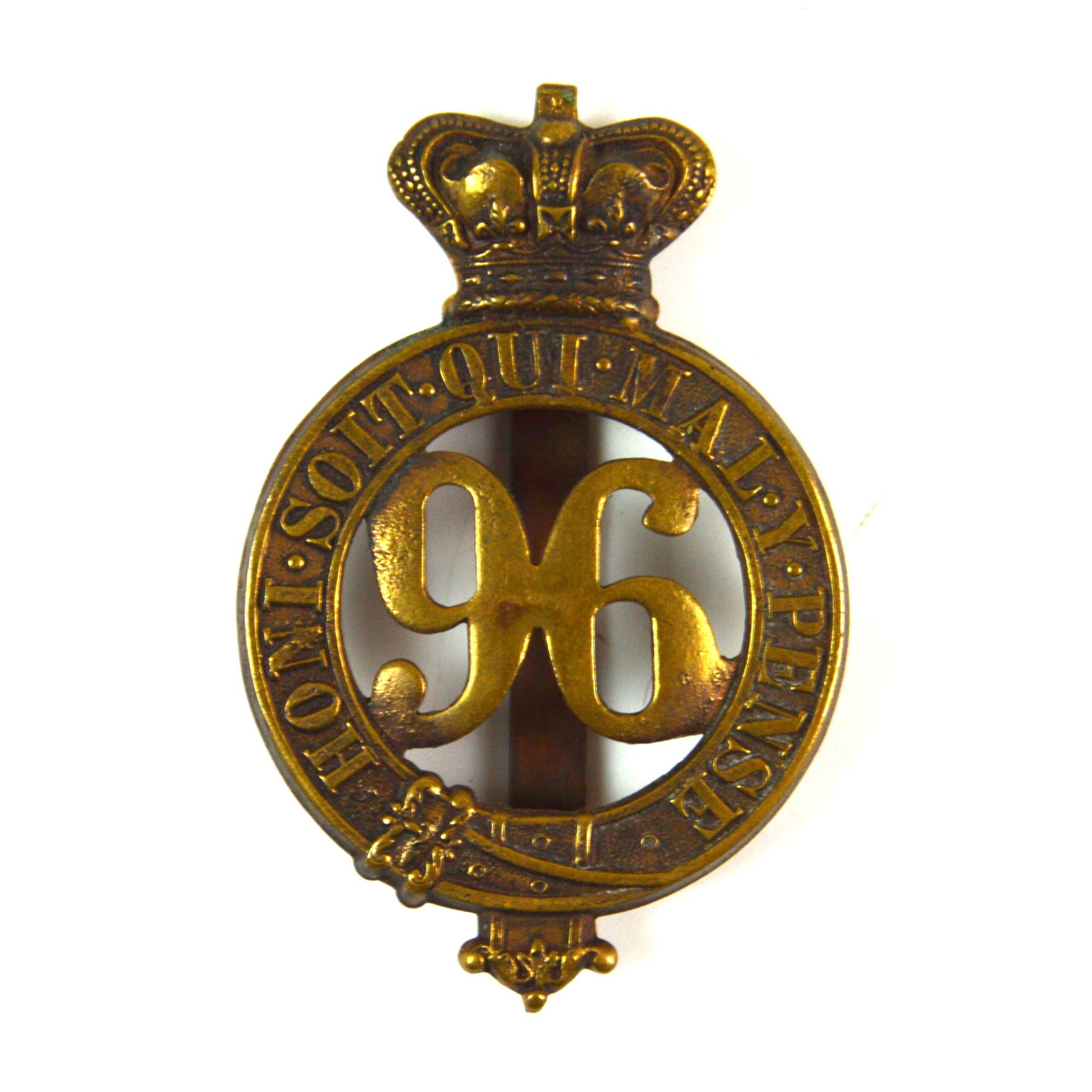
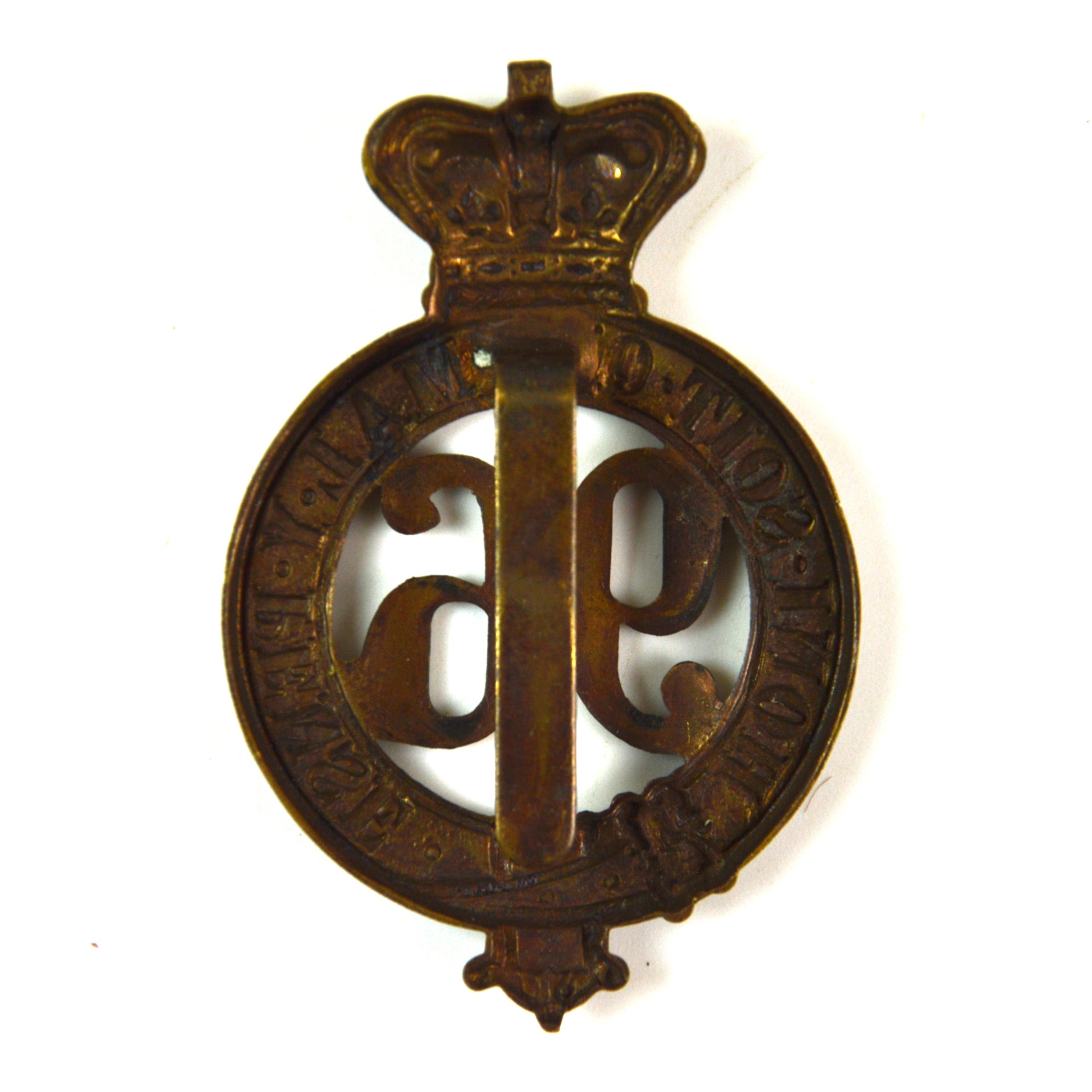
96th Regiment of Foot glengarry badge produced as a restrike of the pattern worn between 1874 and 1881 by the 96th Regiment of Foot of the British Army. This British Army line infantry glengarry badge displays the recognised pre-reform regimental device in clear relief, incorporating the numeral “96” as the central device, encircled by a garter strap bearing the motto “Honi Soit Qui Mal Y Pense” (French: “Shame on him who thinks evil of it”), surmounted by a Victorian Crown. The construction follows the standard Glengarry badge pattern introduced across the British Army in 1874, in which the regimental number formed on a helmet plate centre was combined with a separately struck crown to produce the complete headdress badge. The composition reflects the numbered regiment tradition of the British Army prior to the territorial redesignation of 1881.
The 96th Regiment of Foot was raised on 12 December 1798 in Menorca by Lieutenant-General Sir Charles Stuart, originally from German-speaking prisoners of war of Swiss regiments in Spanish service — an origin that gave the regiment its later designation as the 96th (Queen’s Own Germans) Regiment of Foot, under which it was briefly known until its disbandment at Limerick in December 1818. Reformed in January 1824 in response to the threat posed by French intervention in Spain, the regiment was confirmed as the direct successor of the earlier formation with full continuity of battle honours. The regiment served in the Egyptian campaign of 1801, during which Private Antoine Lutz distinguished himself at the Battle of Alexandria by recovering the colour of the 21st Demi Brigade Légère, a colour that had initially been seized by a sergeant of the 42nd Foot before falling back into French hands. It subsequently served with distinction throughout the Peninsular War, fighting at Vimeiro in 1808, Talavera in 1809, Bussaco in 1810, the First Siege of Badajoz in 1811, and Albuera in 1811, before serving in Canada during the War of 1812. From 1874, the regiment wore the standard other ranks glengarry badge in brass with its regimental number and the Garter motto. On 1 July 1881 the Childers Reforms came into effect and the regiment was amalgamated with the 63rd (West Suffolk) Regiment of Foot to form the Manchester Regiment, with the numbered glengarry badge pattern ceasing at that point. The lineage of the regiment is today perpetuated by the Duke of Lancaster’s Regiment.
Manufactured in brass consistent with the standard Victorian other ranks glengarry badge production of the 1874 to 1881 period, this restrike example provides a sharply defined representation of the numbered regimental badge pattern worn in the final years of the pre-reform British Army. 96th Regiment of Foot glengarry badges are collected as examples of Victorian British Army line infantry militaria, numbered regiment headdress insignia of the pre-Childers era, and uniform hardware associated with the antecedent units of the Manchester Regiment.
Dimensions Approx. 66mm x 43.5 mm
Condition: Good, the design is fairly crude
Later 2nd Manchester Regiment, North-South eyed shank fixings , Ref: Kipling and King Vol.1, Page 178, Plate 578.