
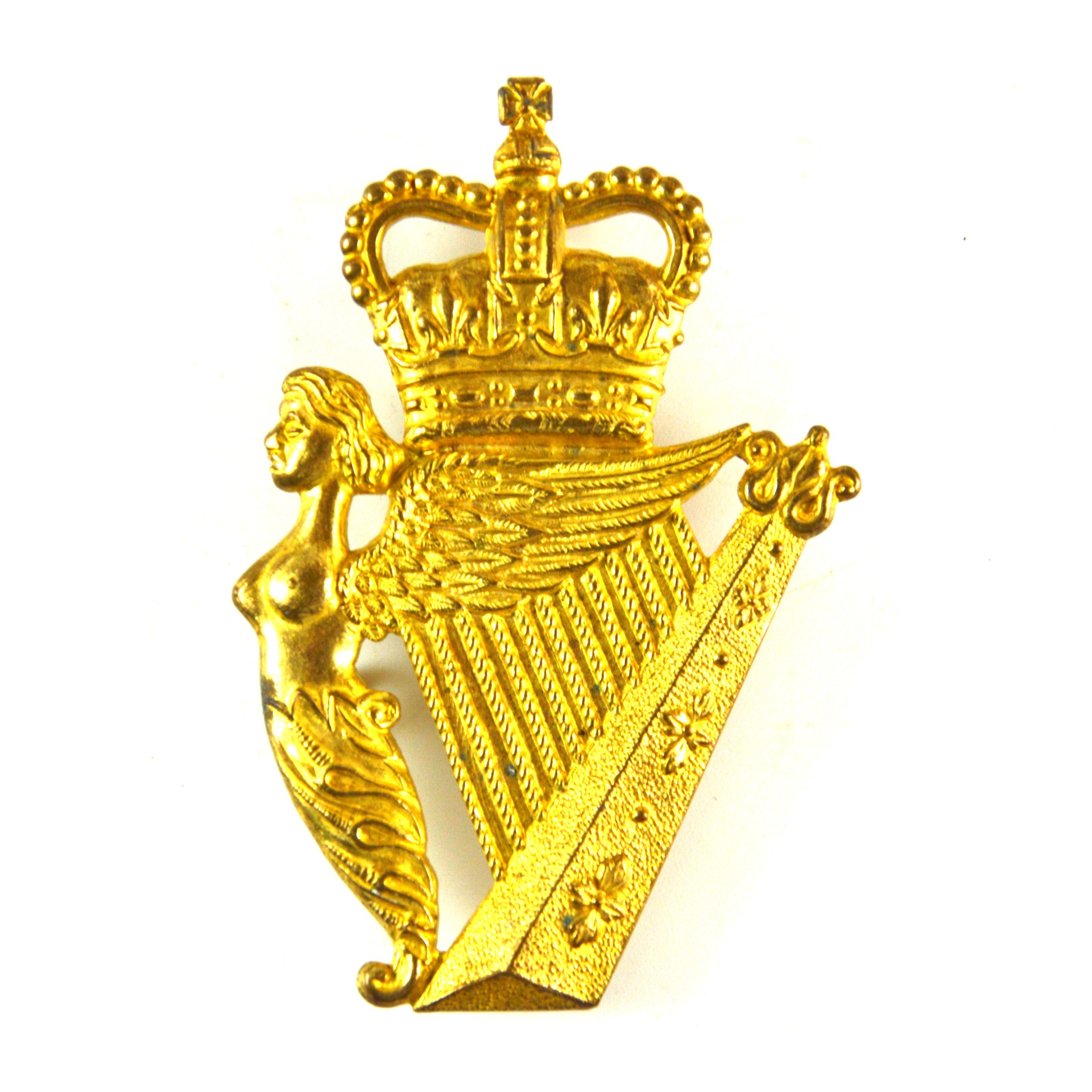
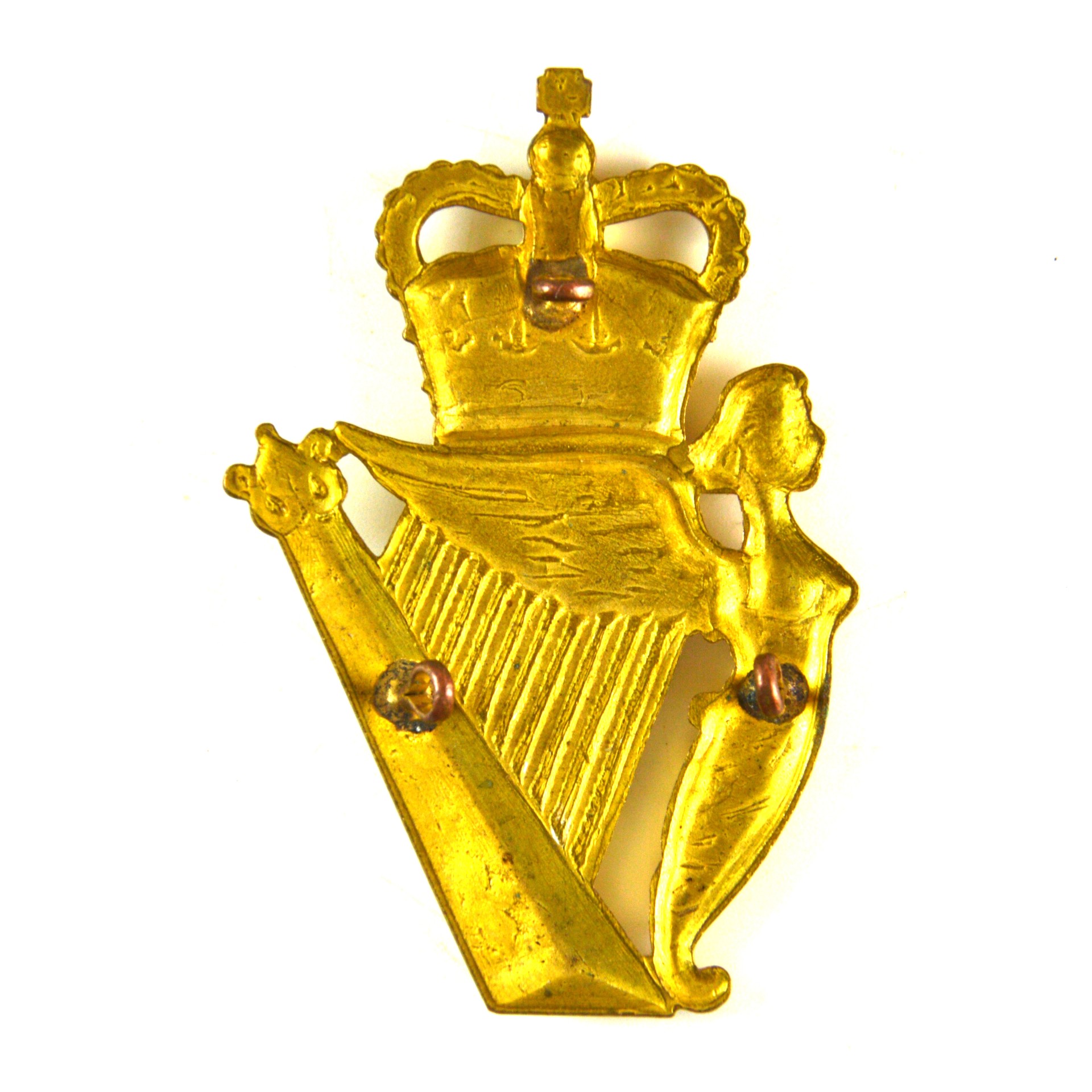
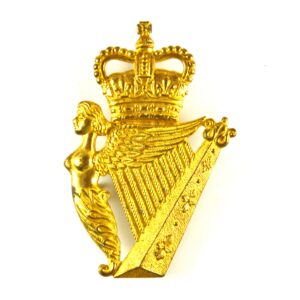
Ulster Defence Regiment piper’s caubeen badge in bright gilt-gilded metal, produced in the pattern worn from 1970 to 1992 by pipers of the Pipes and Drums of the Ulster Defence Regiment of the British Army. This British Army Irish infantry regimental pipe band caubeen badge displays the recognised UDR piper’s device in clear relief, incorporating a female Irish harp with solid, unvoided strings as the central device, surmounted by a Queen’s crown — St Edward’s crown — at the topmost point, the whole produced as a double-size badge in bright gilding metal for prominent wear on the front of the bottle-green caubeen. The reverse carries three attachment loops and two cotter pins, consistent with the construction of a large-format badge designed for secure attachment to the caubeen’s woven fabric front panel. The badge is produced at approximately twice the diameter of the standard UDR service dress cap badge worn by non-piper personnel, the enlarged format being a conventional distinction applied to piper caubeen badges across Irish and Scottish regiments of the British Army to ensure visibility during ceremonial performances.
The Ulster Defence Regiment was established under the Ulster Defence Regiment Act 1969 and began duties on 1 April 1970, replacing the Ulster Special Constabulary as the locally recruited auxiliary security force in Northern Ireland. At its formation, the regiment consisted of seven battalions, expanded to eleven within two years, making it the largest infantry regiment in the British Army by establishment strength throughout its existence. The Pipes and Drums of the Ulster Defence Regiment were constituted as a centralised pipe band drawing pipers from across all battalions, each of which maintained its own complement of pipers who participated in both battalion-level and centralised regimental band activities. The pipe band uniform followed the conventional dress for Irish regimental pipers in the British Army: a saffron kilt, a bottle-green “Prince Charlie” jacket, a bottle-green cape, and the bottle-green caubeen on which this badge was worn. The Irish harp is the principal badge device derived from the wider tradition of Irish regiments within the British Army, the female figure of Erin playing the harp being the heraldic device associated with Ireland since the reign of Henry VIII. The regiment served on continuous active service throughout the entire period of the Troubles, a distinction unique in the British Army, suffering 197 soldiers killed on duty – the highest fatality rate of any regiment serving in Northern Ireland during the conflict. The UDR was amalgamated with the Royal Irish Rangers on 1 July 1992 to form the Royal Irish Regiment, at which point the UDR’s regimental badges and distinctions were superseded.
Manufactured in bright gilding metal with a three-loop cotter-pin reverse, consistent with British Army Irish regimental pipe band caubeen badge production of the 1970 to 1992 period, this example provides a well-defined representation of the UDR piper’s caubeen badge as worn by the Pipes and Drums throughout the regiment’s operational existence. Ulster Defence Regiment piper’s caubeen badges are collected as examples of British Army Irish infantry pipe band insignia, regimental militaria of the Ulster Defence Regiment, and headdress hardware associated with the Troubles-era Northern Ireland security forces.
Dimensions
Approx. 78mm x 53mm
Condition
Very good, some light wear to the finish.

Reviews
There are no reviews yet.