
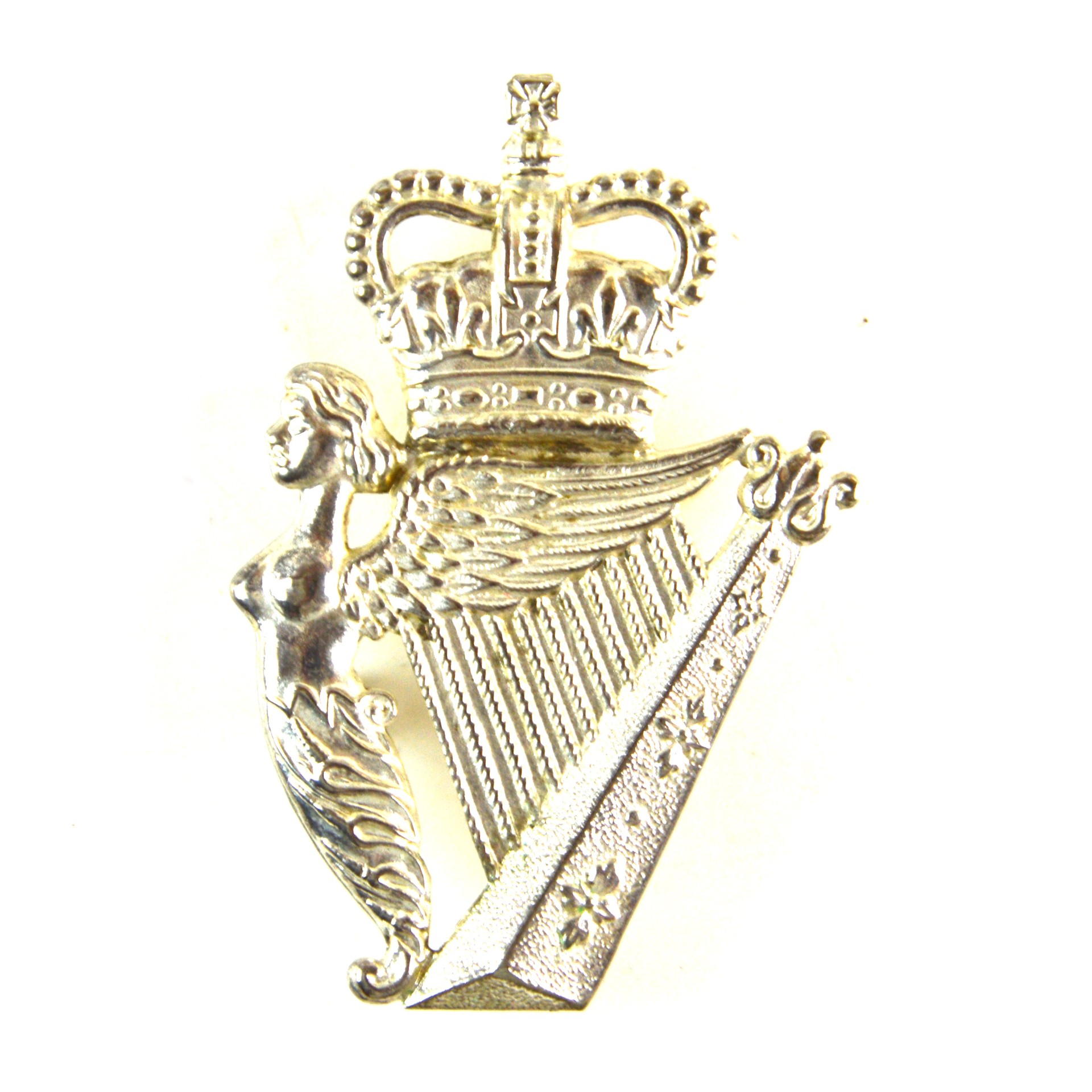
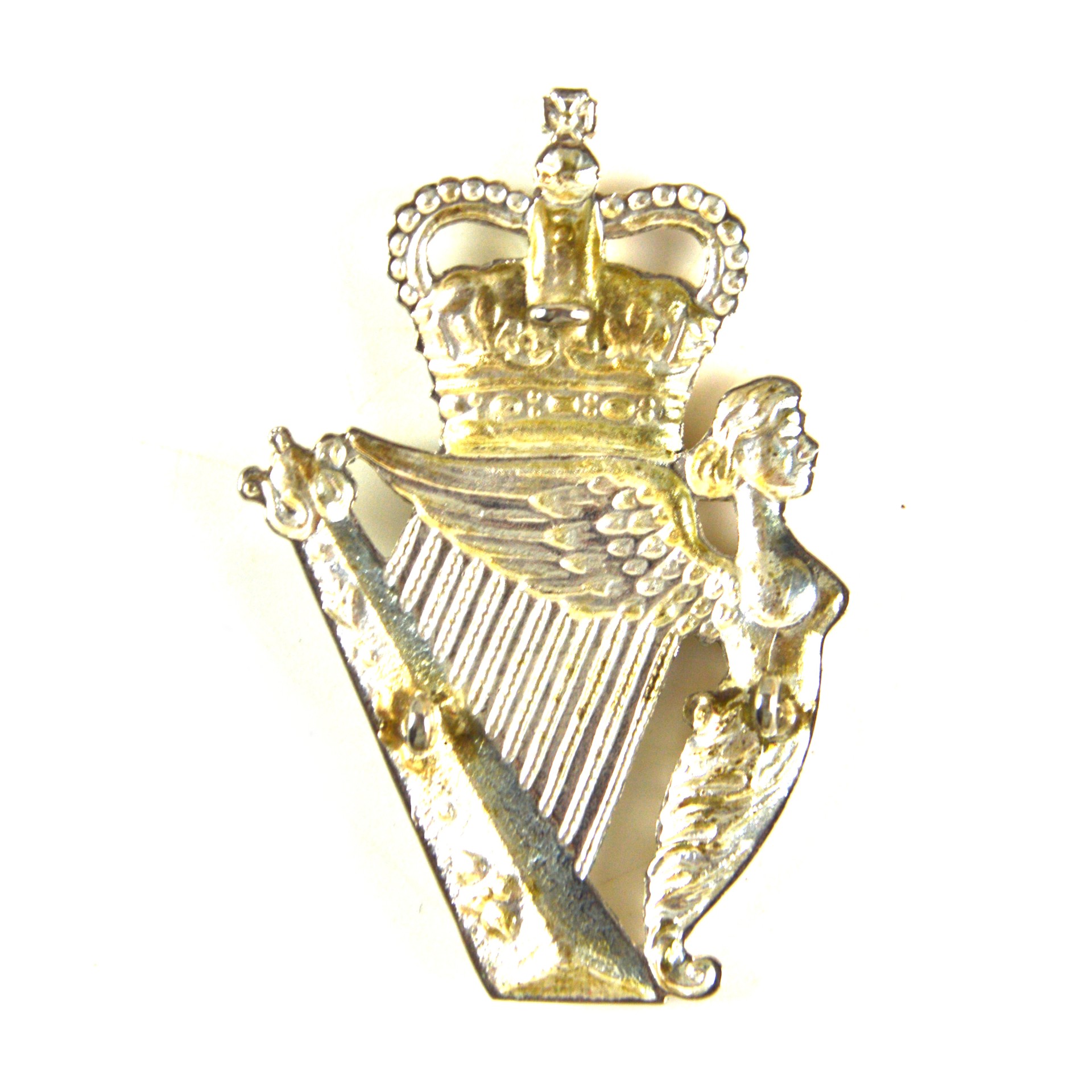
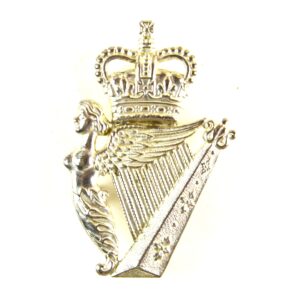
Royal Irish Regiment piper’s caubeen badge in plain silver plate, produced as the 1st Type non-enamel variant of the Queen’s Crown pattern worn from 1992 to 2007 by pipers of the Pipes and Drums of the Royal Irish Regiment of the British Army. This British Army Irish infantry regimental pipe band caubeen badge displays the recognised Royal Irish Regiment device in clear relief, incorporating a winged female Irish harp as the central device, surmounted by a Queen’s Crown — St Edward’s Crown — at the topmost point, the whole produced in plain silver plate throughout without enamel detail to the harp strings, distinguishing this 1st Type example from the later 2nd Type variant in which green enamel infill was applied to the harp strings. The badge is produced at approximately twice the diameter of the standard Royal Irish Regiment service dress cap badge, consistent with the convention applied to piper caubeen badges across Irish and Scottish regiments of the British Army for prominent visibility during ceremonial performance. The reverse carries the standard cotter pin and backing plate fitting consistent with large-format caubeen badge construction.
The Royal Irish Regiment was formed on 1 July 1992 through the amalgamation of the Royal Irish Rangers — itself formed in 1968 from the Royal Inniskilling Fusiliers, the Royal Ulster Rifles, and the Royal Irish Fusiliers — and the Ulster Defence Regiment, which was simultaneously absorbed into the new regiment’s Home Service component. The amalgamation united the two principal Irish infantry traditions remaining in the British Army: the regular infantry heritage of the three North Irish Brigade regiments, tracing their origins to the seventeenth century, and the locally recruited security force tradition of the UDR, established in 1970 as the principal British Army security force in Northern Ireland during the Troubles. The Pipes and Drums of the Royal Irish Regiment were established as the successors to the pipe band traditions of both the Royal Irish Rangers and the UDR, continuing the pipers’ caubeen and saffron kilt dress of the Irish infantry piping tradition. The 1st Type plain silver plate caubeen badge was the earlier production variant, issued from the regiment’s formation in 1992, with the 2nd Type green enamel string infill variant introduced subsequently within the Queen’s Crown production period. The winged female Irish harp device adopted by the Royal Irish Regiment derived directly from the badge of the Royal Irish Rangers, which had in turn adopted it from the Royal Ulster Rifles, the harp tracing its ultimate heraldic origin to the device used for the Kingdom of Ireland from the reign of Henry VIII. The Queen’s Crown caubeen badge in both type variants was worn from the regiment’s formation in 1992 until the accession of King Charles III in September 2022, when a King’s Crown variant was introduced.
Manufactured in plain silver plate without enamel detail, consistent with the 1st Type British Army Irish infantry pipe band caubeen badge production of the early post-1992 Queen’s Crown period, this example provides a well-defined representation of the earlier Royal Irish Regiment piper’s caubeen badge as worn by the regiment’s Pipes and Drums from formation. Royal Irish Regiment 1st Type plain silver plate piper’s caubeen badges are collected as examples of British Army Irish infantry pipe band insignia, earlier-production regimental headdress hardware of the Royal Irish Regiment, and militaria associated with the Irish infantry piping tradition of the British Army.
Dimensions
Approx. 78mm x 53mm
Condition
Very good, with some light wear to the finish.
Reviews
There are no reviews yet.