
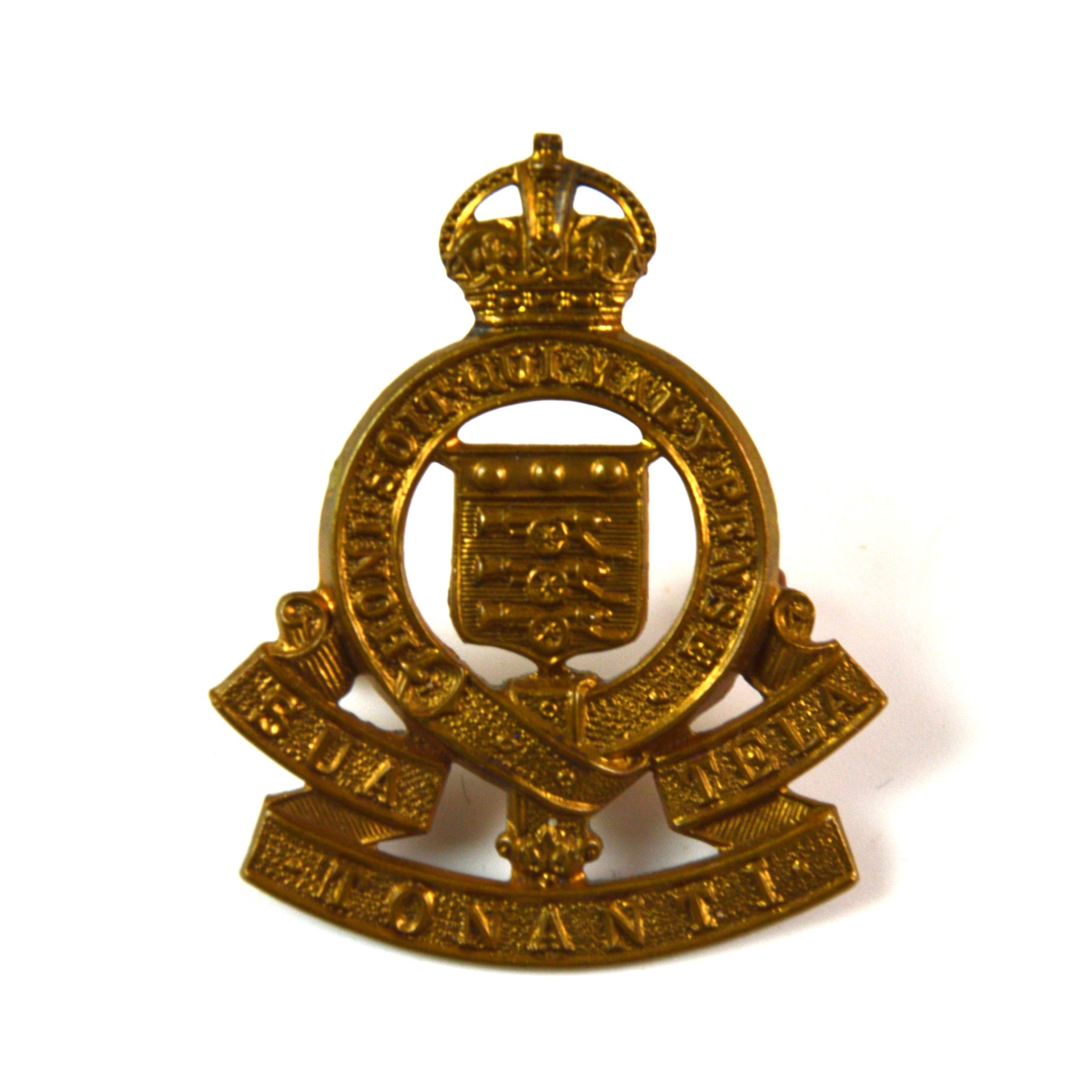
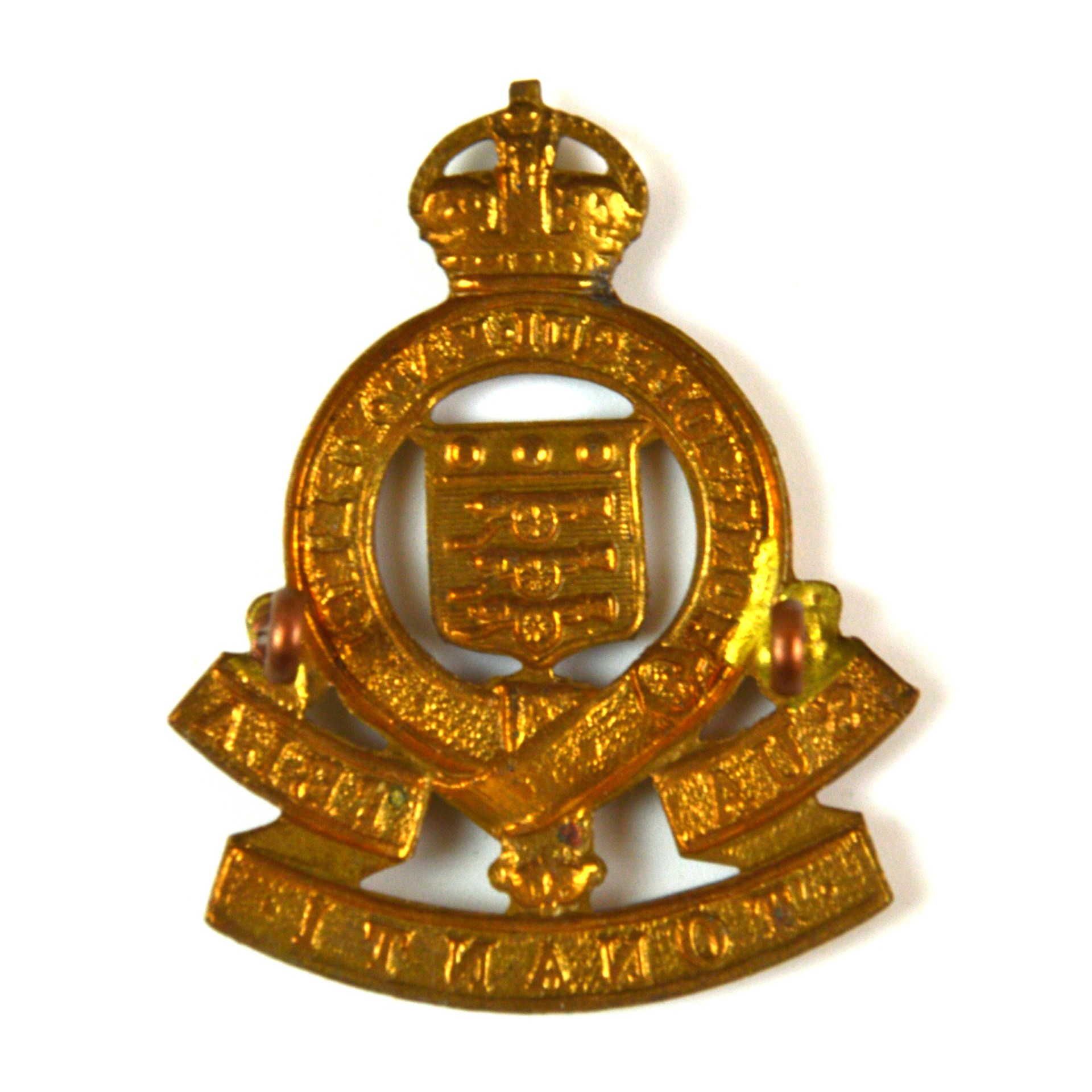
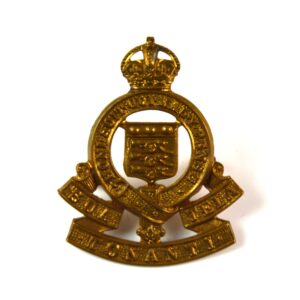
Royal Army Ordnance Corps other ranks’ cap badge in brass with eyed lugs on the reverse, produced in the pattern worn from March 1947 to November 1949 by other ranks of the Royal Army Ordnance Corps of the British Army. This British Army corps cap badge displays the recognised RAOC device in relief, incorporating the Garter of the Order of the Garter as the principal enclosing device, inscribed with the Garter motto “HONI SOIT QUI MAL Y PENSE” (Old French: “Shame on him who thinks evil of it”), enclosing a shield bearing the arms of the Board of Ordnance — three old-pattern field cannon in pale with three cannonballs in chief — surmounted by a King’s Crown at the topmost point of the Garter, with a three-part scroll below the Garter bearing the corps motto “SUA / TONANTI / TELA”. The 1947 pattern is distinguished from the predecessor 1918–1947 badge by the replacement of the corps name scroll reading “ROYAL / ARMY ORDNANCE / CORPS” with the corps motto scroll and from the subsequent 1949 pattern by the position of the King’s Crown above rather than overlaying the Garter, the single-metal brass construction throughout, and the eyed lug reverse fitting. The motto “Sua Tonanti Tela” defies precise translation; the most commonly accepted renderings are “To the Warrior His Arms” or “To the Thunderer His Arms”, though it has also been interpreted as “Science has wrested from thundering Jove his weapons.”
The permanent establishment of an ordnance function in the English military administration long predated any standing army, with the Board of Ordnance — responsible for the provision, storage, and distribution of all weapons, ammunition, and warlike stores to the Crown’s forces — tracing its origins to the mediaeval period and formalised under Henry VIII. The Army Ordnance Department and Corps were combined in 1918 to form the Royal Army Ordnance Corps. The shield and motto at the centre and base of the badge both derive directly from the Arms granted to the Board of Ordnance in 1806 and confirmed in 1823. The 1947 pattern badge was introduced in March of that year when the War Office authorised the replacement of the corps name scroll with the corps motto, acknowledging the motto’s greater historical significance and its direct derivation from the ancient arms of the ordnance establishment. In November 1949 a more significant redesign followed, prompted by the War Office Dress Committee’s decision that a unit would only be allowed one badge for all types of headdress — as the 1947 pattern was considered too large to wear on the beret and not ornate enough for No. 1 Dress, the badge was redesigned with a larger white metal shield, a larger crown overlaying the top portion of the Garter, and a narrower motto scroll restricted to the width of the Garter. This gave the 1947 pattern a production window of approximately thirty months, making confirmed original examples of this transitional badge genuinely scarce. The RAOC was amalgamated into the Royal Logistics Corps in 1993, ending its distinct identity after seventy-five years as a Royal Corps.
Manufactured in brass with eyed lugs on the reverse consistent with British Army corps cap badge production of the March 1947 to November 1949 period, this original example provides a well-defined representation of the transitional motto-scroll RAOC badge in its first and briefest pattern. Royal Army Ordnance Corps 1947–1949 pattern cap badges are collected as examples of post-war British Army corps militaria, transitional headdress insignia of the RAOC between the wartime and Korean War periods, and original uniform hardware of a corps whose logistical contribution to the British Army spanned two world wars and the entire Cold War period.
Dimensions
Approx. 50mm height x 40mm width
Condition
Excellent

Reviews
There are no reviews yet.