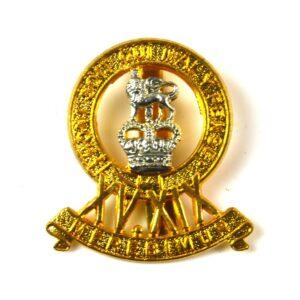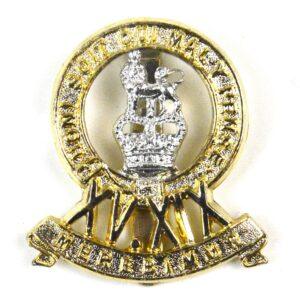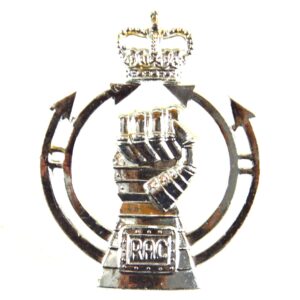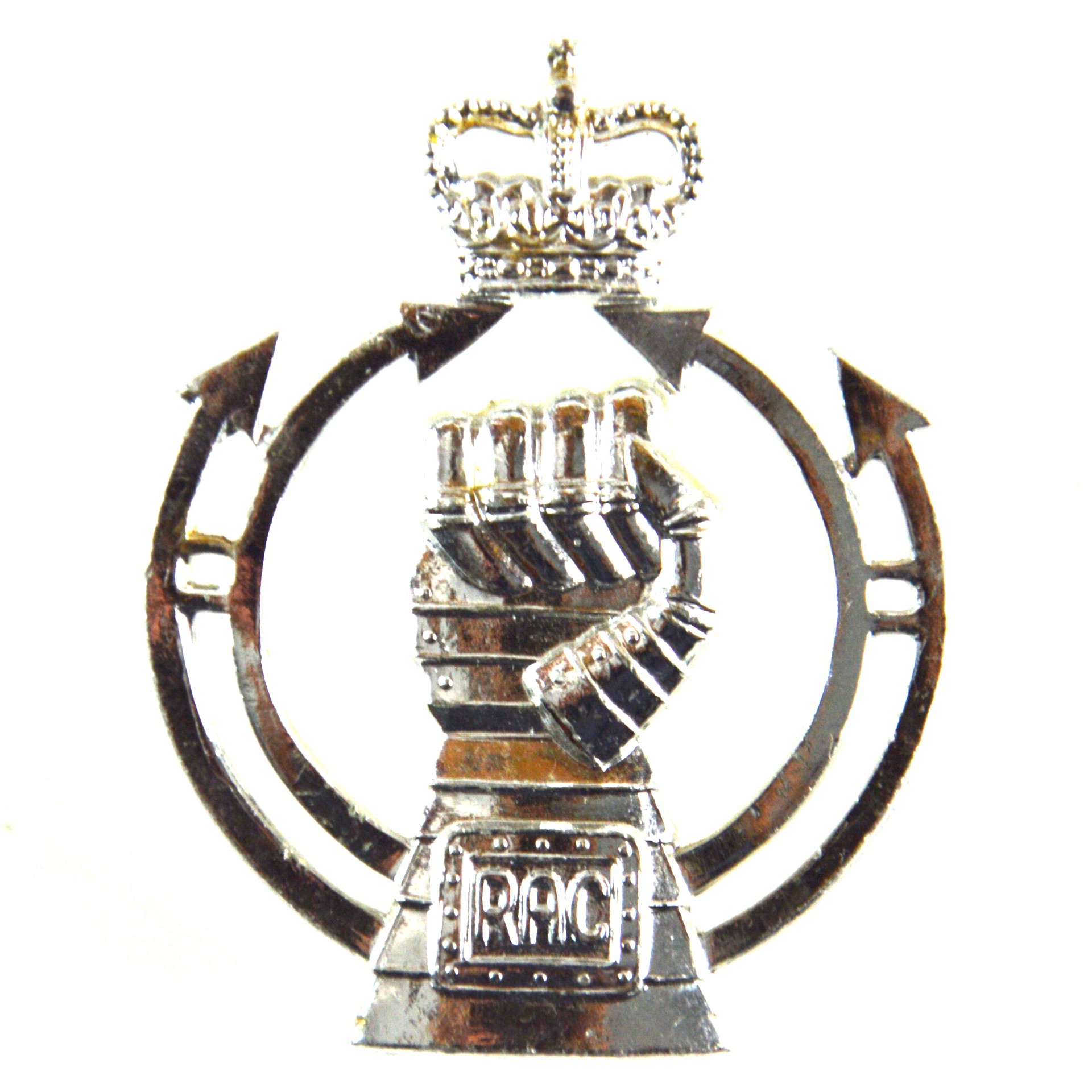
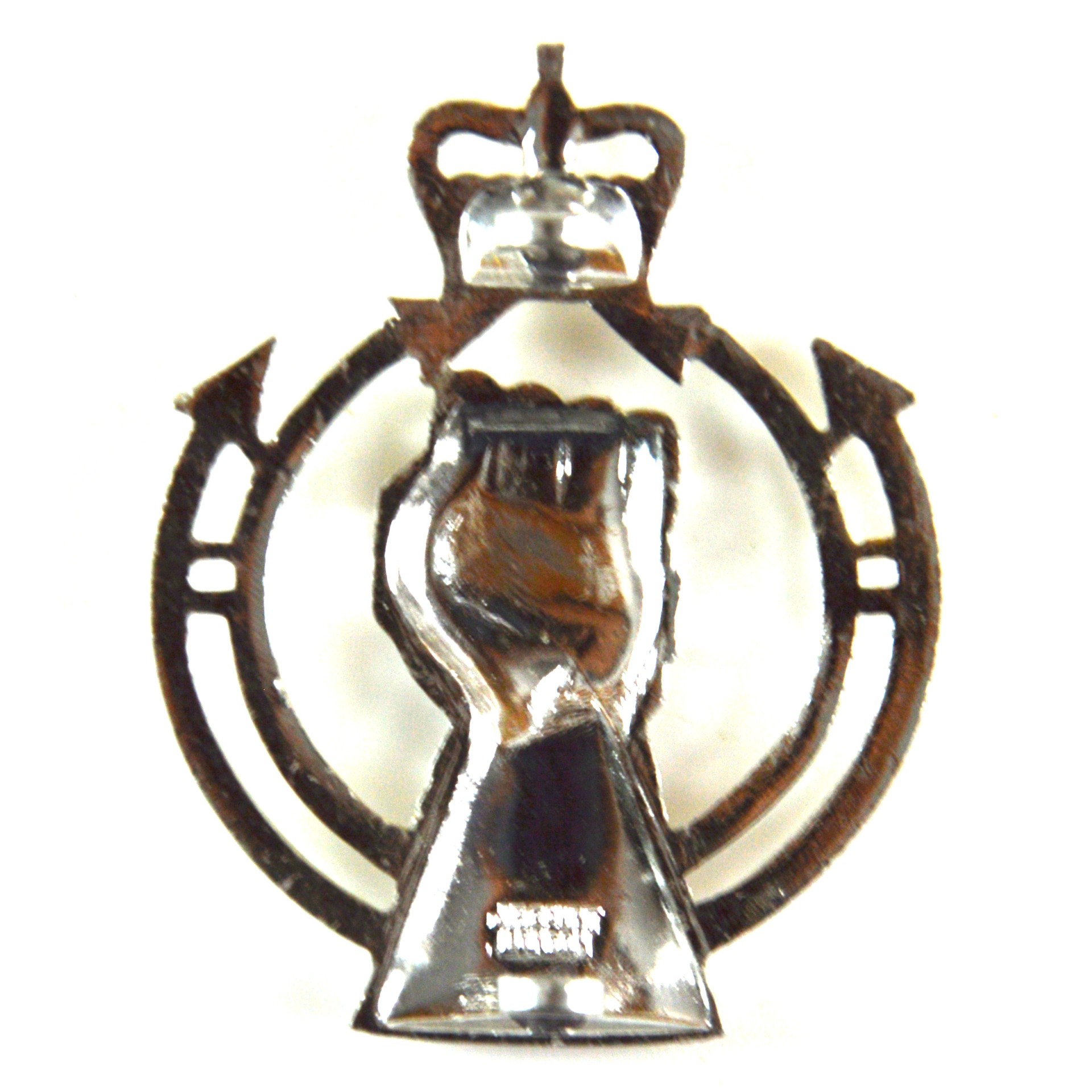
Royal Armoured Corps cap badge in anodised aluminium, produced in the Queen’s Crown pattern worn from 1958 to 2022 by personnel of the Royal Armoured Corps of the British Army. This British Army armoured corps cap badge displays the recognised RAC device in clear relief, incorporating a clenched right-hand mailed gauntlet with palm facing outward as the central device, with a tablet on the wrist embossed with the letters “RAC” in raised capitals, two concentric open circles issuing upward and outward from the wrist, the inner pair of arcs linked at their apex by a Queen’s crown — St Edward’s crown — surmounting the whole device. The badge is produced in anodised aluminium with a silver stay-bright finish throughout, consistent with the other ranks’ anodised production standard introduced across the British Army from 1957 and confirmed for the RAC badge in the sealed pattern of 20 June 1958. The reverse carries a slider fitting. The badge was superseded by a King’s Crown variant on the accession of King Charles III in September 2022.
The Royal Armoured Corps was formed in April 1939 to incorporate all the mechanised cavalry regiments and the Royal Tank Corps — redesignated the Royal Tank Regiment at the same time — into a single administrative corps, except for the Household Cavalry. The new corps badge was first designed in 1939 as a traditional crowned laurel wreath enclosing the corps’ initials, a device considered uninspired. By 1941, a more dynamic badge had been designed and approved, the mailed fist representing armoured power, with the flanking concentric circles denoting the manoeuvre potential of mechanised forces – a device designed by Lieutenant Colonel Geoffrey White and sealed on 3 January 1942. The mailed gauntlet as a heraldic device had long associations with mediaeval mounted warriors and jousting knights, providing a visual continuity between the cavalry traditions of the British Army and the new mechanised arm that had superseded the horse. The white metal King’s Crown badge was worn from 1941 to 1953; the white metal Queen’s Crown badge from 1953 to 1958; and the anodised aluminium Queen’s Crown badge from 1958 to 2022. From the outset the policy was that all cavalry and yeomanry regiments within the RAC, including the Royal Tank Regiment, were to retain their own cap badges — the RAC badge was, accordingly, worn principally by personnel of RAC recruit training units, corps headquarters staff, and those serving in administrative appointments who were not attached to a regiment retaining its own badge. This specific wearing pattern means the RAC badge is less frequently encountered as a period original than its long production run might suggest.
Manufactured in anodised aluminium with a slider reverse, consistent with British Army other ranks’ armoured corps cap badge production of the 1958 to 2022 Queen’s Crown period, this example provides a well-defined representation of the Royal Armoured Corps headdress badge as worn for over six decades across the Cold War, post-Cold War, and contemporary British Army periods. Royal Armoured Corps Queen’s Crown anodised cap badges are collected as examples of British Army armoured corps headdress insignia, uniform hardware of the RAC training and headquarters establishment, and regimental militaria of the post-war mechanised British Army.
Dimensions
Approx. 49mm height x 39mm width
Condition
Very good overall original condition, with crisp detailing and a well-preserved anodised finish. Light wear, minor surface marks, and signs of service use and storage present. Reverse fittings remain intact and secure. No significant damage or repairs evident.
Reference
John Gaylor ‘Military Badge Collecting’ Page 15, Plate 5