- The Desert Fox Meets the Desert Rats
- The Desert War: Context
- First Alamein (1–27 July 1942)
- Montgomery and the Eighth Army
- The Order of Battle
- Second Alamein (23 October – 11 November 1942)
- Operation Lightfoot (23–24 October)
- The “Dog Fight” (25 October – 1 November)
- Operation Supercharge (2 November)
- Casualties and Significance
- Collecting El Alamein Militaria
- Medals
- Desert Equipment
- Captured Items
The Desert Fox Meets the Desert Rats
The Battles of El Alamein — First Alamein in July 1942 and Second Alamein in October–November 1942 — represent the turning point of the North African campaign and one of the most decisive British victories of the Second World War. When Montgomery’s Eighth Army broke through Rommel’s defences on the night of 23 October 1942, it ended the long see-saw of desert warfare and began the process that would clear Axis forces from Africa entirely. Churchill’s famous assessment — “Before Alamein we never had a victory. After Alamein we never had a defeat” — captures the significance of the battle for British morale and military prestige.
The Desert War: Context
The North African campaign had begun in September 1940, when Italian forces invaded Egypt from Libya. The initial British counter-offensive under General O’Connor achieved spectacular success, destroying the Italian Tenth Army and capturing 130,000 prisoners. The arrival of Rommel and the Afrika Korps in February 1941 transformed the war. For the next eighteen months, the campaign oscillated across the Western Desert — advances and retreats covering hundreds of miles, as first one side then the other achieved local superiority.
By the summer of 1942, following the fall of Tobruk (21 June) and a retreat to the Egyptian frontier, the Eighth Army was at its lowest ebb. Rommel’s forces had advanced to within 60 miles of Alexandria. Only the narrow defensive position at El Alamein — a 40-mile gap between the Mediterranean coast and the impassable Qattara Depression — prevented a breakthrough into the Nile Delta.
First Alamein (1–27 July 1942)
General Auchinleck, who had taken personal command of the Eighth Army, fought a brilliant defensive battle at First Alamein that stopped Rommel’s advance cold. Through aggressive counter-attacks and skilful use of artillery, Auchinleck broke the momentum of the Axis advance and inflicted significant losses. First Alamein was the true turning point — yet Auchinleck received little credit, being replaced by Alexander and Montgomery in August 1942.
Montgomery and the Eighth Army
Lieutenant-General Bernard Montgomery arrived in August 1942 and immediately imposed his personality on the Eighth Army. He was unorthodox, abrasive, and supremely self-confident — and exactly what the demoralised Eighth Army needed. Montgomery refused to attack until he had overwhelming superiority in men, tanks, guns, and air power. He also insisted on rehearsal, planning, and the clear communication of his intentions to every level of command.
The Order of Battle
By October 1942, the Eighth Army had been reinforced to approximately 195,000 men with 1,029 tanks (including 252 of the new American Sherman, far superior to any British tank in the desert). Key formations included:
- XXX Corps: 9th Australian Division, 51st (Highland) Division, 2nd New Zealand Division (with 9th Armoured Brigade), 1st South African Division, 4th Indian Division
- X Corps (armour): 1st Armoured Division, 10th Armoured Division
- XIII Corps: 7th Armoured Division (“The Desert Rats”), 44th (Home Counties) Division, 50th (Northumbrian) Division, 1st Free French Brigade, 2nd Free French Brigade
Second Alamein (23 October – 11 November 1942)
Operation Lightfoot (23–24 October)
The battle opened at 9:40 pm on 23 October with a barrage from 882 guns — the largest British barrage since 1918. Under the crushing weight of shellfire, infantry of XXX Corps — the Australians, Highlanders, New Zealanders, South Africans, and Indians — advanced to create corridors through the deep Axis minefields (“the Devil’s Gardens”). Engineers and infantry worked through the night to clear lanes for the following armour.
The “Dog Fight” (25 October – 1 November)
Montgomery described the middle phase as a “crumbling” operation — grinding attrition designed to destroy Rommel’s infantry and draw his armour into defensive battles where it could be destroyed by massed anti-tank fire and artillery. The fighting was brutal, particularly around Kidney Ridge and at “Thompson’s Post,” where the 2nd Rifle Brigade fought an epic anti-tank action. The Australian 9th Division’s operations around the coast road drew Axis reserves northward, setting up the final stroke.
Operation Supercharge (2 November)
The decisive attack came on 2 November. The 2nd New Zealand Division, with the 9th Armoured Brigade and then the 1st Armoured Division, attacked through a narrow corridor south of the coastal sector. The 9th Armoured Brigade’s charge at dawn on 2 November — advancing directly into anti-tank guns at close range — suffered 75% tank losses but breached the final Axis anti-tank screen. By 4 November, Rommel was in full retreat.
Casualties and Significance
Allied casualties at Second Alamein were approximately 13,500 killed, wounded, and missing (2,350 killed). Axis casualties were approximately 30,000, with an additional 30,000 captured. The victory was decisive: Rommel never regained the initiative, and the subsequent advance — covering 1,500 miles to Tunisia — eliminated Axis forces from Africa by May 1943.
Collecting El Alamein Militaria
Medals
North African service is denoted by the Africa Star, with the 8th Army clasp (a narrow bar with “8” on the ribbon) for those who served under Eighth Army command. The key medals for El Alamein collectors:
| Medal Type | Approximate Price Range (2026) |
|---|---|
| Africa Star (unnamed, as issued) | £15–£30 |
| Group with Africa Star to confirmed Alamein unit | £100–£300 |
| Group to 51st Highland Division | £150–£400 |
| Group to 7th Armoured “Desert Rats” | £200–£500 |
| MM or DCM won at El Alamein | £2,000–£6,000 |
| DSO or MC won at El Alamein | £3,000–£8,000 |
Desert Equipment
- Desert headgear: The KD (khaki drill) peaked cap, the slouch hat (Australians), the tam o’shanter (Highlanders), and the iconic “Desert Rat” beret are all prized. A 7th Armoured Division beret with original formation sign fetches £200–£500.
- Formation signs: The red jerboa (Desert Rat) of 7th Armoured, the HD of 51st Highland, the Silver Fern of 2nd NZ Division — cloth formation patches from desert units are collected avidly. £20–£100 for common types, more for scarce variants.
- KD uniforms: Khaki drill shirts, shorts, and bush jackets from the desert campaign. Named or unit-marked examples are particularly sought.
- Tank crew items: Leather helmets, goggles, coveralls, and personal items from armoured crews are scarce survivors from the desert campaign.
Captured Items
The victory at El Alamein and the subsequent advance yielded large quantities of Axis equipment captured as trophies by Eighth Army soldiers. German and Italian items — from Afrika Korps sun helmets to Italian officer’s binoculars — were brought home and remain in British collections. Items with clear provenance linking them to the Eighth Army or a specific capture are particularly valued.
Frequently Asked Questions
What medals were awarded for El Alamein?
The Africa Star was awarded for service in North Africa 1940-43. A clasp marked 8th ARMY was authorised for those serving under Eighth Army command. The standard WWII group includes the 1939-45 Star, Africa Star, and War Medal.
What El Alamein memorabilia can I collect?
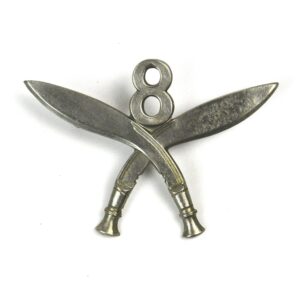
WWII medal groups with the Africa Star, desert formation signs (Desert Rats, Eighth Army), KD (khaki drill) uniforms, desert equipment, cap badges, and documents. Montgomery memorabilia is especially popular.
Sources & References
- Beevor, A., The Second World War
- Holland, J., Together We Stand: North Africa 1942-1943
- Latimer, J., Alamein

Related Items in Our Collection8 items