- The Battle That Defined an Era
- The Strategic Context
- The British Forces at Waterloo
- Infantry
- Cavalry
- Royal Artillery
- The Battle: Key Phases
- 1. The Attack on Hougoumont (11:00 onwards)
- 2. D’Erlon’s Attack (13:30)
- 3. The French Cavalry Charges (16:00–17:30)
- 4. The Fall of La Haye Sainte (18:00)
- 5. The Prussian Arrival and the Final Crisis (19:00)
- Casualties and Aftermath
- Collecting Waterloo Militaria
- The Waterloo Medal
- Weapons and Equipment
- Badges, Buttons, and Insignia
- Documents and Personal Effects
The Battle That Defined an Era
On 18 June 1815, near the small Belgian village of Waterloo, the Duke of Wellington’s allied army and Field Marshal Blücher’s Prussians inflicted a decisive defeat on Napoleon Bonaparte, ending twenty-three years of almost continuous European warfare. Waterloo was the culmination of the Revolutionary and Napoleonic Wars, a battle that reshaped the political map of Europe and propelled Britain to a century of global dominance.
For collectors of British militaria, Waterloo holds a unique significance. It was the first major battle for which a campaign medal was awarded to all ranks — the Waterloo Medal of 1816 — making it the foundation stone of British campaign medal collecting. The material culture of Waterloo, from regimental cap plates to Brown Bess muskets, represents the very origins of what we now recognise as collectable military artifacts.
The Strategic Context
Napoleon’s return from exile on Elba in March 1815 — the “Hundred Days” — caught the Allied powers off guard. While Austria and Russia mobilised their enormous armies, the Duke of Wellington hastily assembled an Anglo-Allied force in the Low Countries, combining British regular troops with contingents from the Netherlands, Hanover, Brunswick, and Nassau. Wellington’s army of approximately 68,000 men was joined by Blücher’s Prussian army of around 89,000 in what amounted to the immediately available Allied force.
Napoleon’s strategic intention was characteristic: strike first, defeat the Allied armies in detail before they could combine, and present Europe with a fait accompli. On 16 June he attacked at both Quatre Bras (engaging Wellington) and Ligny (engaging Blücher), achieving a tactical success against the Prussians but failing to destroy either army. Wellington withdrew north to the ridge of Mont-Saint-Jean, south of the village of Waterloo, where he had previously identified a strong defensive position.
The British Forces at Waterloo
Infantry
Wellington’s infantry was a mix of veteran battalions with Peninsular War experience and less-experienced units. The 1st (Guards) Brigade under Major-General Maitland and the 2nd (Guards) Brigade under Major-General Byng comprised the cream of the army. Line regiments included the 28th (North Gloucestershire), the 32nd (Cornwall), the 79th (Cameron Highlanders), the 92nd (Gordon Highlanders), and the 95th (Rifles) among many others. In total, approximately 25,000 British infantry held the allied centre and left.
The infantry were equipped with the famous “Brown Bess” — the India Pattern musket — a .75 calibre smoothbore flintlock capable of firing three aimed rounds per minute in trained hands. The 95th Rifles carried the Baker rifle, a .62 calibre weapon with superior accuracy at range but a slower rate of fire. Officers carried swords — typically the 1796 or 1803 pattern infantry officer’s sword — and privately purchased pistols.
Cavalry
The British cavalry at Waterloo comprised heavy and light brigades. The Household Brigade (1st and 2nd Life Guards, Royal Horse Guards, 1st Dragoon Guards) and the Union Brigade (1st Royals, 6th Inniskillings, 2nd Scots Greys) were the principal heavy cavalry formations. Light cavalry included hussars and light dragoons.
The cavalry’s great charge — one of the most famous episodes of the battle — saw the Union Brigade sweep through d’Erlon’s attacking infantry columns, capturing two French Eagles (the 45th Ligne’s by Sergeant Ewart of the Scots Greys, and the 105th Ligne’s by Captain Clark-Kennedy of the 1st Royals). However, carried away by their success, the cavalry over-extended and suffered heavily from French lancers during their withdrawal — a cautionary tale Wellington would reference for years afterwards.
Royal Artillery
Artillery played a crucial role throughout the battle. The Royal Horse Artillery accompanied the cavalry while foot batteries supported the infantry positions. Captain Mercer’s troop of the Royal Horse Artillery, positioned near the right centre, left one of the most vivid first-hand accounts of the battle, describing the devastating effect of canister fire on advancing French cavalry and the extraordinary courage required to hold position against charging horsemen.
The Battle: Key Phases
1. The Attack on Hougoumont (11:00 onwards)
Napoleon’s opening move was a diversionary attack on the Château of Hougoumont, a fortified farmhouse complex on Wellington’s right flank. What began as a diversion became an all-day battle-within-a-battle, drawing in ever-increasing French forces. The defence of Hougoumont, principally by the light companies of the Guards and detachments from Hanoverian and Nassau troops, became one of the iconic episodes of the battle. The famous closing of the north gate by Lieutenant-Colonel James Macdonell is widely regarded as the decisive act of the entire day — had Hougoumont fallen, Wellington’s right would have been turned.
2. D’Erlon’s Attack (13:30)
The main French infantry assault came at about 1:30 pm. The Comte d’Erlon’s I Corps — approximately 16,000 men in four divisions — advanced against Wellington’s left-centre in massive columns. The columns were met by devastating musket and artillery fire and then by the charge of the Household and Union Brigades. D’Erlon’s attack was repulsed with enormous losses, though the British cavalry paid heavily for their over-enthusiastic pursuit.
3. The French Cavalry Charges (16:00–17:30)
Marshal Ney, believing Wellington’s line to be weakening, launched repeated massed cavalry charges against the allied centre-right — an extraordinary spectacle of perhaps 10,000 horsemen attacking uphill against infantry formed in square. The British and allied infantry held firm, their squares bristling with bayonets. Without infantry or artillery support, the French cavalry could not break the squares and eventually fell back, exhausted.
4. The Fall of La Haye Sainte (18:00)
The fortified farmhouse of La Haye Sainte, held by the King’s German Legion under Major Baring, finally fell to a determined French assault after the defenders ran out of ammunition. Its loss opened a dangerous gap in Wellington’s centre, and for a brief period the outcome of the battle was genuinely in doubt.
5. The Prussian Arrival and the Final Crisis (19:00)
Blücher’s Prussians, having marched all day from Wavre, began arriving on Napoleon’s right flank in force during the late afternoon. By early evening, the French were engaged on two fronts. Napoleon committed his last reserve — the Imperial Guard — in a final attempt to break Wellington’s line. The Imperial Guard advanced uphill against Maitland’s Guards Brigade, who rose from the shelter of the ridge crest and delivered a devastating volley at close range. The cry of “La Garde recule!” (“The Guard retreats!”) triggered a general French collapse, and Wellington ordered the general advance.
Casualties and Aftermath
Waterloo was extraordinarily costly. Wellington’s army suffered approximately 15,000 killed and wounded; the Prussians around 7,000; and the French approximately 25,000 killed and wounded, with an additional 8,000 captured. Wellington’s famous observation — “Nothing except a battle lost can be half so melancholy as a battle won” — reflected the horror of the field on the morning of 19 June.
Collecting Waterloo Militaria
The Waterloo Medal
The Waterloo Medal, dated 18 June 1815, was the first campaign medal issued to all ranks present at the battle, including officers. Previously, officers had not received campaign medals (with the exception of a few naval actions). The medal, designed by Thomas Wyon, shows the head of the Prince Regent on the obverse and a seated figure of Victory on the reverse. It is named in capitals on the rim.
Approximately 39,000 Waterloo Medals were issued. Prices vary enormously depending on the recipient’s regiment and role in the battle: a medal to a Guards regiment that fought at Hougoumont, or to the Scots Greys who made the great charge, commands a substantial premium. As a guide:
| Unit Type | Approximate Price Range (2026) |
|---|---|
| Line infantry (common regiments) | £1,500–£3,000 |
| Guards regiments | £3,000–£6,000 |
| Cavalry (general) | £3,000–£5,000 |
| Scots Greys, Life Guards | £5,000–£10,000+ |
| 95th Rifles | £4,000–£7,000 |
| Royal Artillery | £2,500–£4,500 |
| King’s German Legion | £2,000–£4,000 |
Weapons and Equipment
Weapons from the Waterloo era are highly prized:
- India Pattern Brown Bess musket: £2,000–£5,000 depending on condition and markings. Examples with regiment marks are at a premium.
- Baker rifle: £5,000–£15,000+ for genuine examples. Heavily faked.
- 1796 Heavy Cavalry Sword: £1,500–£4,000. The fearsome 35-inch, straight-bladed weapon of the heavy cavalry.
- 1796 Light Cavalry Sabre: £800–£2,500. The curved slashing weapon of the hussars and light dragoons.
- 1803 Infantry Officer’s Sword: £600–£2,000. A straight-bladed cut-and-thrust weapon.
Badges, Buttons, and Insignia
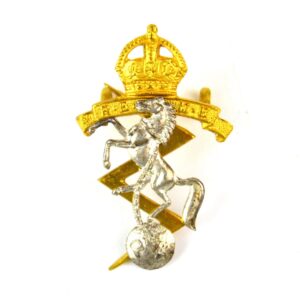
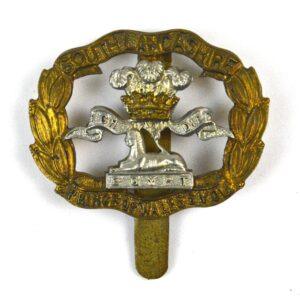
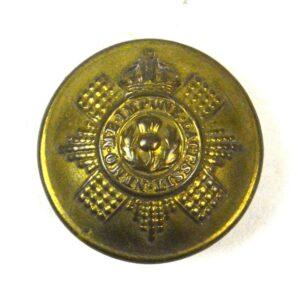
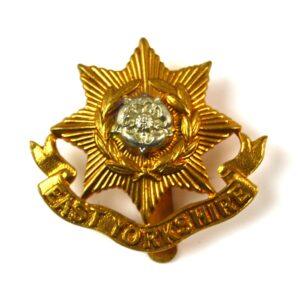
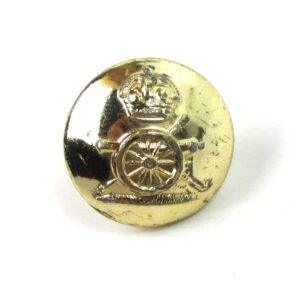
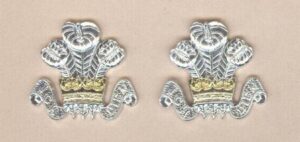
Genuine Waterloo-era insignia is scarce and increasingly difficult to find. Shako plates, belt plates, regimental buttons, gorgets, and epaulettes from units that fought at Waterloo are among the most desirable items in British militaria collecting. Many items in this category are Georgian or Regency period and require specialist knowledge to authenticate — the reproduction market is active and has been since at least the 1960s.
Documents and Personal Effects
Waterloo-related documents — letters, diaries, discharge papers, army lists — add immeasurably to a collection. A letter written on the morning after the battle, or a discharge paper naming a known Waterloo man, provides a direct connection to the individuals who shaped history. Such items appear infrequently at auction and command strong prices.
Frequently Asked Questions
How much is a Waterloo Medal worth?
A Waterloo Medal to an ordinary infantry private typically sells for u00a31,500-u00a33,000. Cavalry examples command u00a32,000-u00a36,000. Medals to Guards regiments, officers, or those confirmed as casualties bring significant premiums.
What other Waterloo collectables are available?
Beyond the medal, collectors seek Napoleonic-era swords, muskets, badges, buttons, and documents. Battlefield relics (musket balls, shrapnel) are also collected, though provenance is important.
Sources & References
- Cornwell, B., Waterloo: The History of Four Days, Three Armies and Three Battles
- Dalton, C., The Waterloo Roll Call
- Siborne, W., History of the War in France and Belgium in 1815

Related Items in Our Collection8 items