- Small but Mighty
- A History of British Military Buttons
- Georgian Era (1714–1837)
- Victorian Era (1837–1901)
- Edwardian and WWI (1901–1918)
- Inter-War and WWII (1919–1945)
- Post-War to Present
- Types of Military Buttons
- By Metal and Finish
- By Size
- By Back Mark
- Collecting Military Buttons
- Building a Collection
- Price Guide
- Authentication
- Sources and References
Small but Mighty
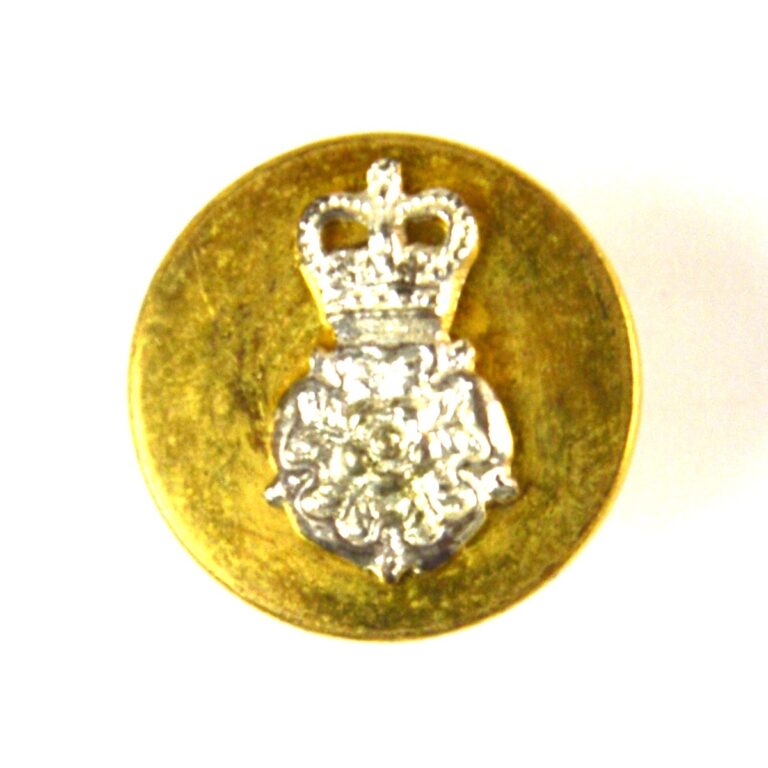
Military buttons may be among the smallest items of militaria, but they carry an extraordinary amount of information. Every button tells you the regiment, the rank category (officer or other rank), the approximate date, and often the manufacturer. With over 1,500 distinct British military button designs recorded, from the earliest pewter regimental buttons of the 1700s to modern anodised aluminium issue, button collecting is a specialist field that rewards knowledge, patience, and sharp eyes. It is also one of the most affordable entry points into militaria collecting.
A History of British Military Buttons
Georgian Era (1714–1837)
Early military buttons were typically pewter (white metal) for other ranks and gilt (gold-washed copper) for officers. Georgian buttons display the regimental number — a simple “23” for the 23rd Foot, for example — sometimes within a wreath or with a crown above. These flat-faced, relatively plain buttons are among the oldest collectable militaria items. Many are found by metal detectorists on former camp sites, barracks grounds, and battlefield sites.
Victorian Era (1837–1901)
The Victorian period saw a flowering of button design. Following the Childers Reforms (1881), which amalgamated numbered regiments into county regiments, new regimental badge designs replaced simple numerals. Buttons now carried full regimental crests — the Sphinx for Egypt-service regiments, the harp for Irish regiments, the thistle for Scottish ones, prancing horses, castle gates, feathered plumes, and dozens more distinctive devices.
Manufacturing became more sophisticated: pressed brass buttons with soldered wire shanks for other ranks; fire-gilt buttons with flat or domed profiles for officers. Makers included Firmin & Sons, Jennens & Co., Smith & Wright, Buttons Ltd., and Pitt & Co. — their back marks are key dating tools.
Edwardian and WWI (1901–1918)
The shift from Queen Victoria’s crown to the King’s crown (Tudor shape for Edward VII and George V) changed the dies on hundreds of button types. Many rare variants exist from short-lived units or wartime-raised battalions. WWI also saw economy buttons in blackened brass or bakelite for active service use, and the creation of buttons for new corps like the Machine Gun Corps, Tank Corps, and Royal Air Force (from 1918).
Inter-War and WWII (1919–1945)
The inter-war period produced some of the most attractive button designs, particularly for newly formed or re-designated units. WWII saw widespread use of bakelite (plastic) economy buttons — lightweight, dark brown or black, often with simplified designs. These are collected in their own right, though they are less visually striking than brass examples.
Post-War to Present
Post-war amalgamations of regiments created new button designs for short-lived intermediate regiments — many surviving only a few years before further mergers. These transitional buttons are often rare. Modern buttons are anodised aluminium or staybrite (a nickel-silver alloy that does not tarnish), replacing the brass and gilt of earlier eras.
Types of Military Buttons
By Metal and Finish
- Gilt: Gold-washed brass — the standard for officers and many NCO patterns. Fire-gilt buttons (genuine gold application) vs. electro-gilt (post-1850s).
- Brass: Standard other-ranks issue. Polished brass with stamped designs.
- White metal: Pewter or nickel-silver, used by certain regiments (many light infantry and rifle regiments used silver/white metal to distinguish themselves).
- Blackened: Oxidised or lacquered dark finish for service dress or wartime economy.
- Bakelite/Plastic: WWII economy issue. Brown, black, or dark green.
- Anodised aluminium: Modern issue — lightweight, corrosion-resistant.
By Size
- Large (tunic/coat buttons): Approximately 24mm diameter — the main button type. These carry the full regimental design.
- Small (cuff/shoulder buttons): Approximately 18–19mm — same design, smaller scale.
- Extra large: Some greatcoat or special-purpose buttons are larger.
By Back Mark
The reverse of a button carries the maker’s name or mark, which is crucial for dating:
| Maker | Active Period | Notes |
|---|---|---|
| Firmin & Sons (various styles) | 1764–present | The most prolific and long-lived maker. “FIRMIN & SONS STRAND” = pre-1852; “153 STRAND” = 1852–1896; “52 CONDUIT ST” = post-1896. |
| Jennens & Co. | c.1830–c.1870 | Birmingham maker, quality comparable to Firmin. |
| Smith & Wright | c.1880–c.1920 | Birmingham maker, common on late Victorian buttons. |
| Buttons Ltd. | c.1900–c.1960 | Birmingham mass production from Edwardian era onward. |
| Gaunt & Son (J.R. Gaunt) | c.1884–present | High-quality maker, also known for badges. |
| Pitt & Co. | c.1830–c.1860 | London maker. |
Collecting Military Buttons
Building a Collection
Several collecting strategies work well:
- By regiment: Collecting every variant of a single regiment’s button — Georgian numeral through Victorian crest through Edwardian through WWI economy through post-war amalgamation — is a rewarding long-term project.
- By era: Focusing on a period (e.g., all Napoleonic-era buttons, or all WWII economy types) gives breadth across units.
- By type: Collecting officers’ gilt buttons only, or white-metal rifle regiment buttons, or peaked-cap buttons.
- Metal detecting finds: Many button collectors are also metal detectorists. Found buttons are often in archaeological condition (corroded, bent, lost shank) but have the romance of being an in-situ discovery. These are generally worth less than cabinet-condition examples but have their own collector following.
Price Guide
| Button Type | Approximate Price Range (2026) |
|---|---|
| Georgian pewter regimental (metal-detected) | £5–£30 |
| Georgian pewter (good cabinet condition) | £20–£80 |
| Georgian officer’s gilt (numbered) | £30–£120 |
| Victorian OR brass (common regiment) | £3–£10 |
| Victorian OR brass (scarce regiment) | £10–£40 |
| Victorian officer’s gilt (common) | £10–£30 |
| Victorian officer’s gilt (scarce/disbanded) | £30–£100 |
| WWI economy blackened brass | £3–£15 |
| WWII bakelite economy | £2–£10 |
| Post-war transitional (short-lived regiment) | £5–£30 |
| Modern staybrite/anodised | £1–£5 |
Authentication
- Weight and feel: Genuine gilt officer’s buttons have a heft and quality that reproductions lack.
- Back marks: Check the maker’s mark against known date ranges. An anachronistic back mark (e.g., a WWI unit on a button with a post-1918 maker’s style) is a red flag.
- Shank type: Wire shanks (bent wire loop soldered to the back) are typical of pre-WWI buttons. Split-ring or alpha shanks indicate later production.
- Die quality: Look at the crispness of the design. Genuine dies produce sharp, well-defined details. Cast reproductions often show softer edges and filled-in fine detail.
- Crown type: Victorian crown (St Edward’s Crown, arched), King’s crown (Tudor crown, flat-topped), Queen’s crown (St Edward’s again). A crown that does not match the era of the button indicates a reproduction or misattribution.
Sources and References
[1] Ripley, H., Buttons of the British Army 1855–1970 — the standard reference, with illustrations of almost every known pattern.
[2] Squire, G., Buttons: A Guide for Collectors (Shire Books) — a good general introduction.
[3] Howard, R.J., Military Buttons of the American Revolution and the War of 1812 — relevant for British button types used during those conflicts.
Frequently Asked Questions
How do I identify a military button?
Examine the front design (regimental crest, number, or badge), the metal (gilt, brass, white metal, bakelite), and the back mark (manufacturer name and address). Cross-reference with Ripley's Buttons of the British Army for identification.
Are military buttons valuable?
Most common Victorian brass buttons sell for three to ten pounds. Scarce regiment variants, dissolved unit buttons, and Georgian pewter examples in good condition can reach thirty to over one hundred pounds. Officer's gilt buttons are generally more valuable than other ranks.
How do back marks help date buttons?
Manufacturers used different address markings over time. For example, Firmin and Sons used STRAND pre-1852, 153 STRAND from 1852-1896, and 52 CONDUIT ST after 1896. These address changes provide precise dating brackets.
Sources & References
- Ripley, H., Buttons of the British Army 1855-1970
- Squire, G., Buttons: A Guide for Collectors (Shire Books)
- Howard, R.J., Military Buttons of the American Revolution

Related Items in Our Collection8 items
Continue Reading