- Introduction to German Daggers
- History of Third Reich Daggers
- Major Dagger Types
- SA Dagger (Sturmabteilung)
- SS Dagger (Schutzstaffel)
- Wehrmacht Army (Heer) Dagger
- Luftwaffe Daggers
- Kriegsmarine (Navy) Daggers
- Hitler Youth (HJ) Knife
- Diplomatic Corps and Government Daggers
- NPEA (National Political Educational Institutions) Dagger
- RAD and NSKK Daggers
- How to Identify an Authentic German Dagger
- 1. Examine the Blade
- 2. Check the Grip
- 3. Inspect the Fittings
- 4. Examine the Scabbard
- 5. Look for Wear Patterns
- 6. Weight and Balance
- Common Fakes and Reproductions
- Price Guide for Genuine Examples
- Where to Buy and Research
- Legal and Ethical Considerations
- Advanced Authentication: Laboratory Techniques
- The Role of Maker Marks
- Presentation and Inscribed Daggers
- Ethical and Legal Dimensions
- Collecting by Type: A Focused Approach
Introduction to German Daggers
Third Reich edged weapons represent one of the most popular — and most heavily faked — areas of militaria collecting. Between 1933 and 1945, Nazi Germany produced an extraordinary variety of presentation and service daggers for its military, paramilitary, and political organisations. These ranged from the ubiquitous Wehrmacht Army dagger (Heer) to rare diplomatic corps pieces that can fetch five-figure sums at auction. [1]
Understanding what you are looking at is essential. The sheer volume of reproductions — many produced since the 1960s — means that at some dealers’ tables and online listings, fakes outnumber genuine examples. This guide covers the major types, what to examine, and how to tell authentic from reproduction.
History of Third Reich Daggers
The tradition of military daggers in Germany predates the Nazi period by centuries. However, the Third Reich elevated the presentation dagger to a tool of propaganda and organisational identity on an unprecedented scale. From 1933 onward, every branch of the military, every political organisation, and every paramilitary body was assigned its own distinctive dagger pattern. [2]
Heinrich Himmler’s SS, Hermann Goering’s Luftwaffe, the Hitler Youth, the National Political Educational Institutions (NPEA), the SA, the NSKK, the NSFK, the Red Cross, the Diplomatic Corps, the Railway Protection Police — all had dedicated dagger patterns. This bewildering variety was deliberate: daggers conveyed status, membership, and ideological commitment. Many were required uniform items; others were awarded for merit or long service.
The major manufacturers were concentrated in Solingen, Germany’s traditional centre of blade-making. Companies such as Carl Eickhorn, Robert Klaas, WKC (Weyersberg, Kirschbaum and Co.), E. and F. Horster, and Paul Weyersberg produced the vast majority. Each maker used distinctive trademarks stamped into the blade — learning these stamps is fundamental to authentication. [1]
Major Dagger Types
SA Dagger (Sturmabteilung)
The most common Third Reich dagger, produced in huge numbers from 1933 onward. It features a brown wooden grip with an inset SA eagle-and-roundel emblem, a nickel-silver crossguard and pommel, and a broad blade etched “Alles fur Deutschland” (Everything for Germany). The scabbard is brown-painted steel with nickel fittings. Blade length is approximately 22cm. [1]
Because millions were produced, genuine SA daggers are among the most affordable Third Reich edged weapons, typically £200–£500 depending on condition and maker. However, they are also the most commonly faked.
SS Dagger (Schutzstaffel)
Visually similar to the SA dagger but with a black wooden grip, SS eagle-and-roundel emblem, and the blade etched “Meine Ehre heisst Treue” (My Honour is Loyalty). Early examples (1933–1935) have maker marks on the blade; later production has RZM (Reichszeugmeisterei) control stamps. The scabbard is black-painted steel. [2]
SS daggers command a significant premium over SA examples — £800–£2,000 for a standard model, considerably more with provenance. The “chained” SS dagger (introduced 1936, with an ornamental chain hanger) is rarer and can reach £3,000–£5,000.
Wehrmacht Army (Heer) Dagger
Introduced in 1935, the Heer officer’s dagger features a white or orange celluloid grip wrapped with silver wire, a crossguard with oak-leaf decoration, and a blade typically 26cm long. The pommel and crossguard are cast white metal (often silver-plated). The scabbard is anodised aluminium or steel with decorative fittings. This is a common dagger, with good original examples at £300–£600. [1]
Luftwaffe Daggers
The Luftwaffe had two main patterns: the first model (1935) with a blue leather grip and silver wire wrap, and the second model (1937) with a yellow or white celluloid grip. Both feature the Luftwaffe eagle-and-swastika pommel. Good originals run £300–£700. A rare “presentation” Luftwaffe dagger from Alcoso or Eickhorn can exceed £2,000.
Kriegsmarine (Navy) Daggers
Naval daggers feature a cream or white celluloid grip, a fouled-anchor crossguard, and a lion-head pommel. The scabbard is ornately decorated. Navy daggers are typically the most visually attractive Third Reich daggers and are priced accordingly: £400–£1,000 for standard models, more for presentation pieces. [2]
Hitler Youth (HJ) Knife
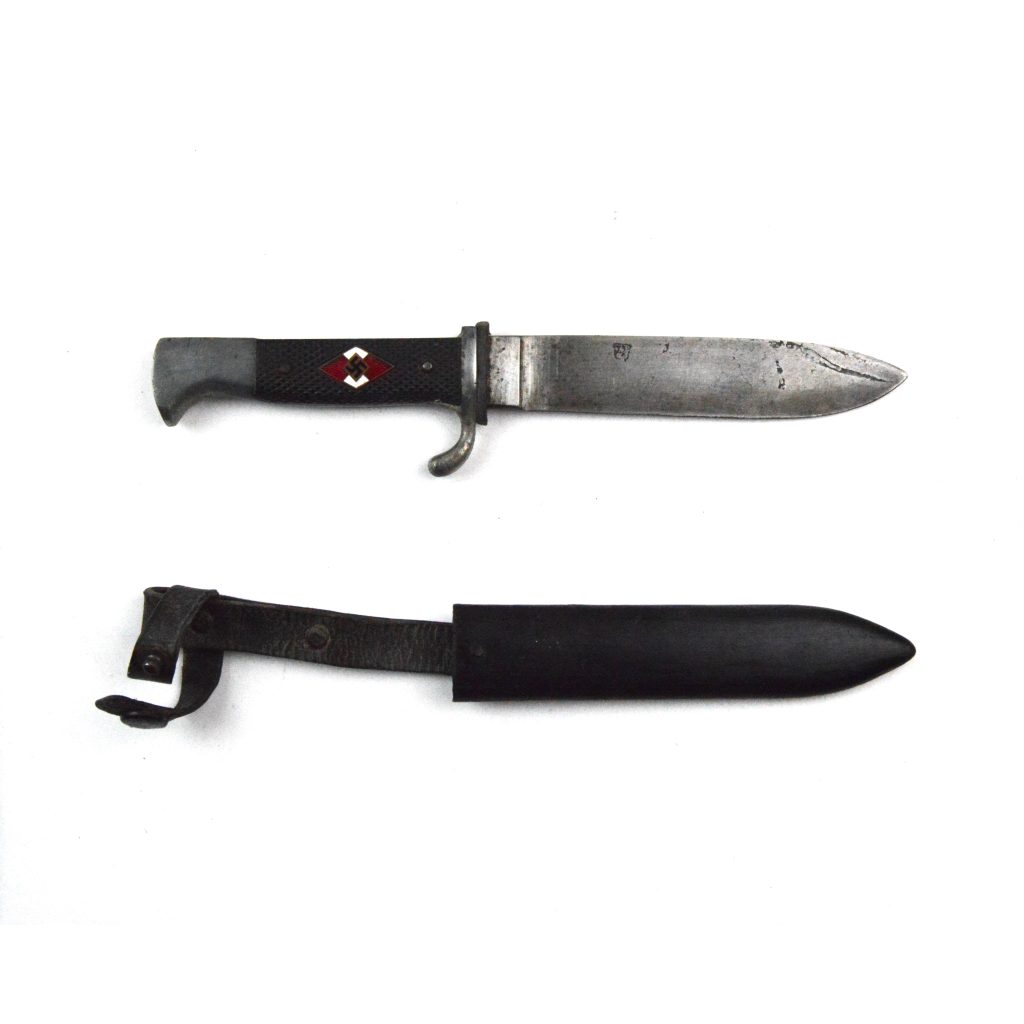
Strictly a knife rather than a dagger, the HJ knife features a chequered black Bakelite grip, a diamond-shaped inset HJ emblem, and the blade etched “Blut und Ehre” (Blood and Honour). Scabbard is black-painted steel. These are common and affordable (£150–£300) but heavily reproduced. The DJ (Deutsches Jungvolk) version for younger boys is slightly smaller and has a different blade motto.
Diplomatic Corps and Government Daggers
Among the rarest and most valuable. The Diplomatic Corps dagger features a mother-of-pearl grip and heavily gilded fittings. Government official daggers vary by position and rank. Prices for authentic examples start at £3,000 and can reach £15,000–£20,000 for top-condition examples with provenance. [1]
NPEA (National Political Educational Institutions) Dagger
Carried by students and staff of the elite NPEA schools, this is one of the most sought-after patterns. It features a distinctive black grip with a silver eagle and the blade etched with the NPEA motto. Genuine examples are rare: £2,000–£4,000.
RAD and NSKK Daggers
The RAD (Labour Service) dagger has a stag-antler grip and a blade etched “Arbeit adelt” (Work Ennobles). The NSKK (Motor Corps) dagger resembles the SA pattern but in black. Both are moderately common and fall in the £300–£600 range for originals.
How to Identify an Authentic German Dagger
1. Examine the Blade
The blade is the most reliable indicator of authenticity. Original blades have a distinctive hand-polished sheen that differs from modern machine polishing. Under magnification, you should see fine parallel polish lines. The etched mottoes on genuine daggers show clean, crisp edges with even acid depth. Fakes often have uneven or “fuzzy” etching. [1]
Maker marks should be clearly stamped (not engraved or laser-etched). Common genuine marks include the Eickhorn squirrel, the Klaas “two knights” trademark, and the WKC knight’s head. RZM stamps (M7/ followed by a number) appeared from the mid-1930s. The stamping should be even and deep; shallow or uneven stamps suggest a fake.
2. Check the Grip
Original wooden grips (SA, SS) should show genuine aging — slight shrinkage, fine cracks, and a warm patina. Modern reproductions often use a different wood or have a “plasticky” feel. The grip eagle-and-roundel emblem should be cleanly cast with sharp detail; reproduction emblems are often slightly soft or poorly detailed. [2]
For daggers with celluloid or Bakelite grips, check for warping, discolouration, and shrinkage consistent with age. Modern plastic reproductions feel different in the hand and often show mould lines.
3. Inspect the Fittings
Crossguards and pommels on original daggers were cast in high-quality white metal or nickel silver, then hand-finished. They should show even patina, with detail sharp but not razor-perfect. Reproduction fittings are often die-cast from a softer alloy and may show porosity (tiny pinholes) under magnification. The fit between grip and fittings should be tight; loose or wobbly fittings are suspicious. [1]
4. Examine the Scabbard
Original scabbards show period paint (slightly textured, with occasional brush marks) that has naturally worn and aged. Modern repainted scabbards have a different appearance — the paint is typically too smooth or too thick. Check the scabbard fittings: original spot-welds should look period-correct, and the spring clip mechanism should work with the distinctive “snap” of well-aged spring steel.
5. Look for Wear Patterns
A genuine wartime dagger that was worn on a belt will show specific wear patterns: the scabbard will be worn at the chape (bottom tip) and where the fittings meet the belt hanger. The crossguard and pommel will show wear on the edges. A dagger in perfect condition raises questions — though “unissued” attic finds do exist. [2]
6. Weight and Balance
Original daggers have a characteristic weight and balance that reproductions rarely match exactly. Handling genuine examples regularly is the best way to develop this instinct. The blade should feel substantial; many fakes use thinner, lighter blades.
Common Fakes and Reproductions
The reproduction dagger industry began in the 1960s in Solingen — ironically, the same city that made the originals. Over the decades, fakes have become increasingly sophisticated. Modern Chinese reproductions are the most problematic: they are mass-produced at low cost and can deceive inexperienced buyers. [1]
Key red flags include:
- Price too good to be true — an SS dagger at £100 is almost certainly fake
- Perfect condition — an 80-year-old dagger with no wear is suspect
- Wrong maker marks — combinations that never existed historically
- Modern fasteners — Phillips-head screws, modern springs
- Uniform patina — chemical aging produces an even, unconvincing appearance
- Soft, poorly detailed castings on grip emblems and fittings
- Magnetic blades — some cheap reproductions use stainless steel (detectable with a magnet; originals may also be magnetic, so this is indicative rather than conclusive)
Price Guide for Genuine Examples
| Type | Good Condition | Excellent/Mint |
|---|---|---|
| SA dagger (standard) | £200 – £400 | £500 – £700 |
| SS dagger (standard) | £800 – £1,500 | £1,800 – £2,500 |
| SS dagger (chained) | £2,500 – £3,500 | £4,000 – £5,000 |
| Heer officer’s dagger | £300 – £500 | £600 – £800 |
| Luftwaffe 1st model | £350 – £550 | £600 – £900 |
| Luftwaffe 2nd model | £300 – £500 | £500 – £750 |
| Kriegsmarine dagger | £400 – £700 | £800 – £1,200 |
| HJ knife | £150 – £250 | £300 – £400 |
| NPEA dagger | £2,000 – £3,000 | £3,500 – £4,500 |
| Diplomatic dagger | £5,000 – £10,000 | £12,000 – £20,000 |
Where to Buy and Research
Purchase only from established dealers who guarantee authenticity. Join collecting communities such as the German Dagger Collectors Guild and online forums where experienced collectors share knowledge. Key reference books include Thomas M. Johnson’s Collecting the Edged Weapons of the Third Reich multi-volume series, and the Angolia and Schlicht reference works. [2]
Reputable auction houses for German daggers include Bosleys (UK), Hermann Historica (Munich), C&T Auctions, and Wallis and Wallis. Online platforms should be approached with extreme caution — always request high-resolution photographs of maker marks, blade close-ups, fitting details, and scabbard interiors before committing to a purchase.
Legal and Ethical Considerations
Collecting Third Reich militaria is legal in the United Kingdom. In Germany and Austria, the display of Nazi symbols is restricted under law, which affects the export and sale of these items in those countries. Collectors should be aware that some online platforms restrict or prohibit the sale of items bearing Nazi insignia. [3]
The ethical debate around collecting Third Reich items is ongoing. Most serious collectors view these objects as historical artefacts — primary sources that document a catastrophic period in human history. Preserving them in private collections, where they are studied and contextualised, serves a different purpose from glorification. The majority of collectors are historians and history enthusiasts, not ideologues.
Advanced Authentication: Laboratory Techniques
Beyond the visual and physical checks described above, advanced collectors and dealers increasingly use laboratory techniques to verify German daggers. X-ray fluorescence (XRF) analysis can identify the precise alloy composition of metal fittings — genuine wartime German aluminium, nickel-silver, and zinc alloys have specific compositional signatures that differ from modern metals used in reproductions. XRF devices are now available as handheld instruments, and some specialist dealers offer testing as a service. [3]
Magnetic testing provides a quick field check: genuine SA and SS dagger blades are made from carbon steel and are strongly magnetic, while the crossguards and other fittings on genuine pieces are typically non-magnetic (nickel-silver or aluminium). A fake with steel fittings (cheaper to produce) will fail this simple test. Blade metallurgy also differs — genuine Solingen blades were forged from high-carbon steel and hardened to approximately 56–58 Rockwell C hardness, giving them a distinctive sound when tapped and a particular feel when run across a fingernail. [3]
The Role of Maker Marks
The maker’s mark (etched or stamped on the blade) is one of the most important authentication points. Major manufacturers include:
- Carl Eickhorn, Solingen — squirrel mark; one of the largest producers of SA and SS daggers
- J.A. Henckels, Solingen — twin-man mark; produced SA, SS, and Heer daggers
- Robert Klaas, Solingen — kissing crane mark; produced various political and military blades
- F.W. Höller, Solingen — knight’s head mark; SS and Heer daggers
- Eduard Wüsthof, Solingen — trident mark; quality manufacturer
- Alcoso (Alexander Coppel & Sohn), Solingen — produced military and political daggers
- Ernst Pack & Söhne, Solingen — Heer daggers and officer’s swords
- WKC (Weyersberg, Kirschbaum & Cie), Solingen — the oldest Solingen sword company; Heer and Luftwaffe daggers
The etching style, depth, and positioning of maker marks are critical. Genuine etching was done by skilled craftsmen using acid-resist techniques; the lines are clean, even, and precise. Fake etching often shows irregular depth, fuzzy edges, or inconsistent letter spacing. Some reproductions use laser etching — identifiable under 10x magnification by the characteristic stippled (dot-matrix) pattern rather than the smooth-edged lines of acid etching. [3]
Presentation and Inscribed Daggers
A small but highly significant category of German daggers bears personal inscriptions — typically engraved on the blade or crossguard. These include:
- “In herzlicher Kameradschaft” (In warm comradeship) — the standard inscription on SS honour daggers presented by Heinrich Himmler to early SS members (SS membership numbers below approximately 50,000). These daggers, with Himmler’s facsimile signature, are among the most valuable Third Reich edged weapons — genuine examples have sold for £20,000–£50,000+.
- “Alles für Deutschland” (Everything for Germany) — the standard SA motto, etched on all SA daggers. This is not a personalisation but a factory-applied feature.
- Personal presentation inscriptions — daggers engraved for specific individuals or occasions. These should always be verified against documentary evidence where possible.
Presentation daggers are among the most commonly faked items in the Third Reich collecting field. The high values involved create a powerful incentive for sophisticated forgery. No expensive inscribed or presentation dagger should be purchased without expert authentication from a recognised authority. Several authentication services operate within the collecting community, and their opinions carry significant weight in disputes over genuineness. [3]
Ethical and Legal Dimensions
The collection of Third Reich militaria, including daggers, raises ethical questions that each collector must answer for themselves. In the United Kingdom, the collection and sale of Nazi-era items is legal and is widely practised within the militaria community. However, collectors should be aware that the display and sale of items bearing Nazi symbols is illegal in several European countries (notably Germany, Austria, and France) and that cross-border transactions may be affected. [3]
Within the collecting community, the prevailing view is that these objects are historical artefacts that document a significant period of world history, and that their preservation serves an educational and memorial purpose. Responsible collectors typically display items in private settings and are sensitive to the feelings of those who may find such objects distressing. The major auction houses and specialist dealers handle Third Reich items routinely and professionally, treating them as historical objects rather than ideological statements.
Collecting by Type: A Focused Approach
Serious collectors of German daggers often specialise in a single type, building deep expertise and a reference collection that allows them to identify variations, fakes, and rarities that generalists miss. The most popular specialisations include SA daggers (the most commonly encountered and therefore the most affordable entry point), SS daggers (scarcer and more expensive), and the various military patterns (Heer, Luftwaffe, Kriegsmarine). Each type rewards specialist knowledge: SA daggers alone exist in sufficient variety — different makers, crossguard finishes, scabbard anodising shades, and grip colours — to occupy a lifetime of collecting. [3]
The diplomat’s dagger (Diplomatendolch) and the various NSDAP political leader patterns represent the highest tier of Third Reich dagger collecting. These were produced in relatively small numbers, are extremely well-made, and command prices in the thousands of pounds. Genuine examples are rare; fakes and “upgraded” pieces (ordinary daggers with added inscriptions or upgraded fittings) are common. Expert authentication is essential before any significant purchase in this category. [3]
Cross-collecting — assembling a German dagger alongside its contemporary British, American, or Soviet equivalent — can provide fascinating comparative context. A display showing an SS honour dagger beside a British commando fighting knife and an American Marine Raider stiletto tells a story about different military cultures and their approaches to ceremony, symbolism, and close combat that no single item can convey alone. [3]
Frequently Asked Questions
How can I tell if a German dagger is genuine?
Examine the blade etching (genuine uses acid-resist with clean, even lines), weight and balance, maker marks (Solingen manufacturers like Eickhorn, Henckels, Klaas), metal composition (XRF testing for correct alloys), and overall construction quality. Expert authentication is recommended for expensive pieces.
What are the most valuable German daggers?
SS honour daggers with Himmler inscription (£20,000–£50,000+), diplomatic daggers (£5,000–£15,000+), and Luftwaffe 2nd Model daggers by top makers (£2,000–£5,000). Presentation or inscribed pieces to identified individuals command the highest prices.
Is it legal to own German WWII daggers in the UK?
Yes, in the United Kingdom the collection and sale of Third Reich edged weapons is legal. However, display and sale of items bearing Nazi symbols is illegal in Germany, Austria, and France — so cross-border transactions may be affected.
What is the most common type of German dagger?
The SA dagger is the most commonly encountered Third Reich edged weapon, as the SA was the largest Nazi paramilitary organisation. This makes SA daggers the most affordable entry point for new collectors, with genuine examples starting around £400–£800.
Sources & References
- Johnson, T.M. — *Collecting the Edged Weapons of the Third Reich* (8 vols)
- Wittmann, J.A. — *Exploring the Dress Daggers of the German Army*
- Angolia, J.R. — *Daggers, Bayonets & Fighting Knives of Hitler's Germany*

Related Items in Our Collection8 items