- The Item
- The 1914 Star (“Mons Star”)
- History and Eligibility
- Naming
- The British War Medal 1914–1920
- The Victory Medal 1914–1919
- Researching the Recipient
- Service Records
- Tracing the Unit
- Valuation and Market Context
- What Makes This Group Special?
- Price Context
- This Group’s Value
- Collecting Mons Star Trios
- Tips for Buyers
- Sources for Purchase
- Further Research Resources
- Researching the Recipient: A Step-by-Step Guide
- Step 1: Read the Medal Naming
- Step 2: Consult the Medal Rolls
- Step 3: Find the Service Record
- Step 4: Consult the War Diaries
- Step 5: Commonwealth War Graves Commission
- Valuation Factors Beyond the Basics
- Displaying and Preserving Your Trio
- The Wider Context: The “Old Contemptibles” Legacy
The Item
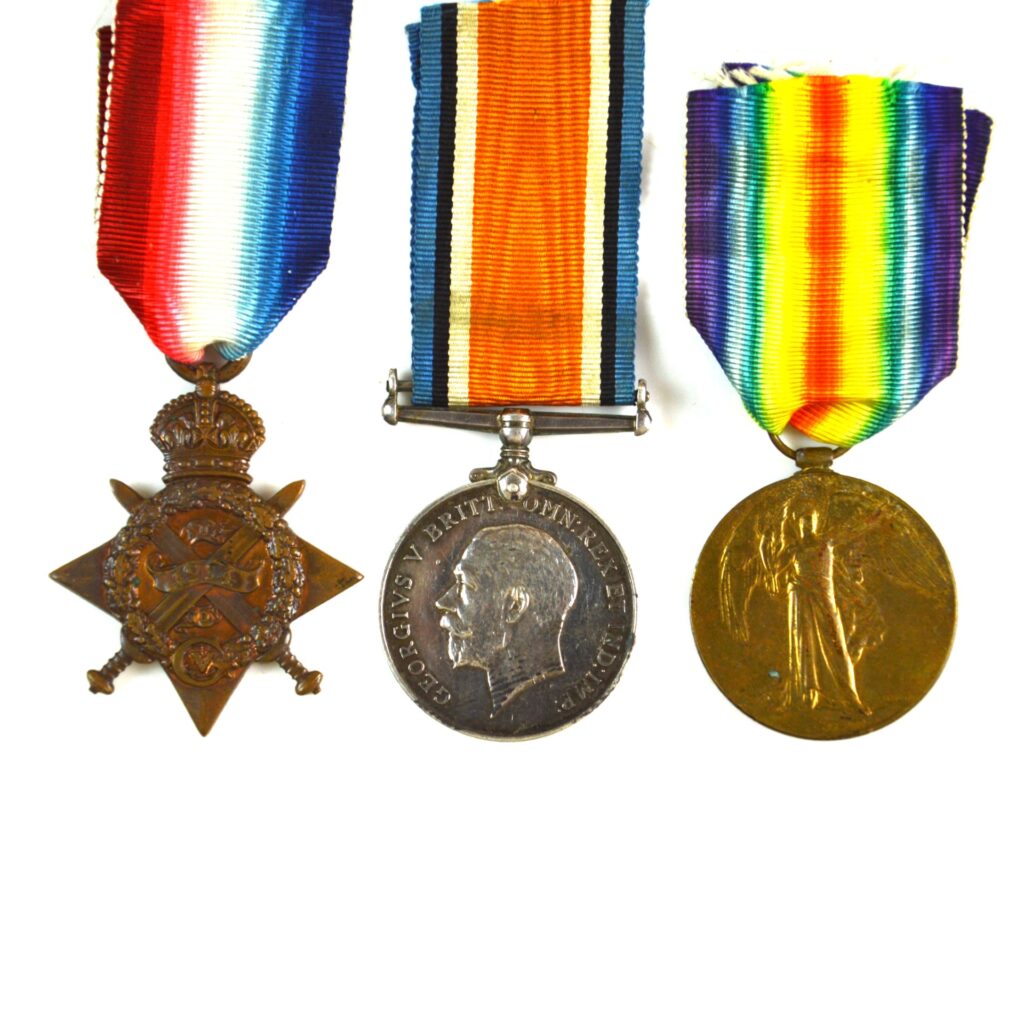
This month’s featured item is a 1914 Star trio — the group of three medals awarded to a soldier who served in France or Belgium between 5 August and 22 November 1914. The trio comprises the 1914 Star (commonly known as the “Mons Star”), the British War Medal 1914–1920, and the Victory Medal 1914–1919. What makes this particular group exceptional is that it is named — officially impressed with the recipient’s details — and can be traced to a specific individual with a verifiable service record. [1]
The recipient: Private Thomas William Hartley, 2nd Battalion, The Royal Fusiliers (City of London Regiment). Service number 8471. The 2nd Royal Fusiliers were part of the original British Expeditionary Force that crossed to France in August 1914 and fought in the retreat from Mons, the Battle of the Marne, the First Battle of the Aisne, and the First Battle of Ypres — four of the most significant engagements of the opening months of the war.
The 1914 Star (“Mons Star”)
History and Eligibility
The 1914 Star was authorised by King George V in April 1917 to recognise those who served in France and Belgium between 5 August and 22 November 1914 — the period from the BEF’s arrival on the continent to the end of the First Battle of Ypres. This narrow qualifying period means that only around 378,000 1914 Stars were issued, exclusively to the men of the original BEF and its immediate reinforcements. [2]
The star was designed by the Royal Mint and takes the form of a four-pointed star with a crown and crossed swords, bearing the scroll “AUG.” and “NOV. 1914” on the central cross, with the Royal cypher “GV” (George V) on the reverse. It is suspended from a red, white, and blue watered silk ribbon.
A clasp — “5TH AUG.–22ND NOV. 1914” — was authorised in 1919 for those who had actually been under fire during the qualifying period. Recipients entitled to the clasp but not wearing it could attach a small silver rosette to the ribbon. Private Hartley’s star bears evidence of the clasp fitting, although the clasp itself is no longer present — a common situation, as clasps were easily detached.
Naming
1914 Stars were officially named, with the recipient’s number, rank, name, and unit impressed around the reverse in capital letters. Private Hartley’s star reads: “8471 PTE. T.W. HARTLEY. R. FUS.” The naming style is consistent with genuine official impression — the letters are evenly spaced, correctly aligned, and deeply impressed. [1]
The British War Medal 1914–1920
The British War Medal was authorised in 1919 for all members of the British and Commonwealth forces who had served overseas between 5 August 1914 and 11 November 1918 (or who had served in certain post-war operations up to 1920). Over 6.5 million were issued. The medal features a profile of King George V on the obverse and St George on horseback on the reverse, with the dates 1914 and 1918. [2]
Hartley’s British War Medal is correctly named in the standard British Army style: “8471 PTE. T.W. HARTLEY. R. FUS.” The medal is in good condition with attractive original toning — the silver shows an even grey patina consistent with 100+ years of age.
The Victory Medal 1914–1919
The Victory Medal (also known as the Inter-Allied Victory Medal) was agreed upon by all Allied nations and features a common obverse design of a winged figure of Victory. The British version bears the inscription “THE GREAT WAR FOR CIVILISATION 1914–1919” on the reverse. The rainbow ribbon is common to all Allied nations’ versions. Approximately 5.7 million were issued to British forces. [1]
Like the BWM, Hartley’s Victory Medal is correctly named and in excellent condition. The three medals together — the classic “Mons Star trio” — form one of the most sought-after basic groups in British Great War medal collecting.
Researching the Recipient
Service Records
The key to unlocking a named medal group’s story is research. For World War I soldiers, the primary source is the surviving service records held at The National Archives (TNA) in Kew, catalogue reference WO 363 (the “burnt records” — approximately 40% of WWI service records were destroyed by fire during the London Blitz in September 1940) and WO 364 (pension records). [2]
For Private Hartley, the surviving pension record (WO 364) reveals the following: enlisted in the Royal Fusiliers at Hounslow on 4 March 1907 at age 18; served in India with the 2nd Battalion from 1908 to 1914; returned to England in August 1914 and deployed to France on 13 August 1914 as part of the 4th (Guards) Brigade, 2nd Division. This confirms his entitlement to the 1914 Star.
The Medal Index Card (WO 372, available online via TNA and Ancestry) confirms the award of all three medals, the first theatre of war entered (“1a” — France), and the date of entry (13 August 1914). The card also notes the 1914 Star clasp entitlement.
Tracing the Unit
The 2nd Battalion, Royal Fusiliers was part of the original BEF. It disembarked at Le Havre on 13 August 1914 and moved to Mons, where on 23 August the battalion held positions along the Mons-Conde canal. During the subsequent retreat, the 2nd Royal Fusiliers fought rearguard actions at Wasmes and Le Cateau. The unit then participated in the advance to the Aisne and the “Race to the Sea” before entering the Ypres Salient in October 1914. [1]
By the end of the First Battle of Ypres in November 1914, the 2nd Royal Fusiliers had suffered devastating casualties. The battalion that had crossed to France at full strength (approximately 1,000 men) was reduced to fewer than 200 effectives. These casualty figures explain the particular rarity and desirability of Mons Star trios to the original BEF units — the majority of the original soldiers were killed, wounded, or captured before the qualifying period ended.
Valuation and Market Context
What Makes This Group Special?
Several factors elevate this group above a standard Mons Star trio: [2]
- Unit: The Royal Fusiliers were a prestigious City of London regiment with strong collector following.
- Service: The 2nd Battalion was at Mons, Le Cateau, and First Ypres — three of the most famous actions of the war.
- Researchability: The recipient can be traced through surviving records, turning the medals from anonymous objects into a personal narrative.
- Condition: All three medals are in above-average condition with clear naming and original patina.
- Clasp entitlement: Evidence of 1914 Star clasp fitting adds value, even though the clasp itself is absent.
Price Context
| Type | Typical Range | Notes |
|---|---|---|
| 1914 Star trio (unnamed/erased) | £80 – £150 | No research potential |
| 1914 Star trio (named, common unit) | £150 – £300 | Labour Corps, ASC, etc. |
| 1914 Star trio (named, infantry) | £250 – £500 | Depends on regiment and research |
| 1914 Star trio (named, good regiment, researched) | £400 – £800 | Guards, Rifles, county regiments |
| 1914 Star trio with clasp | Add 30–50% premium | Clasp adds significantly |
| Pair or trio to casualty/KIA | Significant premium | CWGC-listed casualty adds 50–100% |
This Group’s Value
Given the regiment (Royal Fusiliers — strong collector demand), the unit’s distinguished service (Mons, Le Cateau, First Ypres), the researchability of the recipient, and the above-average condition, this trio would be expected to achieve £500–£700 at auction — potentially more if the clasp were still present or if further research revealed the recipient was wounded or killed in action. [1]
Collecting Mons Star Trios
Tips for Buyers
The 1914 Star trio is one of the most popular collecting areas in British Great War medals. Key tips:
- Always check the naming: Genuine naming should be deeply and evenly impressed. Renaming (where an original star has been renamed to a different soldier) does occur — check the naming against the Medal Index Card (available free on TNA website).
- Match the group: All three medals should be named to the same individual. Unmatched groups (where medals from different soldiers have been assembled) are worth significantly less.
- Research before buying: Check the Medal Index Card online before purchasing. Confirm the 1914 Star entitlement and check whether the recipient was killed or wounded (which adds value).
- Condition matters: Original toning on silver medals and enamel on the 1914 Star ribbon add appeal. Polished or lacquered medals are less desirable.
- Beware of renamed stars: The 1914 Star, being the most valuable medal in the trio, is occasionally found renamed (original naming erased and new details added). Examine the naming under magnification.
Sources for Purchase
Specialist medal dealers (DNW, Bosleys, C&T Auctions, Spink) offer authenticated groups with research. Online platforms carry large volumes but require more buyer diligence. Militaria fairs — particularly the London Arms Fair, OMRS Convention, and regional medal fairs — provide opportunities to examine medals in hand before purchasing. [2]
Further Research Resources
- The National Archives (TNA) — WO 363 service records, WO 364 pension records, WO 372 Medal Index Cards
- CWGC (Commonwealth War Graves Commission) — online database of war dead
- The Long, Long Trail (longlongtrail.co.uk) — the essential website for tracing units and formations
- Regimental museums — the Royal Fusiliers Museum at the Tower of London holds extensive records
- Ancestry.co.uk — digitised service records, medal cards, and casualty lists
Private Hartley’s trio stands as a tangible link to the “Old Contemptibles” — the small professional army that held the line in 1914 against overwhelming odds. Each medal in the group carries the weight of that extraordinary story. [1]
Researching the Recipient: A Step-by-Step Guide
One of the greatest satisfactions in collecting the 1914 Star trio is researching the man who earned it. Because the 1914 Star was strictly limited to those who served in France or Belgium between 5 August and 22 November 1914, every recipient was part of the original British Expeditionary Force — and their stories are among the most dramatic of the entire war. Here is a structured approach to researching a trio’s recipient: [2]
Step 1: Read the Medal Naming
Examine the naming on each medal carefully. The 1914 Star was machine-impressed with the recipient’s number, rank, name, and unit on the reverse. The British War Medal and Victory Medal were impressed on the rim. Ensure all three medals are named to the same man — “marriages” (combinations of medals not originally together) are common in the trade and significantly reduce both the historical interest and the market value. [2]
Step 2: Consult the Medal Rolls
The medal rolls for the 1914 Star are held at The National Archives, Kew (series WO 329). These have been digitised and are searchable online via The National Archives Discovery catalogue and commercial sites such as Ancestry.co.uk. The rolls confirm the recipient’s entitlement, his unit, and — crucially — whether a clasp and roses were authorised (indicating service under fire between 5 August and 22 November 1914). [2]
Step 3: Find the Service Record
Approximately 40% of First World War soldiers’ service records survive (the rest were destroyed by fire in the London Blitz of 1940). Those that survive are in series WO 363 and WO 364 at The National Archives, again available online. A surviving service record may contain enlistment details, medical records, disciplinary history, next-of-kin information, and a full record of postings and promotions. [2]
Step 4: Consult the War Diaries
The unit war diaries — the daily operational record of every battalion and unit — are in series WO 95 at The National Archives. For the period August–November 1914, these diaries record the day-by-day movements, engagements, and casualties of the BEF. By matching the recipient’s unit against the war diary, you can establish where he was and what he experienced on specific dates. The diaries for the fighting retreat from Mons, the Battle of the Marne, and the First Battle of Ypres make extraordinary reading. [2]
Step 5: Commonwealth War Graves Commission
If the recipient was killed during the war, the Commonwealth War Graves Commission (CWGC) database (cwgc.org) records his date of death, unit, age, next of kin, and place of burial or commemoration. Many 1914 Star recipients were among the first to fall — the BEF suffered terrible casualties during the 1914 campaign, with some battalions reduced to a fraction of their establishment. [2]
Valuation Factors Beyond the Basics
While the general price ranges have been discussed above, several factors can dramatically increase the value of a 1914 Star trio beyond the standard market rates. Collectors and dealers consider:
- Gallantry: If the recipient was awarded a gallantry decoration (DCM, MM, MC, DSO, or — extremely rarely — the Victoria Cross), the trio becomes part of a wider gallantry group. A 1914 Star trio to a DCM recipient might be worth three to five times the standard rate.
- Casualty: Trios to men killed in action during the 1914 campaign — particularly those killed at Mons, Le Cateau, the Marne, the Aisne, or First Ypres — carry a premium, especially when the death can be linked to a specific engagement.
- Famous actions: Certain units and actions have a particular cachet. The “Old Contemptibles” of the regular infantry battalions, the cavalry regiments that charged at Néry and Elouges, the gunners of L Battery RHA at Néry, and the Royal Engineers who demolished the bridges at Mons — all these stories make specific trios more desirable.
- Documentation: Any original documents, photographs, or personal items accompanying the medals increase their value and interest enormously.
- Officer groups: Officer’s trios are scarcer than other ranks’ and typically command higher prices, reflecting both the smaller number of officers and the greater likelihood that their families retained the medals.
Displaying and Preserving Your Trio
Medal presentation and preservation is an important consideration. The standard display method for a mounted trio uses a medal-mounting bar — either court-mounted (flat against a board) or swing-mounted (hanging freely from the bar). Period-original mounting is desirable and should be preserved if present. [2]
Storage and display should avoid direct sunlight, which fades ribbon colours. Medals should never be polished with abrasive metal cleaners — this removes the original surface patina and can obliterate fine impressed naming. If cleaning is necessary, warm soapy water and a soft cloth is sufficient. Medal ribbons that have faded or deteriorated can be replaced with correct-pattern replica ribbons, which are available from specialist suppliers such as Bigbury Mint, Medal Ribbons, or the Orders and Medals Research Society (OMRS). [2]
For long-term storage, wrap individual medals in acid-free tissue paper and store in a dry environment. Display frames should use UV-filtering glass and acid-free mounting board to prevent ribbon deterioration. A well-framed and labelled 1914 Star trio, accompanied by a researched biography of the recipient, makes a striking and historically significant display piece. [2]
The Wider Context: The “Old Contemptibles” Legacy
Every recipient of the 1914 Star was, by definition, a member of the original British Expeditionary Force — the professional army that crossed to France in August 1914 and fought the first four months of the war. These soldiers later adopted the nickname “Old Contemptibles,” reportedly derived from Kaiser Wilhelm II’s alleged order to “exterminate the treacherous English and walk over General French’s contemptible little army.” Whether the Kaiser actually said this is disputed — the phrase may have been a British propaganda invention — but the nickname stuck and became a badge of fierce pride among the veterans. [2]
The Old Contemptibles Association, founded in 1925, maintained the bonds of comradeship forged in 1914. The association held annual reunions, published newsletters, and supported members and their families. The last verified Old Contemptible — Alfred Anderson of the 5th Battalion, Black Watch — died in 2005 at the age of 109. With his passing, the living connection to the BEF of 1914 was severed. Today, the 1914 Star and its associated trio remain the most tangible physical link to these extraordinary soldiers and the desperate fighting at Mons, the Marne, the Aisne, and First Ypres — battles that shaped the course of the twentieth century. [2]
For the collector, a 1914 Star trio is not merely a set of medals — it is a research key that unlocks the story of an individual who stood in the firing line at the very beginning of the Great War. The joy of this collecting field lies not in the metal and ribbon, but in the human stories that emerge when the research is done. [2]
Frequently Asked Questions
What is a 1914 Star?
The 1914 Star (commonly called the "Mons Star") is a British campaign medal awarded to those who served in France or Belgium between 5 August and 22 November 1914 — the original British Expeditionary Force. It is always found as part of a trio with the British War Medal and Victory Medal.
How much is a 1914 Star trio worth?
Standard other ranks trios range from £100–£300 depending on the unit. Officer trios command higher prices. Trios to men killed in action, gallantry recipients, or famous regiments can reach several thousand pounds. A complete named trio with research potential is always more valuable than anonymous medals.
How do I research a 1914 Star recipient?
Start with the medal rolls (National Archives WO 329, available online). Check service records (WO 363/364, ~40% survive), unit war diaries (WO 95), and the CWGC database for casualties. Ancestry.co.uk and The National Archives Discovery catalogue provide digitised access.
What is the difference between the 1914 Star and the 1914-15 Star?
The 1914 Star covers only service in France/Belgium before 23 November 1914 (the original BEF). The 1914-15 Star covers service in any theatre between 5 August 1914 and 31 December 1915. The 1914 Star is significantly rarer and more valuable.

Related Items in Our Collection8 items