- The Forgotten Years
- Demobilisation and Reduction: 1918–1922
- The Ten-Year Rule
- Imperial Policing: The Army’s Primary Role
- Ireland (1919–1921)
- Iraq (1920–1932)
- India and the North-West Frontier
- Palestine (1936–1939)
- Mechanisation and Modernisation
- The Tank Debate
- Cavalry Mechanisation
- Infantry Modernisation
- Regimental Life Between the Wars
- Social Composition
- Uniforms and Dress
- Rearmament: 1935–1939
- Legacy and Collector Interest
- Case Studies: Imperial Policing Operations
- The Irish War of Independence (1919–1921)
- The North-West Frontier: A Permanent Training Ground
- The Palestine Mandate (1920–1939)
- Technology and Doctrine: The Debates That Shaped WWII
- Armoured Warfare: The Fuller-Liddell Hart Vision
- Air Power and Army Co-operation
The Forgotten Years
The period between the Armistice of November 1918 and the outbreak of the Second World War in September 1939 is one of the most neglected chapters in British military history. Overshadowed by the cataclysm of the First World War and the drama of the Second, the inter-war years are often dismissed as two decades of stagnation and decline. In reality, they were a period of profound transformation — in doctrine, technology, organisation, and social composition — that shaped the army which fought in 1939–1945 and, in many ways, the army that exists today. [1]
For collectors and historians of British militaria, the inter-war period offers rich material: distinctive uniforms and equipment, fascinating regimental histories, and a wealth of medals connected to campaigns from Iraq to the North-West Frontier that are often overlooked by the wider market.
Demobilisation and Reduction: 1918–1922
At the Armistice, the British Army stood at approximately 3.8 million men. By 1922, it had been reduced to fewer than 230,000 — a contraction of over 93%. The process of demobilisation was fraught with difficulty. The initial plan, which prioritised men with job offers at home rather than those with the longest service, provoked near-mutiny at several camps in January 1919. Winston Churchill, newly appointed Secretary of State for War, swiftly reversed the policy to a “first in, first out” basis, defusing the crisis. [2]
The regular army that emerged from this contraction was small, professional, and shaped by the Geddes Axe — the sweeping defence cuts recommended by the Committee on National Expenditure in 1922. The army budget fell from £395 million in 1919 to £36 million in 1932. Entire units were amalgamated or disbanded. The cavalry was reduced from 31 regiments to 22 (20 in the line plus two Household regiments). Several infantry battalions lost their second regular battalions entirely. [1]
The Ten-Year Rule
From 1919, defence planning was governed by the Ten-Year Rule — the assumption that Britain would not be involved in a major war within the next ten years. Originally a single assessment, Churchill (as Chancellor of the Exchequer) made it a rolling assumption in 1928, meaning the ten-year window reset each year. The rule was not formally abandoned until March 1932, and its effect was to justify minimal defence spending throughout the 1920s. [2]
Imperial Policing: The Army’s Primary Role
While the army at home trained for a major European war that the Ten-Year Rule said would never come, the reality of soldiering between the wars was imperial garrison duty and “small wars.” The British Army was deployed across a vast empire, and the inter-war period saw active operations on multiple fronts simultaneously.
Ireland (1919–1921)
The Irish War of Independence was the army’s most immediate post-war challenge. Regular army battalions, reinforced by the infamous Black and Tans and Auxiliaries, fought an ugly counter-insurgency campaign that left deep scars on the army and contributed to the partition of Ireland and the creation of the Irish Free State in 1922. The experience of Ireland — ambushes, intelligence failures, reprisals, political constraints — offered lessons in counter-insurgency that the army would struggle to learn for decades. [1]
Iraq (1920–1932)
The British Mandate in Iraq produced a major revolt in 1920 that required 60,000 troops and cost over £40 million to suppress. The subsequent “air policing” policy — using RAF bombers and armoured cars to control tribal areas at a fraction of the cost of ground forces — represented a revolutionary shift in imperial governance. Army garrisons remained in Iraq (renamed the Iraq Levies) until full independence in 1932. [2]
India and the North-West Frontier
India remained the largest overseas garrison throughout the period. The British and Indian armies maintained approximately 60,000 British troops and 150,000 Indian troops on the subcontinent. The North-West Frontier — the mountainous border with Afghanistan — was a near-permanent theatre of operations. Major campaigns included:
- Waziristan 1919–1920: Large-scale operations against Mahsud and Wazir tribes following the Third Afghan War
- Malabar 1921–1922: Suppression of the Moplah Rebellion in southern India
- Waziristan 1936–1939: The largest single campaign between the wars, deploying over 40,000 troops against the Faqir of Ipi
Frontier service shaped the inter-war army profoundly. It fostered expertise in mountain warfare, column operations, and the use of air support. It also produced a distinctive set of medals — the India General Service Medal 1908–1935 (with clasps such as “Waziristan 1919–21”, “Malabar 1921–22”, “Waziristan 1921–24”) and the India General Service Medal 1936–1939 (with the “North West Frontier 1936–37” and “North West Frontier 1937–39” clasps). [1]
Palestine (1936–1939)
The Arab Revolt in the British Mandate of Palestine from 1936 to 1939 was the last major inter-war campaign. Two divisions of British troops were deployed to suppress the insurgency. The campaign produced the General Service Medal 1918–1962 with “Palestine” clasp and gave combat experience to a generation of officers and NCOs who would lead in the Second World War — including Bernard Montgomery, who commanded a division in Palestine in 1938–1939. [2]
Mechanisation and Modernisation
The Tank Debate
The inter-war period saw one of the most consequential debates in British military history: mechanisation versus the horse. Britain had invented the tank in 1916 and by 1918 had the world’s most experienced armoured force. Visionaries like J.F.C. Fuller and B.H. Liddell Hart argued passionately for an army built around armoured formations — mobile, hard-hitting, and capable of decisive manoeuvre. [1]
The Experimental Mechanised Force, assembled on Salisbury Plain in 1927, was the world’s first combined-arms armoured formation. It showed remarkable promise in exercises but was disbanded after a single season due to cost, institutional resistance, and the opposition of cavalry and infantry traditionalists. The irony is bitter: the lessons that Fuller and Liddell Hart taught were absorbed more eagerly in Germany, where Heinz Guderian and others built the panzer divisions that would revolutionise warfare in 1939–1940. [2]
Cavalry Mechanisation
Despite the resistance, mechanisation progressed steadily through the 1930s. The first cavalry regiment to be mechanised was the 11th Hussars in 1928, converting to armoured cars. Others followed throughout the 1930s:
| Year | Regiment | Converted To |
|---|---|---|
| 1928 | 11th Hussars | Armoured cars |
| 1935 | 5th Royal Inniskilling Dragoon Guards | Light tanks |
| 1936 | 3rd The King’s Own Hussars | Light tanks |
| 1937 | 4th/7th Royal Dragoon Guards | Light tanks |
| 1938 | Royal Scots Greys | Light tanks |
| 1938 | 13th/18th Royal Hussars | Light tanks |
By September 1939, eight cavalry regiments had been mechanised, while the remaining cavalry units retained their horses — some would not fully mechanise until 1941–1942, well into the war. [1]
Infantry Modernisation
Infantry weapons evolved significantly between the wars. The Lee-Enfield SMLE Mk III* remained the standard rifle, but support weapons were transformed. The Vickers machine gun was supplemented by the Bren light machine gun (adopted 1937), one of the finest squad automatic weapons ever produced. The Boys anti-tank rifle (1937) provided infantry with their first anti-armour capability. The 2-inch mortar (1938) gave sections an integral indirect fire weapon. [2]
These weapons — all introduced in the last two to three years before war — transformed the infantry section from a group of riflemen into a combined-arms team. They remain among the most collectible items of British military equipment.
Regimental Life Between the Wars
Social Composition
The inter-war regular army was a distinctive social institution. Enlisted men were predominantly working-class, many driven to enlist by unemployment during the Depression. Engagements were for seven years with the colours and five on the reserve. The army offered food, clothing, shelter, and a degree of stability that civilian life could not match in the 1920s and 1930s. Pay was low — a private earned 14 shillings a week in 1930 — but conditions were slowly improving. [1]
The officer corps remained overwhelmingly upper-middle and upper class, drawn from public schools and Sandhurst (or Woolwich for the technical arms). The purchase of commissions had been abolished in 1871, but the costs of an officer’s life — mess bills, uniforms, horses, entertaining — effectively maintained a financial barrier that excluded most of the population. An infantry officer needed a private income of at least £100–£150 per year to supplement his pay. [2]
Uniforms and Dress
The inter-war period saw the transition from the last vestiges of Victorian-era ceremonial dress to a more standardised system. Key developments included:
- Service Dress: The 1922 pattern Service Dress tunic became standard, replacing the multiple war-time patterns. It was simplified in 1937 (“Austerity” pattern) as rearmament budgets tightened.
- Battledress: The revolutionary 1937 Pattern Battledress was introduced in the last year of peace, replacing Service Dress for field wear. Its short blouse and high-waisted trousers represented a radical departure from traditional military tailoring.
- Tropical Kit: Khaki drill (KD) uniforms continued for overseas service, but the Wolseley-pattern pith helmet was gradually replaced by the Bombay Bowler and, by 1939, the bush hat and field service cap.
- No.1 Dress (Blue Patrols): Introduced in 1934–1935 as the new “walking out” and formal dress, replacing the darker blue frocks that had been worn since the Victorian era.
Rearmament: 1935–1939
The abandonment of the Ten-Year Rule in 1932, the rise of Hitler, and the reoccupation of the Rhineland in 1936 forced a belated programme of rearmament. The Defence White Paper of 1935 announced significant increases in military spending, and by 1939 the defence budget had risen to £700 million — a ten-fold increase from the Geddes-era nadir. [1]
For the army, rearmament meant:
- Expansion: The Territorial Army was doubled in size in March 1939, and conscription (under the Military Training Act) was introduced in April 1939 — the first peacetime conscription in British history.
- New equipment: New tanks (Matilda, Cruiser Mk I–IV), artillery (25-pounder), anti-aircraft guns (Bofors 40mm), and transport were ordered in large quantities, though most would not arrive before war broke out.
- Organisation: The formation of the British Expeditionary Force for deployment to France was planned in detail, with four regular divisions and supporting formations earmarked for the continent. The force that crossed to France in September 1939 was far better equipped than the BEF of 1914, but still desperately short of modern tanks and anti-tank guns. [2]
Legacy and Collector Interest
The inter-war army is increasingly appreciated by collectors and historians. Key areas of interest include:
- Medals: India General Service Medals (1908–1935 and 1936–1939), the General Service Medal with Palestine clasp, and long-service medals to regular soldiers with service spanning both wars — all offer excellent value compared to WWI and WWII groups.
- Uniforms: 1922 Pattern Service Dress, early Battledress, tropical KD, and ceremonial items from this period are scarce and increasingly sought-after. Officers’ mess dress from the 1930s is among the most elegant military tailoring ever produced.
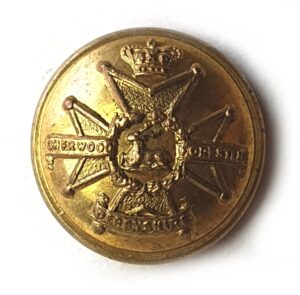
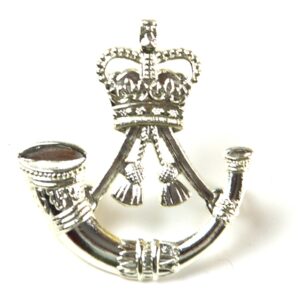
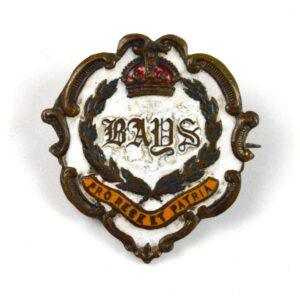
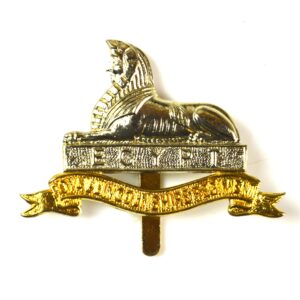
- Cap Badges: Several regiments were amalgamated in 1922 (the “Cardwell reforms” completion), producing transitional badges that are highly collectible. The switch from brass to bi-metal and white-metal badges also occurred during this period.
- Equipment: The 1937 Pattern webbing set, Bren gun accessories, and early anti-gas equipment are all distinctive to the period and offer collecting depth.
| Item | Typical Range | Notes |
|---|---|---|
| IGSM 1908–35, single clasp | £80 – £200 | Common clasps; rare clasps significantly more |
| IGSM 1936–39, NWF clasp | £100 – £250 | Fewer issued than 1908–35 type |
| GSM 1918–62, Palestine clasp | £120 – £300 | Growing demand; unit-specific prices vary |
| 1922 Pat. Service Dress tunic | £80 – £200 | Named/badged examples at premium |
| 1937 Pat. Battledress blouse | £60 – £150 | Pre-war dated most desirable |
| Inter-war officer’s mess dress | £150 – £500 | Cavalry and Guards at top end |
The British Army between the wars was small, stretched thin across a vast empire, and chronically underfunded — yet it produced some of the finest professional soldiers in British history. The men who served in Waziristan, Palestine, and on Salisbury Plain formed the cadre around which the wartime army would be built. Their story deserves remembering. [1]
Case Studies: Imperial Policing Operations
The Irish War of Independence (1919–1921)
The conflict in Ireland presented the British Army with its most politically fraught inter-war challenge. Unlike traditional colonial policing, the Irish campaign was fought against a European population with significant international sympathy — particularly in the United States, where the large Irish diaspora lobbied aggressively for recognition of the Irish Republic. [2]
The British response combined conventional military operations with a counter-insurgency campaign that relied heavily on intelligence, cordon-and-search operations, and the deployment of auxiliary police forces — the infamous “Black and Tans” (recruited from demobilised soldiers) and the Auxiliaries (former officers). These forces gained a reputation for reprisals and indiscipline that damaged British prestige internationally and horrified many senior army officers. General Sir Nevil Macready, the GOC-in-C Ireland, struggled to maintain military discipline while conducting operations alongside poorly controlled paramilitary forces. [2]
The Irish experience had lasting implications: it demonstrated the political limitations of military force in counter-insurgency, the danger of relying on hastily recruited auxiliary forces, and the importance of maintaining strict discipline even under provocation. The lessons were imperfectly learned — similar patterns would recur in Palestine, Malaya, Kenya, and Northern Ireland in later decades. [2]
The North-West Frontier: A Permanent Training Ground
If Ireland was the army’s most politically sensitive inter-war commitment, the North-West Frontier of India was its most tactically demanding. The mountainous border between British India and Afghanistan was home to Pashtun tribes who fiercely resisted any external authority, and the army maintained a permanent garrison of four to five divisions to guard the passes and punish incursions. [2]
The Frontier served as a practical training school that shaped the inter-war army more profoundly than any other single factor. Virtually every officer who rose to senior command in the Second World War had served on the Frontier — Slim, Auchinleck, Alexander, Montgomery (briefly), and Wavell all learned their trade in the harsh conditions of Waziristan and the Khyber. The tactical lessons — the importance of ground, of fire and movement, of logistical self-sufficiency, and of the devastating effect of well-aimed rifle fire from concealed positions — would prove directly relevant to the campaigns of 1939–1945. [2]
The Palestine Mandate (1920–1939)
The British Mandate in Palestine, assigned by the League of Nations after the collapse of the Ottoman Empire, presented the army with the unenviable task of maintaining order between increasingly hostile Arab and Jewish communities — both of whom regarded the British as an obstacle to their national aspirations. [2]
The Arab Revolt of 1936–1939 was the most serious inter-war insurgency the British Army faced. At its peak, it required the deployment of two full divisions and an additional brigade — a significant commitment for an army already stretched thin by global imperial obligations. The counter-insurgency tactics developed in Palestine — including cordon-and-search, population movement, the construction of physical barriers, the use of collective punishment, and collaboration with local auxiliary forces (including the Special Night Squads led by Orde Wingate) — anticipated many of the methods that would be used in post-war counter-insurgency campaigns. [2]
Technology and Doctrine: The Debates That Shaped WWII
Armoured Warfare: The Fuller-Liddell Hart Vision
The most historically significant doctrinal debate of the inter-war period concerned the role of the tank and mechanised forces. J.F.C. Fuller and B.H. Liddell Hart — both of whom had served in the First World War and witnessed the tank’s potential — argued passionately for an independent armoured force capable of deep penetration operations that would paralyse an enemy’s command and logistics. [3]
Their vision was revolutionary: instead of the broad-front infantry advances of 1914–1918, a concentrated armoured force would punch through the enemy line and exploit into the rear areas at speeds of 20–30 miles per day, overrunning headquarters, cutting supply lines, and creating panic and confusion far faster than the defending army could respond. This concept — which the Germans would later develop as Blitzkrieg — was arguably first articulated in English by Fuller and Liddell Hart. [3]
However, the British Army’s institutional response was cautious. The cavalry lobby — socially powerful and well-represented at senior levels — resisted what they saw as the abolition of their arm while offering their own claim to the mobile warfare role. The infantry centre argued that tanks were properly a support weapon for infantry operations, not an independent strike force. The result was a series of compromises that left British armoured doctrine muddled and incomplete when war came in 1939. [3]
Air Power and Army Co-operation
The creation of the Royal Air Force as an independent service in 1918 — the first such arrangement in the world — had profound implications for the army. The new RAF, fighting for its institutional survival against proposals to return it to army and navy control, emphasised strategic bombing as its primary mission and treated army co-operation as a secondary role. The army, deprived of its own air arm, found itself increasingly unable to train for air-ground co-ordination until the late 1930s. [3]
The consequences became apparent in France in 1940, when British ground forces found themselves without the close air support that the German Luftwaffe provided to the Wehrmacht — a collaboration refined through years of joint exercises. It was not until the North African campaign of 1942–1943 that effective RAF–Army co-operation was finally achieved, under the leadership of Air Marshal Arthur Coningham and General Montgomery. [3]
Frequently Asked Questions
What was the Ten-Year Rule?
Adopted in 1919 and made rolling in 1928 (cancelled 1932), the Ten-Year Rule was a Treasury assumption that Britain would not be involved in a major war for at least ten years. It was used to justify severe cuts to military spending throughout the 1920s and early 1930s, leaving the Army ill-prepared for rearmament.
Who were Fuller and Liddell Hart?
J.F.C. Fuller and B.H. Liddell Hart were the leading British advocates of mechanised armoured warfare in the inter-war period. They argued for independent armoured forces capable of deep penetration — a concept the Germans later developed as Blitzkrieg. British institutional conservatism prevented full adoption of their ideas before 1939.
Where did the British Army serve between the wars?
Major commitments included Ireland (War of Independence 1919–1921), Iraq (mandate and revolts), India (North-West Frontier permanent garrison), Palestine (Arab Revolt 1936–1939), and various smaller colonial policing operations across the Empire.

Related Items in Our Collection8 items