
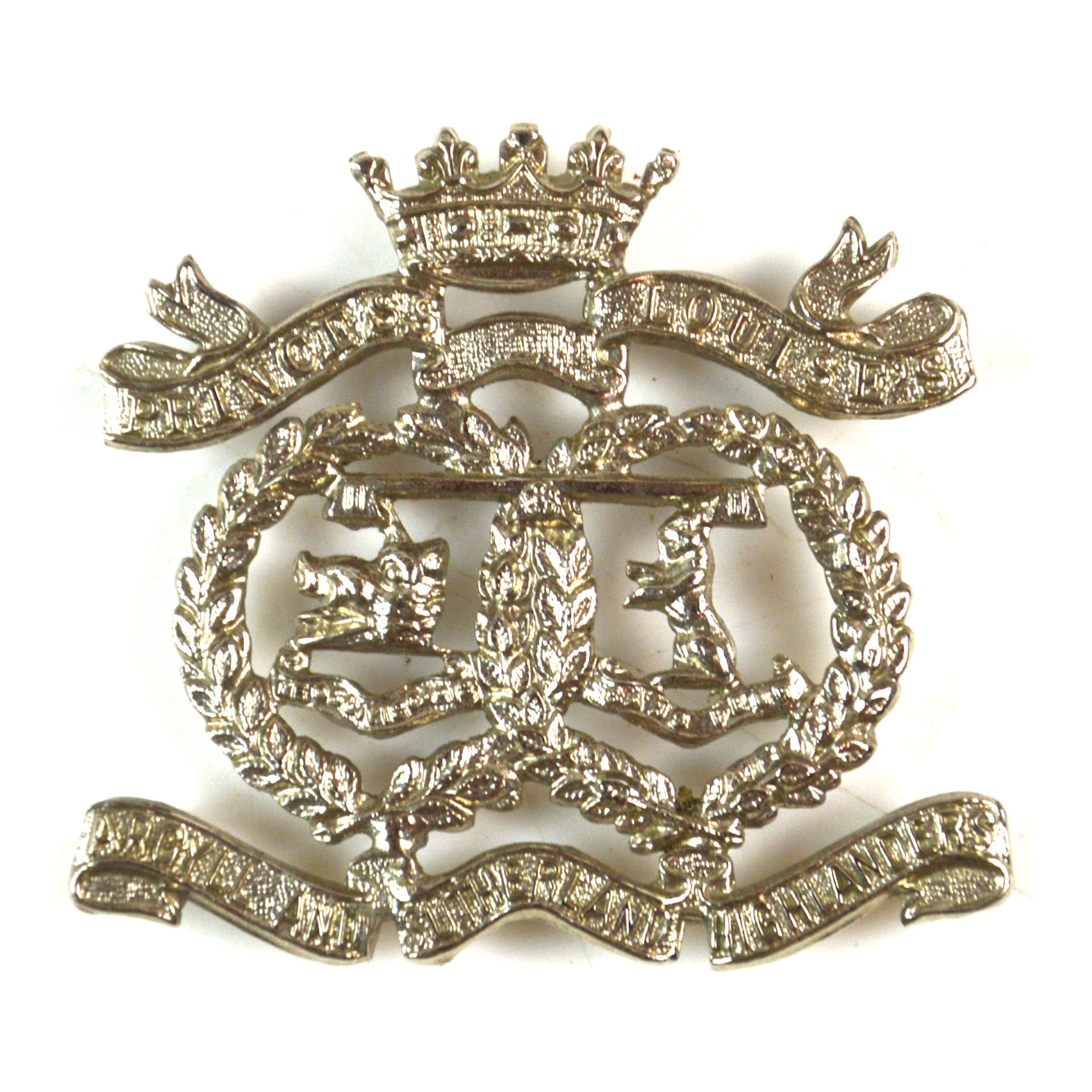
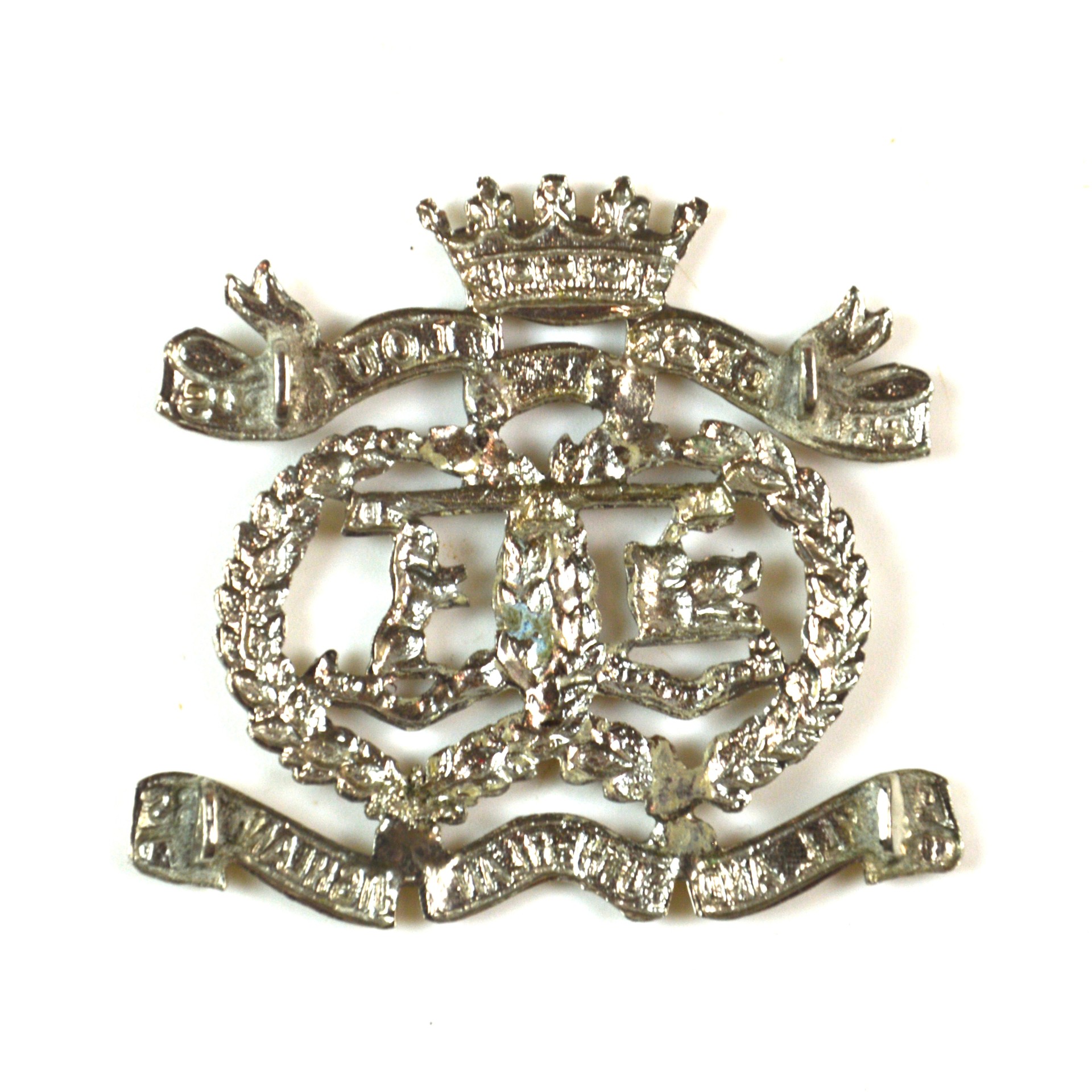
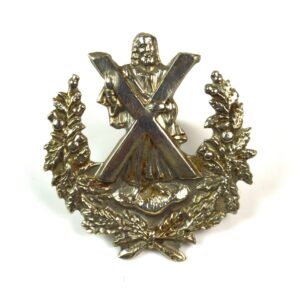
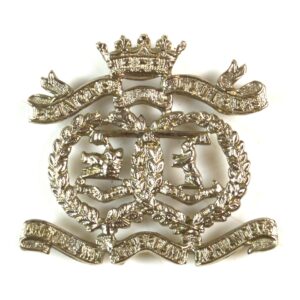
Argyll and Sutherland Highlanders waist belt buckle badge in white metal, produced in the pattern worn from 1881 to 2006 by the Argyll and Sutherland Highlanders (Princess Louise’s) of the British Army. This Scottish Highland infantry regimental belt buckle badge displays the recognised regimental insignia in clear relief, incorporating a wreath of laurels as the outer border, enclosing a boar’s head to the left and a cat-a-mountain to the right, with an upper scroll inscribed “PRINCESS LOUISE’S” surmounted by Princess Louise’s Royal Ducal Coronet at the topmost point, and a lower scroll inscribed “ARGYLL AND SUTHERLAND HIGHLANDERS”. The badge would have been mounted to a square brass two-part belt buckle plate, the white metal badge secured to the plate by four small square lugs passing through the plate and retained by split pins or wires on the reverse. The badge device is derived from the regimental collar badge pattern rather than the larger cap badge, and is rendered entirely in nickel-plated white metal consistent with other ranks’ and NCOs’ production standard.
The regiment was formed on 1 July 1881 through the Childers Reforms by the amalgamation of the 91st (Argyllshire Highlanders) Regiment of Foot and the 93rd (Sutherland Highlanders) Regiment of Foot, originally designated the Princess Louise’s (Sutherland and Argyll Highlanders) before the order of the subtitle was reversed the following year. The badge was designed by Princess Louise herself — the sixth child of Queen Victoria and a trained sculptor — to combine the heraldic devices of the families associated with the two predecessor regiments. The boar’s head is the crest of Clan Campbell of Argyll, which had long supplied officers and men to the 91st, while the cat-a-mountain is the crest of Clan Sutherland, from whose recruiting ground the 93rd had drawn its strength since its formation in 1800. The Princess’s reversed cypher and her Royal Ducal Coronet acknowledge her personal patronage of the regiment, which bore her name throughout its existence from 1882 until 2006. The thistle wreath framing the central device reflects the broader Highland and Scottish tradition common to both predecessor units. The waist belt and its associated buckle badge formed part of the Highland service dress uniform worn in both undress and walking-out order, and the badge pattern remained unchanged throughout the regiment’s existence. The regiment was amalgamated into the Royal Regiment of Scotland on 28 March 2006, becoming the 5th Battalion (Argyll and Sutherland Highlanders).
Manufactured in nickel-plated white metal consistent with British Army Highland infantry other ranks’ and NCOs’ belt plate production, this example provides a well-defined representation of the regimental waist belt buckle badge as worn across two world wars and the post-war period. Argyll and Sutherland Highlanders belt buckle badges are collected as examples of Scottish Highland regiment uniform accoutrements, regimental hardware of Princess Louise’s regiment, and militaria associated with one of the most distinguished Highland regiments of the British Army.
Dimensions Approx. 60mm x 54mm
Condition Excellent

Reviews
There are no reviews yet.