
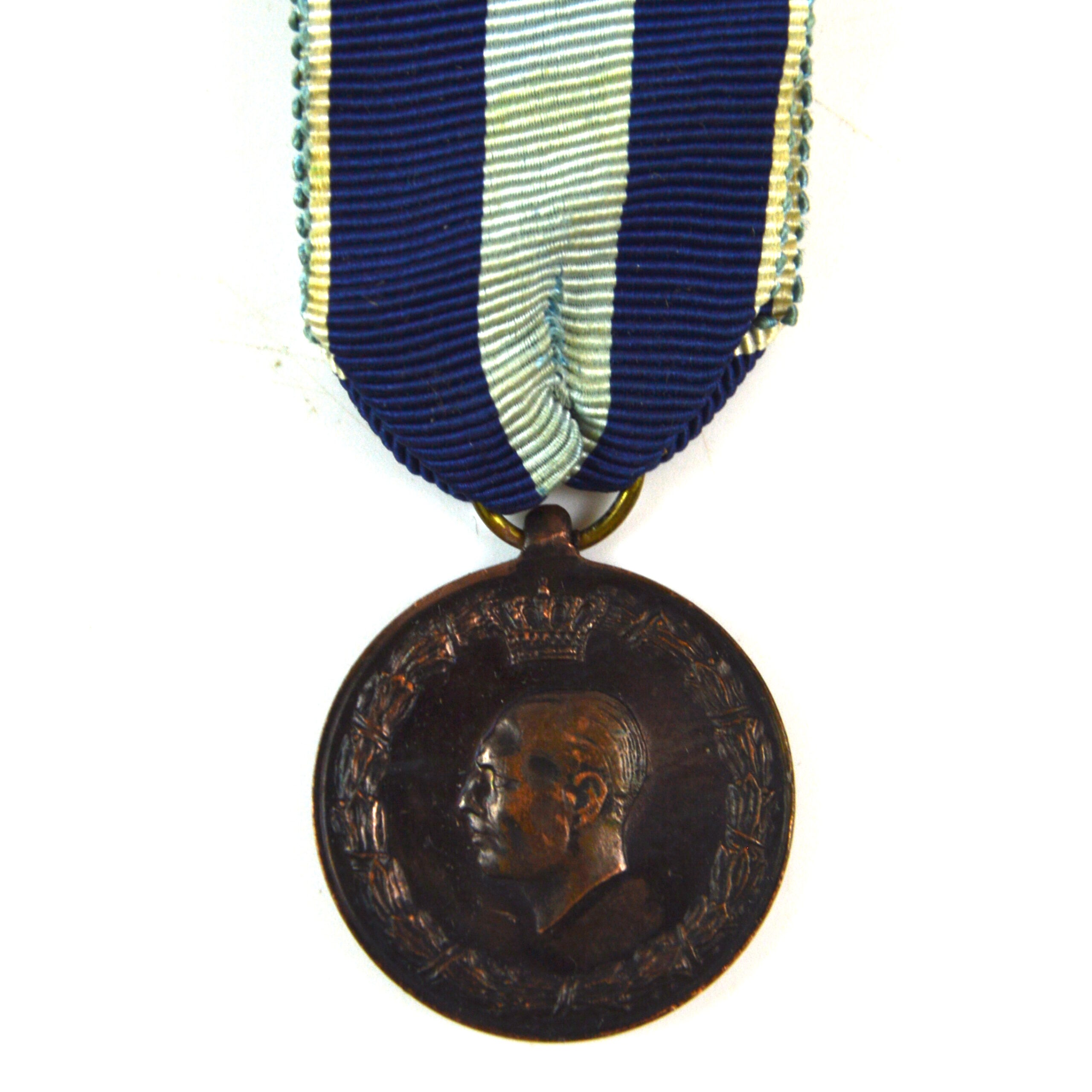
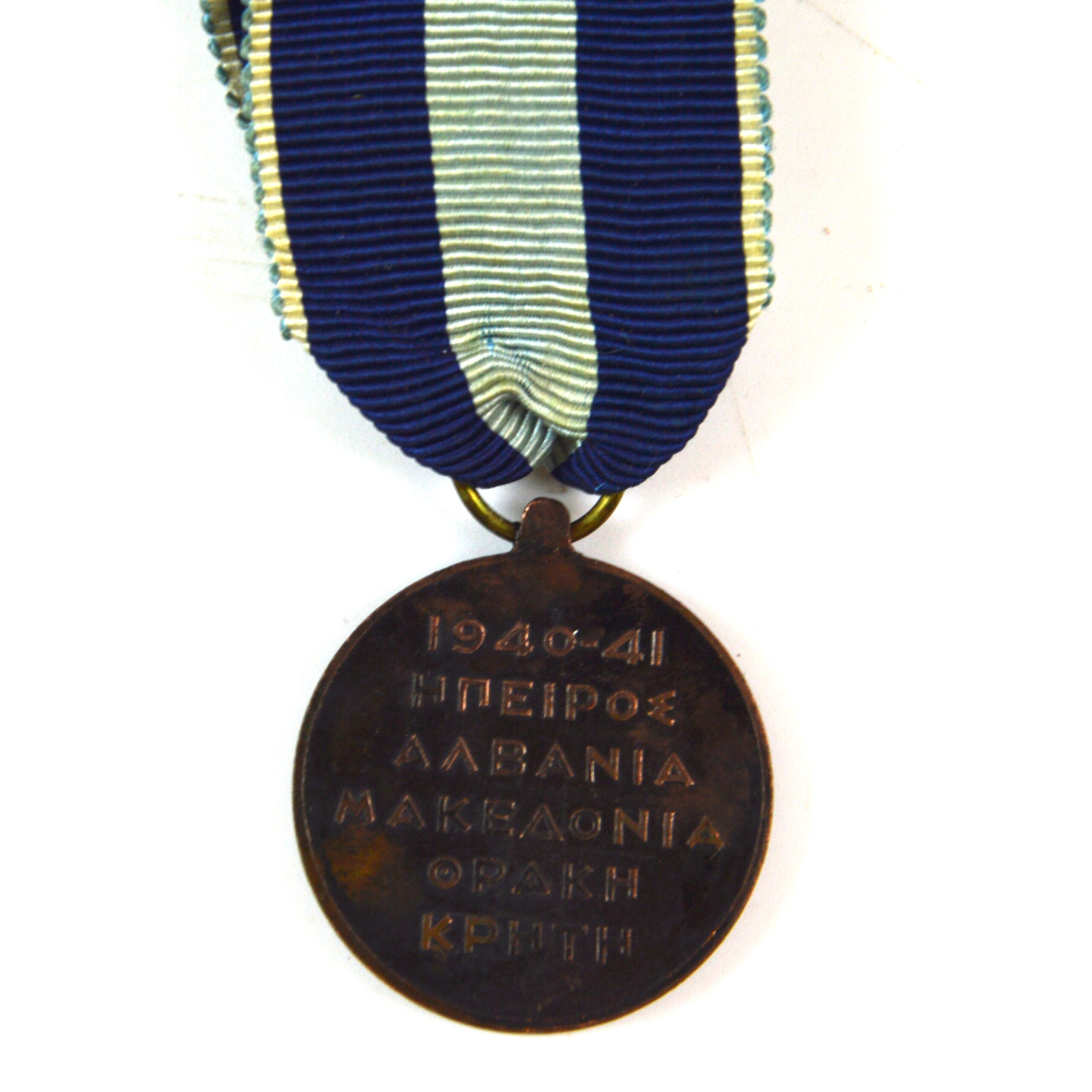
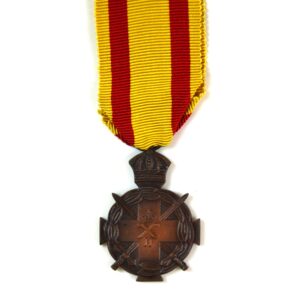
Kingdom of Greece Commemorative War Medal 1940–1941 in bronze, Army issue, produced in the original pattern instituted by Royal Decree of 19 August 1947 to recognise the actions of the Royal Greek Armed Forces who took part in the war from the outbreak of hostilities in Greece in 1940 until the fall of Crete in 1941. The medal was also awarded to foreign forces that fought on Greek soil, including British, Commonwealth, Australian, and New Zealand troops who served in the Greek and Cretan campaigns of 1941.
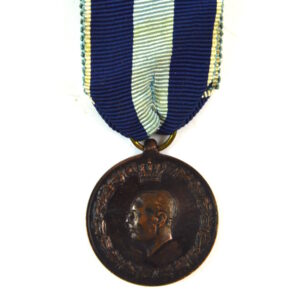
The obverse bears the profile of King George II of Greece facing left, the circumference edged with a garland of laurels, terminating above the king’s head with the ends resting against either side of the royal crown. The reverse carries raised Greek lettering reading “1940–41 Epirus, Albania, Macedonia, Thrace, Crete”, denoting the principal theatres of the land campaign. The medal is circular, manufactured in bronze in the colour of aged bronze, with a suspension ring of the same metal. The ribbon comprises of three stripes in the Greek national colours of blue, white, and blue, with the medal suspended from the ribbon via the suspension ring and sphere mount.
The medal commemorates one of the most remarkable defensive campaigns of the Second World War. Following the Italian invasion of Greece on 28 October 1940 — a date still celebrated in Greece as “Oxi Day” — the Royal Hellenic Army repulsed the initial Italian assault and subsequently drove the invading forces back into Albania, marking one of the first Allied offensive successes of the war. The German invasion launched on 6 April 1941 overwhelmed Greek and Allied resistance, resulting in the fall of the Greek mainland by late April and the subsequent Battle of Crete in May 1941, which marked the end of organised resistance in Greek territory and the limit of the medal’s qualifying period. The medal exists in two issue variants distinguished by their reverse inscription: the Army version, inscribed with the land campaign theatres of Epirus, Albania, Macedonia, Thrace, and Crete, and the Naval version, inscribed with the Aegean, Ionian, Myrtoum, and Adriatic. From 1983, replacement medals issued to veterans who had lost their originals bear a modified obverse showing a headless winged female figure in place of the royal portrait, reflecting the change of Greece from a kingdom to a republic in 1974.
This example is collected as a piece of Greek Second World War campaign militaria, a decoration of the Hellenic Armed Forces of the Kingdom of Greece, and a medal associated with the Greek and Cretan campaigns in which British and Commonwealth forces participated alongside their Greek allies.
Condition Good, with some light wear.

Reviews
There are no reviews yet.