- Introduction
- Origins: The Anglo-Nepalese War
- The Kukri
- The Indian Mutiny and Frontier Wars
- World War I
- World War II
- Partition and the British Brigade of Gurkhas
- Post-War Service: Malaya to Afghanistan
- The Gurkha Ethos
- Selection and Training
- The Right to Settle
- Current Structure
- Collector’s Corner: Gurkha Militaria
- Kukris
- Cap Badges
- Medal Groups
- Other Items
- Sources
- Introduction
- Origins: The Anglo-Nepalese War
- The Kukri
- The Indian Mutiny and Frontier Wars
- World War I
- World War II
- Partition and the British Brigade of Gurkhas
- Post-War Service: Malaya to Afghanistan
- The Gurkha Ethos
- Selection and Training
- The Right to Settle
- Current Structure
- Collector’s Corner: Gurkha Militaria
- Sources
Introduction
The Gurkhas — Nepalese soldiers in the service of the British Crown — are amongst the most respected fighting troops in the world. For over two hundred years, Gurkha regiments have fought in every major British conflict, earning a reputation for extraordinary courage, loyalty and ferocity in close combat that is unmatched in military history. [1]
Field Marshal Sam Manekshaw, former Chief of the Indian Army Staff, famously said: “If a man says he is not afraid of dying, he is either lying or he is a Gurkha.” It is a sentiment shared by virtually every army that has fought alongside — or against — them. Their iconic weapon, the kukri, and their motto, Kafar hunnu bhanda marnu ramro (“It is better to die than to be a coward”), encapsulate an ethos that has not dimmed across two centuries of service. [2]
Origins: The Anglo-Nepalese War
British and Gurkha soldiers first met as enemies during the Anglo-Nepalese War of 1814–1816. The fighting qualities of the Nepalese hillmen — their courage, physical endurance, and skill in mountain warfare — so impressed the East India Company that the Treaty of Sugauli (1816) included provisions for Gurkha recruitment into British service. The first Gurkha units — the Nasiri and Sirmoor Battalions — were raised almost immediately. [1]
A famous anecdote captures the relationship’s founding spirit: when a British officer asked a captured Gurkha why he had fought so fiercely, the soldier replied that he fought because he was a soldier — and that he would fight just as fiercely for the British if they employed him. They did, and he was right.
Early recruitment centred on the western hills of Nepal, drawing particularly from the Magar and Gurung ethnic groups, later extending to the Rai, Limbu, Tamang, and Sunwar communities of eastern Nepal. The relationship between Britain and Nepal that underpins Gurkha recruitment has endured for over two centuries — one of the longest-standing military partnerships in the world. [2]
The Kukri
The kukri (also spelled khukuri) — the iconic curved Nepalese knife — is the universal symbol of the Gurkhas. Far more than ceremonial, the kukri is a practical working tool and a devastating close-combat weapon. The blade curves forward, concentrating the force of a blow at the point of impact, making it effective for chopping, cutting and thrusting. [1]
Service-issue kukris are typically 12–14 inches overall, with a heavy blade, horn or wood grip, and a leather scabbard containing two smaller utility knives: the karda (for skinning and cutting) and the chakmak (for sharpening and striking sparks). The distinctive notch at the base of the blade — the cho or kaura — has various attributed purposes, from preventing blood running onto the handle to a Hindu religious symbol, though its exact origin is debated among scholars. [3]
For collectors, Gurkha kukris range from common 20th-century issue patterns to rare Victorian-era examples with silver-mounted hilts. Detailed collector guidance is in the Collector’s Corner below.
The Indian Mutiny and Frontier Wars
The Sirmoor Battalion (later 2nd Gurkha Rifles) defended Hindu Rao’s House above Delhi for over three months during the Indian Mutiny of 1857, losing 327 of 490 men. The house was the highest point on the ridge commanding the British position, and its loss would have been catastrophic. The 2nd Gurkhas repelled no fewer than 26 major assaults. Queen Victoria granted the Sirmoor Battalion the unique honour of a third Colour — the “Truncheon” — in recognition of their extraordinary valour. [1]
For decades, Gurkha regiments served on the turbulent North-West Frontier of India (modern Pakistan/Afghanistan), fighting in the numerous tribal campaigns that characterised British India’s border wars. The Tirah Campaign (1897–98), the Waziristan operations, and the various Frontier risings saw Gurkha units repeatedly in action in some of the most difficult terrain on earth. Their hillcraft, endurance, and ability to operate in precipitous mountain country made them natural frontier soldiers — and the experience forged the small-unit skills that remain Gurkha strengths to this day. [2]
World War I
Over 100,000 Gurkhas served in the Great War, fighting in France, Gallipoli, Palestine and Mesopotamia. The 2/3rd Gurkha Rifles were among the first troops ashore at Suvla Bay, Gallipoli. On the Western Front, Gurkha battalions served in the trenches alongside British and Indian Army units, earning universal respect for their courage under conditions profoundly different from the hills of Nepal. [1]
At Loos (1915), at Neuve Chapelle (where the 2/3rd Gurkhas broke into the village in the first wave), and on the Somme, Gurkha soldiers demonstrated that their fighting qualities translated to industrialised warfare. The Gurkhas’ willingness to close with the enemy in trench raids — kukris in hand — became legendary among both Allied and German troops. [2]
World War II
Over 250,000 Gurkhas served in the Second World War — the largest Gurkha mobilisation in history. They fought with distinction in every major theatre: [1]
- North Africa and Italy — The 2nd and 9th Gurkha Rifles served in Tunisia and the brutal fighting up the Italian peninsula, including the four battles for Monte Cassino. At Cassino, the 1/9th Gurkha Rifles fought their way onto Hangman’s Hill, within yards of the monastery, in some of the most intense close-quarter fighting of the entire war.
- Burma — Gurkha battalions formed the backbone of Slim’s Fourteenth Army, fighting at Imphal, Kohima, and the subsequent advance to Rangoon. At Kohima in April 1944, the 4th Battalion 1st Gurkha Rifles helped hold the critical positions around the tennis court and District Commissioner’s bungalow in what the Japanese high command regarded as their army’s greatest defeat. [4]
- Malaya and Singapore — Gurkha units were among the forces that suffered the fall of Singapore in 1942, with many enduring years of appalling Japanese captivity.
Gurkha soldiers won 12 Victoria Crosses during the World Wars. The most celebrated recipient is Havildar Lachhiman Gurung VC, 4/8th Gurkha Rifles, who defended his position alone against approximately 200 Japanese soldiers at Taungdaw, Burma, in May 1945. Despite losing his right hand to a grenade — he had caught and thrown back two grenades before the third exploded in his grip — he continued firing his rifle one-handed for four hours, killing 31 of the enemy. He survived his injuries and lived until 2010, aged 92. [5]
Partition and the British Brigade of Gurkhas
After Indian independence in 1947, the Gurkha brigade was split between British and Indian service under a tripartite agreement between Britain, India, and Nepal. Four regiments — the 2nd, 6th, 7th, and 10th Gurkha Rifles — transferred to the British Army, while the remainder (1st, 3rd, 4th, 5th, 8th, 9th, and 11th) joined the Indian Army. The division was painful; bonds of loyalty between officers and men of the departing regiments ran deep, and the handover ceremonies were emotional. [2]
The four British Gurkha regiments were eventually amalgamated into the present Royal Gurkha Rifles in 1994 — first 2nd and 6th GR merged into 1 RGR, then 7th and 10th GR into 2 RGR.
Post-War Service: Malaya to Afghanistan
The British Brigade of Gurkhas has served in virtually every post-war deployment:
- Malaya (the Emergency, 1948–60) — Gurkhas were central to the successful counter-insurgency campaign, their jungle skills ideally suited to operations against communist guerrillas in deep primary jungle [4]
- Borneo (Confrontation, 1962–66) — Lance Corporal Rambahadur Limbu won the VC for his actions at the Battle of Bau in November 1965, rescuing two wounded comrades under point-blank enemy fire
- The Falklands (1982) — 1/7th Gurkha Rifles deployed with 5th Infantry Brigade. The Argentine surrender at Goose Green was partly attributed to fear of the approaching Gurkhas — their reputation preceded them across the South Atlantic [1]
- Kosovo, Sierra Leone, East Timor — peacekeeping and stabilisation operations
- Iraq and Afghanistan — 1st and 2nd Royal Gurkha Rifles deployed extensively in Helmand Province. Corporal Dipprasad Pun of the RGR fought off up to 30 Taliban fighters single-handedly in 2010, firing over 400 rounds, throwing 17 grenades, and even hurling a tripod at one attacker — earning the Conspicuous Gallantry Cross. [5]
The Gurkha Ethos
The Gurkhas maintain a distinctive martial culture that underpins their formidable reputation. The concept of izzat — honour, reputation and self-respect — drives Gurkha soldiers to extraordinary feats. A Gurkha who shows cowardice shames not only himself but his family and his village — a social consequence far more powerful than any military sanction. [2]
The Dashain festival, celebrated in October, is the most important event in the Gurkha calendar. In military service, Dashain involves traditional ceremonies including the sacrifice of animals (goats and buffalo), feasting, sporting competitions, and the blessing of weapons — including the kukri. The festival reinforces the bonds of unit cohesion and cultural identity that are central to Gurkha military effectiveness. [1]
Each Gurkha battalion maintains a Pandit (Hindu priest) and a Gurkha Major — the senior Gurkha officer who acts as principal advisor to the commanding officer on all matters of Nepalese customs, welfare and traditions. The Gurkha Major holds a unique position: he is the bridge between two cultures, ensuring that the British chain of command understands and respects Gurkha traditions while maintaining military discipline and operational effectiveness.
Selection and Training
The annual recruitment process in Nepal is legendary for its difficulty. Approximately 25,000 young Nepalese men apply each year for around 200 places — a ratio that makes Gurkha selection one of the most competitive military intakes in the world. [2]
Regional selection involves a series of physical tests, culminating in the famous doko race: carrying 25 kg of rocks in a traditional Nepalese wicker basket up a steep hill — typically 4.2 km with an altitude gain of 600 metres — in under 46 minutes. Those who pass proceed to Central Selection in Pokhara, where they face further physical tests, medical examinations and educational assessments under the supervision of British Gurkha recruiting officers. [1]
Successful recruits travel to the UK for 39 weeks of training at the Infantry Training Centre, Catterick, where they learn English alongside military skills. The Gurkha Company at Catterick maintains the distinctive traditions and standards that have characterised Gurkha training since the 19th century. Recruits must reach a functional level of English — no small task — while simultaneously mastering the same infantry syllabus as British recruits.
The Right to Settle
Until 2009, Gurkhas who retired before 1997 had no automatic right to settle in the United Kingdom despite decades of loyal service. A high-profile campaign led by actress Joanna Lumley — whose father served with the 6th Gurkha Rifles — and backed by the Gurkha Justice Campaign successfully pressured the government. The decision, announced in May 2009, was widely celebrated and led to several thousand retired Gurkhas and their families settling in the UK, particularly in Aldershot (long the home of the Brigade of Gurkhas) and Folkestone. [5]
The campaign became a landmark in the broader recognition that military service creates an obligation of care that extends beyond discharge — a principle now widely accepted but which, in the Gurkha case, had been scandalously neglected.
Current Structure
Today, the Brigade of Gurkhas comprises: [2]
| Unit | Role | Base |
|---|---|---|
| 1st Royal Gurkha Rifles | Infantry (Light Role) | Brunei |
| 2nd Royal Gurkha Rifles | Infantry | Various UK |
| Queen’s Gurkha Engineers | Combat Engineers | Various UK |
| Queen’s Gurkha Signals | Communications | Various UK |
| Queen’s Own Gurkha Logistic Regt | Logistics | Various UK |
| Gurkha Staff & Personnel Support | Administration | Various UK |
Approximately 3,000 Gurkhas serve in the British Army. The garrison at British Forces Brunei — where 1 RGR is permanently stationed — is the last major permanent British military deployment east of Suez.
Collector’s Corner: Gurkha Militaria
Gurkha militaria combines great historical significance with accessibility — it is possible to begin a Gurkha collection at modest cost while aspiring to genuinely rare material.
Kukris
The most collected Gurkha item. The MkII pattern (issued from the 1940s onwards) is the most commonly encountered military kukri and can be found for £40–80. MkI patterns (pre-WWII, with a narrower blade profile) fetch £80–150. Earlier patterns — especially named or provenanced pieces from the Indian Mutiny or the Frontier Wars — command significantly higher prices. Victorian silver-mounted officers’ kukris, often presentation pieces with engraved blades, can reach £300–800+. Provenance, date and regimental connection are the key value factors. [3]
Cap Badges
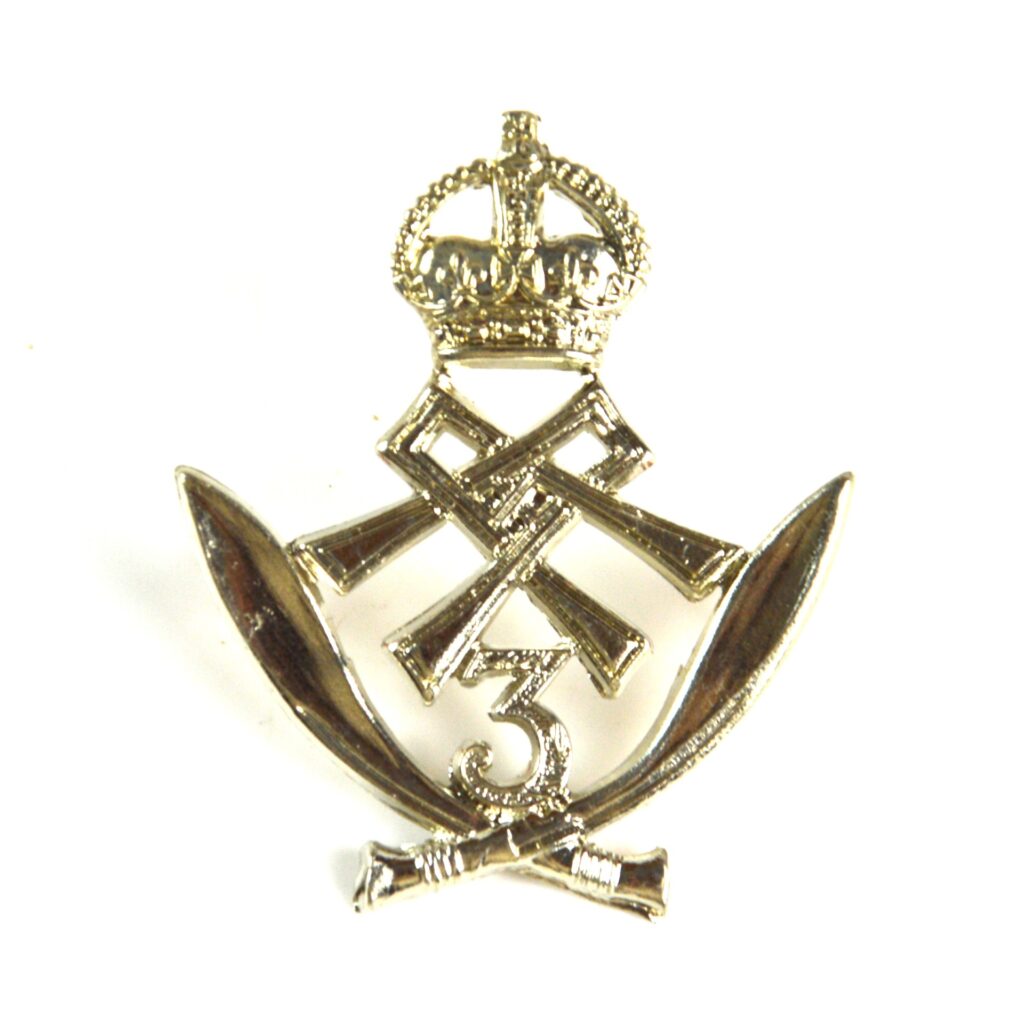
Each Gurkha regiment had its own distinctive badge — the crossed kukris motif appearing in most. Pre-1947 examples to disbanded regiments (the 3rd, 4th, 5th, 8th, and 9th Gurkha Rifles, which went to the Indian Army) are scarce and actively sought by British collectors. The 2nd Goorkhas badge, with its distinctive Burma Star, is particularly popular. Modern Royal Gurkha Rifles badges are available and attractive. [1]
Medal Groups
Gurkha medal groups, especially those with gallantry awards, are highly valued. Named Indian General Service Medals with Gurkha regiment naming are sought after — the IGSM with North West Frontier clasps to a Gurkha unit is a classic group. A WWII group with Burma Star to a named Gurkha is a desirable combination that typically carries a 50–100% premium over an equivalent un-named group.
Other Items
- Shoulder titles — “2 G.R.”, “6 G.R.”, etc., in brass and anodised patterns
- Photographs and documents — pre-1947 regimental photographs showing Gurkha units in the field are both historically significant and increasingly collected
- Regimental silver — Gurkha mess silver, when it occasionally appears at auction, is among the most attractive in the British Army
Sources
- Parker, John. The Gurkhas: The Inside Story of the World’s Most Feared Soldiers. London: Headline, 1999. ISBN 978-0-7472-7527-3.
- Bellamy, Chris. The Gurkhas: Special Force. London: John Murray, 2011. ISBN 978-1-84854-265-1.
- Windrow, Martin. The Gurkha Kukri. Oxford: Osprey, 2004. ISBN 978-1-84176-617-1.
- Cross, J.P. and Gurung, Buddhiman. Gurkhas at War: In Their Own Words. London: Greenhill Books, 2002. ISBN 978-1-85367-501-4.
- The Gurkha Museum, Peninsula Barracks, Winchester. thegurkhamuseum.co.uk.
Frequently Asked Questions
Who are the Gurkhas?
The Gurkhas are Nepalese soldiers who have served in the British Army since 1815, following the Anglo-Nepalese War. Recruited primarily from the hill tribes of Nepal, they are renowned for their courage, loyalty, and fighting prowess. The Brigade of Gurkhas currently comprises around 3,500 soldiers serving in infantry, engineer, signals, and logistic roles within the British Army.
What is a kukri?
The kukri (also spelled khukuri) is the iconic curved knife carried by Gurkha soldiers. It serves as both a practical tool and a fearsome close-combat weapon. The distinctive forward-curved blade is designed for chopping and slashing. Every Gurkha soldier carries a kukri, and it has become the universal symbol of Gurkha identity and martial tradition.
How many Victoria Crosses have Gurkhas won?
Gurkha soldiers have been awarded 26 Victoria Crosses — 13 to Gurkha officers and soldiers and 13 to British officers serving with Gurkha regiments. These were earned across campaigns from the Indian Frontier Wars through both World Wars. The most famous Gurkha VC action was at Mogaung in Burma, 1944, by Rifleman Tulbahadur Pun.
Sources & References
- Parker, J. — *The Gurkhas: The Inside Story of the World's Most Feared Soldiers* (2005)
- The Gurkha Museum, Winchester
- The Brigade of Gurkhas — army.mod.uk/gurkhas

Related Items in Our Collection8 items