- Head Protection Through the Centuries
- A Chronological Guide
- Civil War and 17th Century (1640–1700)
- 18th Century (1700–1800)
- Napoleonic Era (1800–1815)
- Victorian Era (1837–1901)
- World War I: The Brodie Helmet
- World War II
- Cold War to Present
- Collecting Tips
- Authentication
- Display and Preservation
- Price Guide Summary
Head Protection Through the Centuries
Few categories of militaria are as visually dramatic or historically evocative as helmets. From the lobster-tailed pot helmets of the English Civil War, through the gleaming brass and silver of Victorian full-dress headdress, to the distinctive shape of the Brodie tin hat and the modern Mk 7 ballistic helmet, British military helmets chart the evolution of warfare itself. For collectors, helmets offer tangible connections to specific eras, campaigns, and units — and they make magnificent display pieces.
A Chronological Guide
Civil War and 17th Century (1640–1700)
The English Civil War saw the last widespread use of armour on the battlefield. Key helmet types:
- Lobster-tail pot (English pot): A round-skulled helmet with a segmented neck guard (the “lobster tail”), a peak, and often a face bar or triple-bar visor. Worn by cavalry on both sides. £3,000–£10,000+ for genuine examples.
- Morion: An open-faced helmet with a pronounced crest and turned-up brim, used by pikemen and musketeers. Less common in English service than Continental armies. £2,000–£5,000.
- Siege helmet: Heavy face-protecting helmets for storming parties. Rare survivors: £5,000+.
18th Century (1700–1800)
The 18th century largely abandoned helmets. Infantry wore tricorn hats, then shakos. Light Dragoons wore “Tarleton” helmets from the 1780s — a leather helmet with a fur crest, named after the cavalry officer Banastre Tarleton. Other cavalry regiments wore bicorne hats until the introduction of the shako.
Napoleonic Era (1800–1815)
- Heavy Cavalry helmet (1812 pattern): A classical-style brass helmet with a horsehair crest, worn by the Life Guards, Royal Horse Guards, and Dragoon Guards. Magnificent display pieces: £3,000–£8,000.
- Tarleton helmet: Continued in use with Light Dragoons. £2,000–£5,000.
- Infantry shako: Not technically a helmet, but the “stovepipe” shako (1806) and Belgic shako (1812) are key Napoleonic headgear items. £1,000–£3,000.
Victorian Era (1837–1901)
The Victorian era produced some of the most ornate and collectible military headdress:
- Albert pattern shako (1844): A smaller, neater shako replacing the Napoleonic era designs. £500–£2,000.
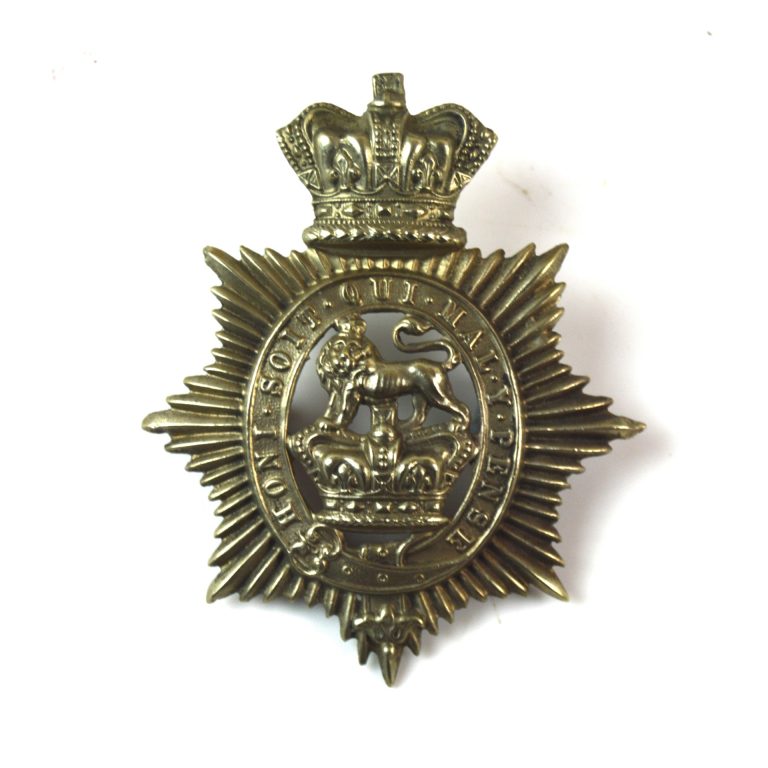
- Home Service helmet (1878): The iconic “Bobby” style spiked helmet in blue cloth or white foreign service pattern. Worn by line infantry, artillery, and engineers. Two main types: blue cloth (home service) and white (foreign service/tropics). £300–£1,500 for other ranks, £500–£3,000 for officers.
- Foreign Service/pith helmet: The white cork helmet of colonial campaigns — Zulu Wars, Sudan, Boer War. £200–£800.
- Cavalry helmets: Household Cavalry and Dragoon Guards retained metal helmets — brass or nickel-plated steel with plumes. Full-dress examples: £1,000–£5,000+.
- Scottish headdress: Feather bonnets (Highland regiments), Glengarry caps, Kilmarnock caps. £200–£800.
- Wolseley pattern helmet (1899): A grey felt helmet introduced for the Boer War, named after Lord Wolseley. £200–£500.
World War I: The Brodie Helmet
The steel helmet revolution came in 1915–16 when the British introduced the Brodie helmet (officially the Helmet, Steel, Mark I). The distinctive “tin hat” — a pressed steel dome with a wide brim — was designed to protect against shrapnel falling from above in trench warfare. Key variants:
- Mk I Brodie (1916): The original, with a simple leather liner and chinstrap. Sometimes painted with unit markings (divisional signs, rank stripes). £100–£400. Named/identified examples or those with painted unit markings: £300–£800.
- Mk II (1938): An improved version with a better liner system, used through WWII. £60–£200.
- Camouflage nets and covers: Helmets with wartime scrim nets, hessian covers, or camouflage paint fetch premiums. £100–£400.
World War II
- Mk II Brodie: As above — the standard issue throughout WWII.
- Mk III “Turtle” helmet (1944): A new shape — deeper, with a shorter brim and improved ballistic protection. Introduced late in the war, used post-war. £80–£250.
- Airborne helmet: A modified Mk II with a shortened brim and a special chin-cup liner for parachuting. Highly collectible: £300–£1,000. Red Devils helmets with airborne markings or Denison helmet covers: £500–£1,500.
- Dispatch rider’s helmet: A distinctive all-round brim helmet for motorcycle riders. £100–£300.
- Tank crew helmet (RAC helmet): A padded fibre shell protecting against interior impacts. £100–£300.
Cold War to Present
- Mk IV helmet (1950s–80s): The turtle shape continued. £40–£100.
- Mk 6 helmet (1986–2000s): The first modern ballistic (Kevlar-type) helmet in British service. Distinctive shape with extended ear and nape coverage. £50–£150. Falklands-era helmets (Mk IV or early Mk 6) bring premiums.
- Mk 7 helmet (2009–present): The current issue, manufactured by NP Aerospace. Improved ballistic protection and comfort. Surplus/issued examples: £80–£200.
Collecting Tips
Authentication
- Maker’s marks: Most helmets carry manufacturer stamps (inside the crown or on the rim). Common WWII makers include Briggs, Rubery Owen, and British Motor Company.
- Liner dating: Liner types and stamps help date helmets accurately. WWII liners have specific patterns by year.
- Paint and markings: Original paint (olive drab, textured anti-glare) is key to value. Repainted helmets are worth significantly less. Unit markings should show appropriate paint layering.
- Weight and shape: Reproduction helmets often have slightly different weights and profiles from originals. Handling genuine examples builds familiarity.
Display and Preservation
- Store helmets on padded stands to avoid denting the crown.
- Do not attempt to strip original paint — even worn paint is authentic character.
- Leather liners benefit from occasional conditioning (Renaissance wax or museum-quality leather feeder).
- Metal helmets should be kept in stable humidity to prevent rust.
Price Guide Summary
| Helmet Type | Approximate Price Range (2026) |
|---|---|
| English Civil War pot helmet | £3,000–£10,000+ |
| Napoleonic heavy cavalry helmet | £3,000–£8,000 |
| Victorian Home Service helmet (OR) | £300–£1,500 |
| Victorian pith/foreign service helmet | £200–£800 |
| WWI Mk I Brodie (plain) | £100–£400 |
| WWI Brodie with unit markings | £300–£800 |
| WWII Mk II Brodie (standard) | £60–£200 |
| WWII Airborne helmet | £300–£1,000 |
| WWII RAC tank crew helmet | £100–£300 |
| Mk 6 ballistic helmet | £50–£150 |
| Mk 7 helmet | £80–£200 |
Frequently Asked Questions
What is the most valuable British military helmet?
English Civil War pot helmets and lobster-tail helmets are the most valuable, ranging from u00a33,000-u00a310,000+. Napoleonic heavy cavalry helmets also reach u00a33,000-u00a38,000. Among 20th-century helmets, WWII airborne helmets (u00a3300-u00a31,000) are the most prized.
How do I date a British steel helmet?
Check the liner type, maker's stamps inside the crown or rim, and paint/finish. WWII helmets typically have maker stamps (Briggs, Rubery Owen) and date stamps. Liner patterns changed by year, providing precise dating for experts.
Are reproduction helmets common?
Yes, especially for WWI/WWII Brodie helmets and Victorian pith helmets. Weight, paint texture, liner construction, and rim finish are key authentication points. Handle genuine examples whenever possible to build familiarity.
Sources & References
- Haselgrove, M. & Radovic, B., Helmets of the First World War
- Sumner, I., British Colours & Standards 1747-1881
- Rankin, R., Military Headdress: A Pictorial History

Related Items in Our Collection8 items
Continue Reading