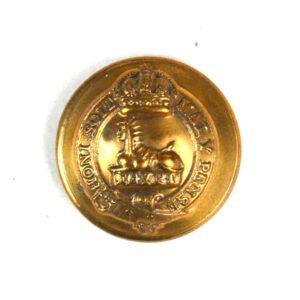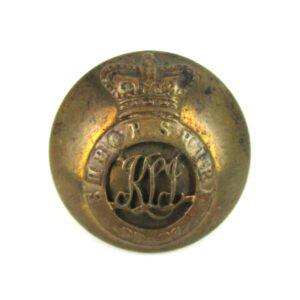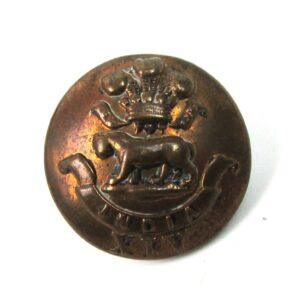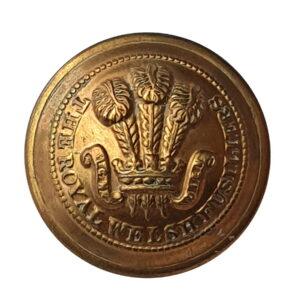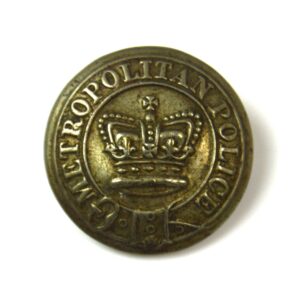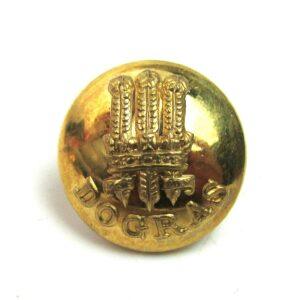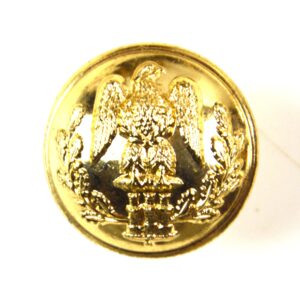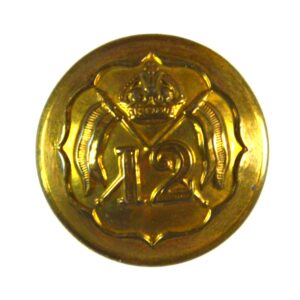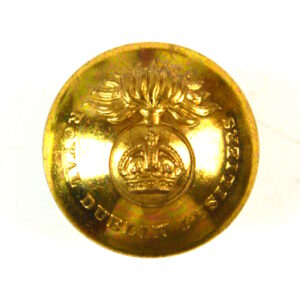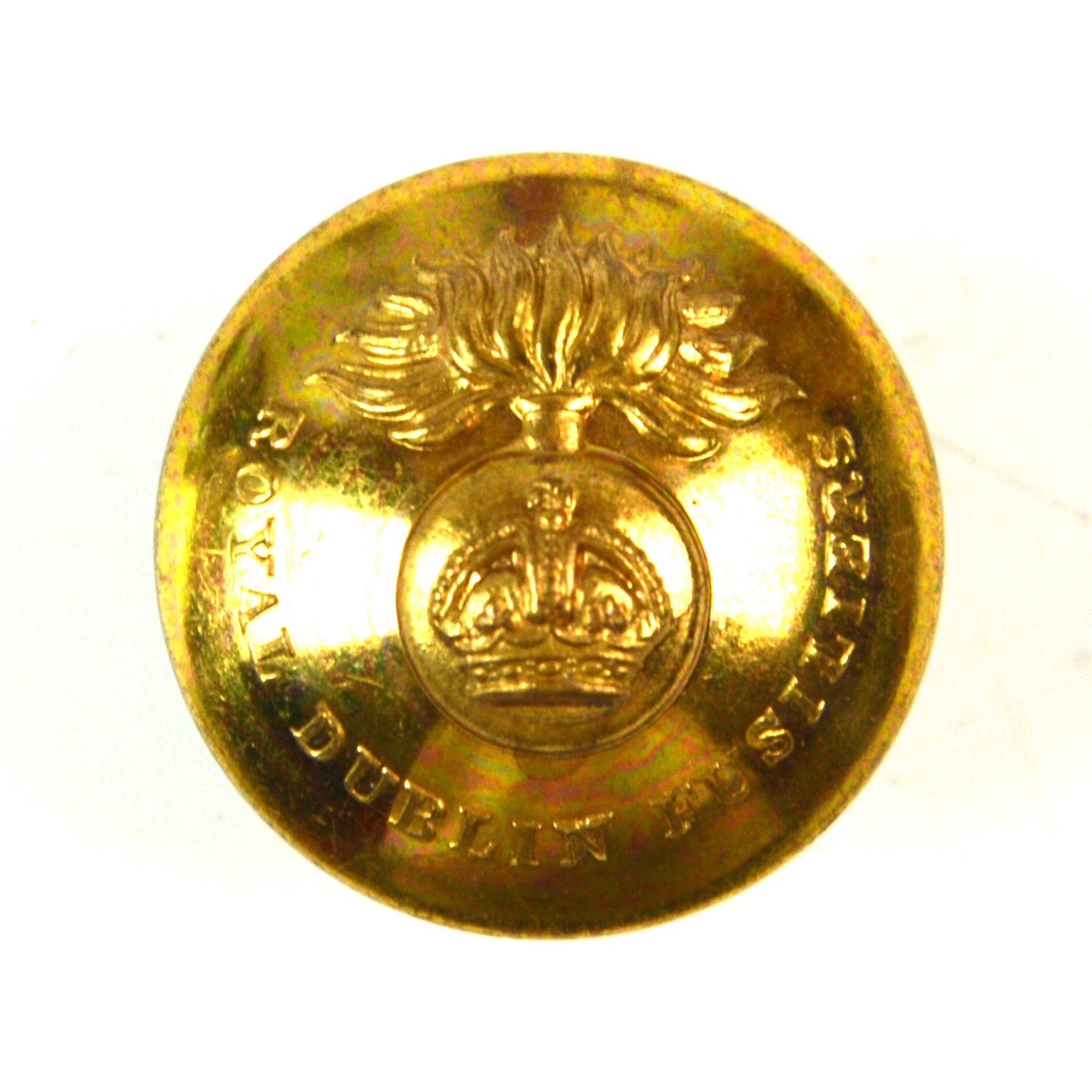
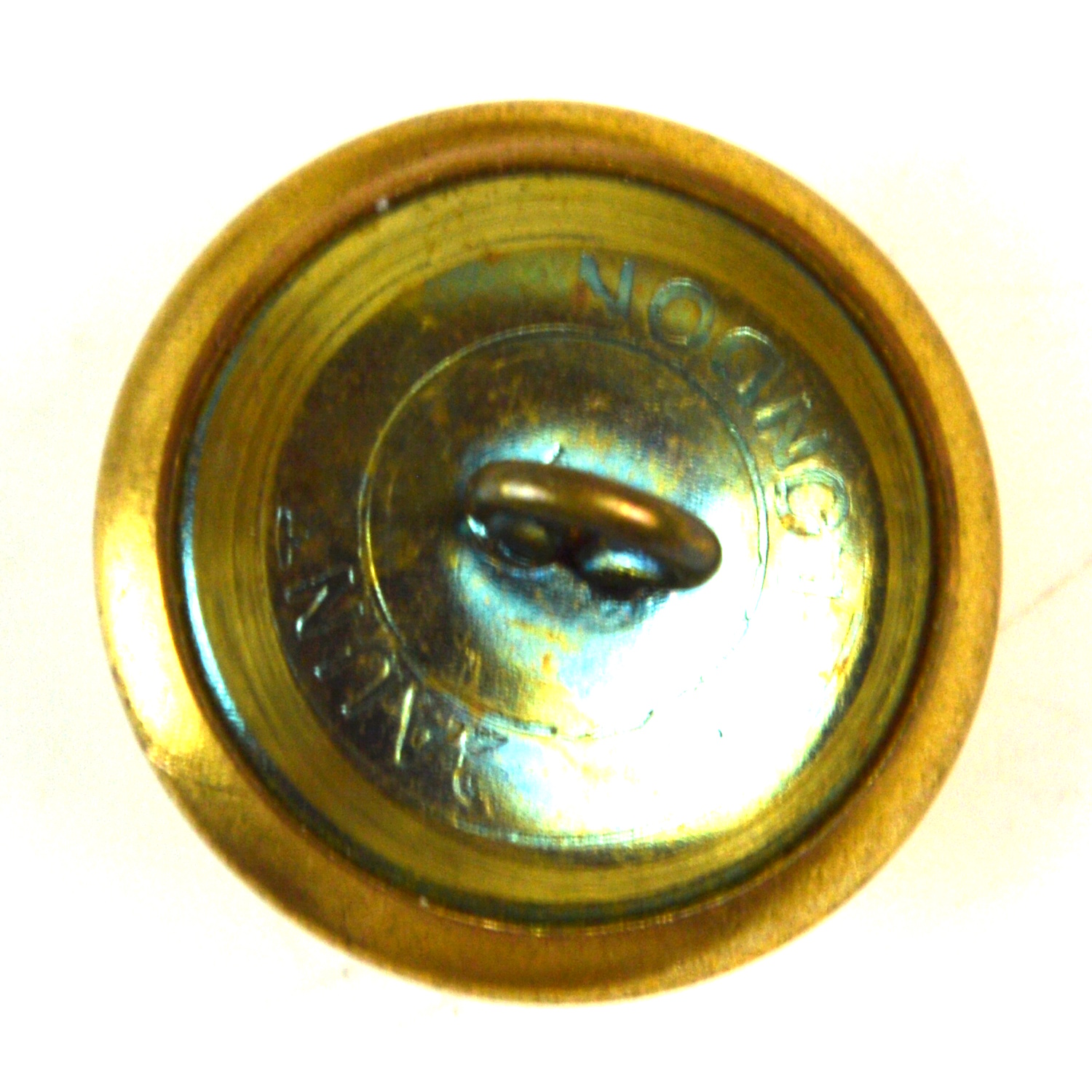
Royal Dublin Fusiliers officer’s uniform button in gilt metal finish, produced in the pattern worn from 1902 to 1922 by the Royal Dublin Fusiliers of the British Army. This British Army fusilier regiment officer’s button displays the recognised regimental device in clear relief, incorporating a fused grenade with a fan of multi-tiered flames as the principal device, the ball of the grenade bearing an Imperial King’s Crown, with the regimental title “Royal Dublin Fusiliers” encircling the circumference of the grenade ball. The reverse carries a shank loop for attachment and, on original period examples, typically a backmark of a London manufacturer such as Jennens & Co. The officer’s pattern is distinguished from other ranks’ production by the finer quality of the gilt finish and the greater crispness of the modelling throughout. The King’s Crown device on the grenade ball distinguishes this button pattern from the cap badge of the regiment, which carries the Royal Bengal Tiger above an elephant as its central device.
The regiment was formed on 1 July 1881 under the Cardwell and Childers Reforms through the amalgamation of the 102nd Regiment of Foot (Royal Madras Fusiliers) and the 103rd Regiment of Foot (Royal Bombay Fusiliers), both former fusilier regiments of the Honourable East India Company’s army co-opted into the British Army in 1861 following the dissolution of the Company in the aftermath of the Indian Mutiny. The fused grenade common to all fusilier regiments was carried forward from the earlier badge patterns of both predecessor regiments, with the King’s Crown introduced to the button ball on the accession of King Edward VII in 1902, replacing the Victorian Crown pattern in use from 1881. The regiment recruited in the counties of Dublin, Kildare, Wicklow, and Carlow, with its depot at Naas. It served with distinction in the Second Boer War — the 2nd Battalion taking part in one of the first major engagements of the war at the Battle of Talana Hill on 20 October 1899 — and throughout the First World War on the Western Front, at Gallipoli, in Salonika, and in Palestine, raising ten battalions in addition to its two regular battalions. The regiment was disbanded on 31 July 1922 as one of the six Southern Irish regiments stood down on the establishment of the Irish Free State, with its colours laid up in a ceremony at Windsor Castle in the presence of King George V.
Manufactured in gilt metal to the officer’s pattern standard, this 26mm button provides a well-defined representation of the Royal Dublin Fusiliers King’s Crown button pattern as worn across the Edwardian period and throughout the First World War. Royal Dublin Fusiliers officers’ buttons are collected as examples of Edwardian and First World War British Army fusilier regiment uniform accessories, officers’ insignia of the disbanded Irish regiments of the line, and militaria associated with one of the six Southern Irish regiments disbanded in 1922.
Dimensions 26mm diameter
Condition Excellent