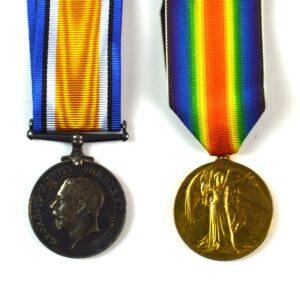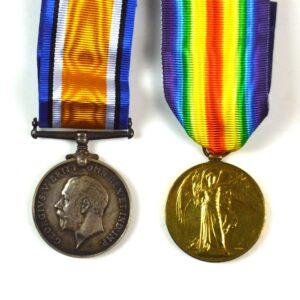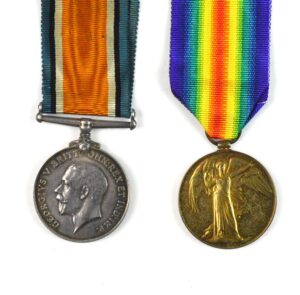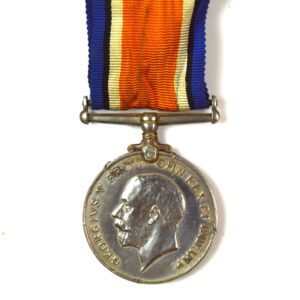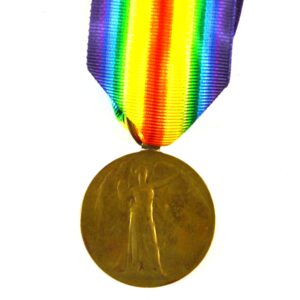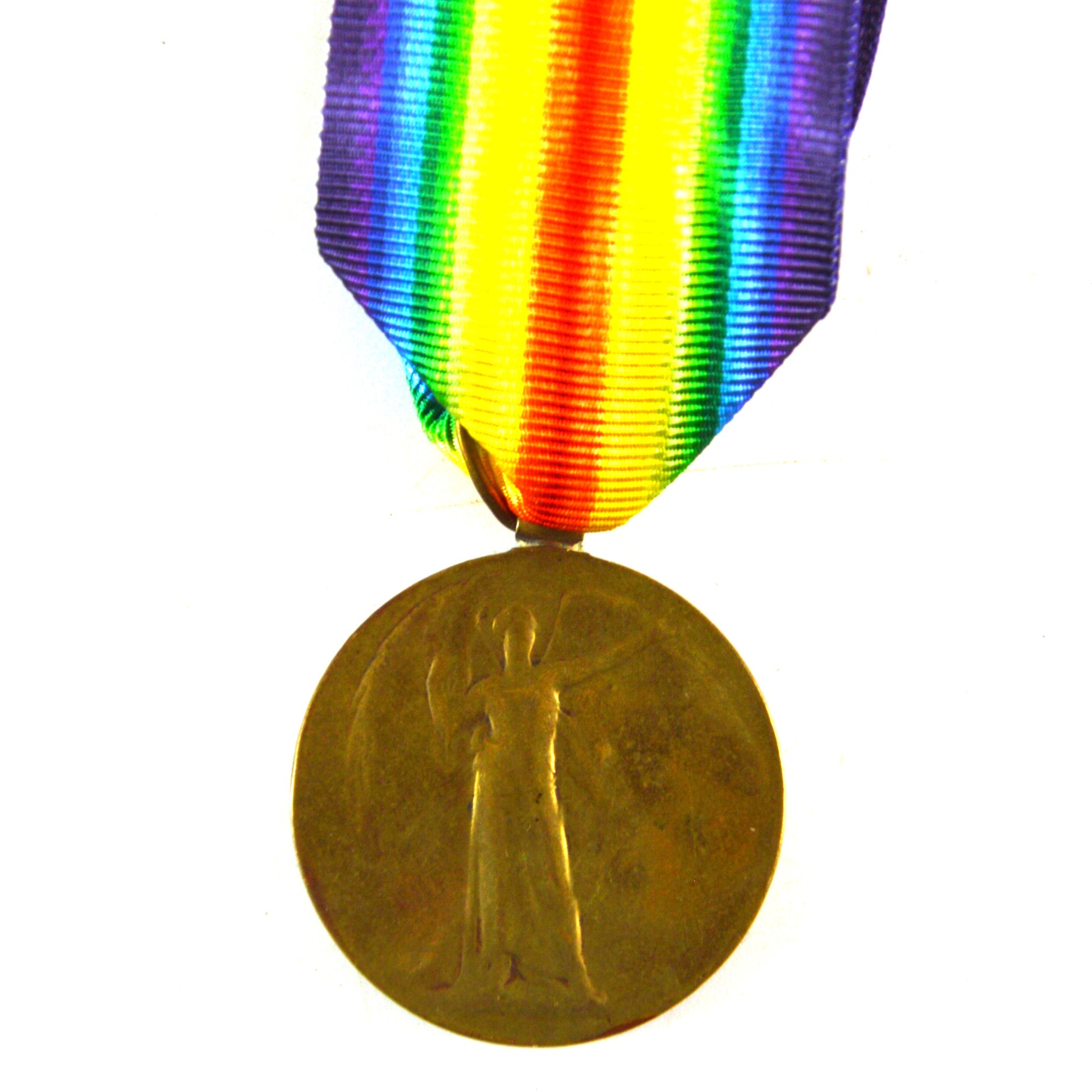
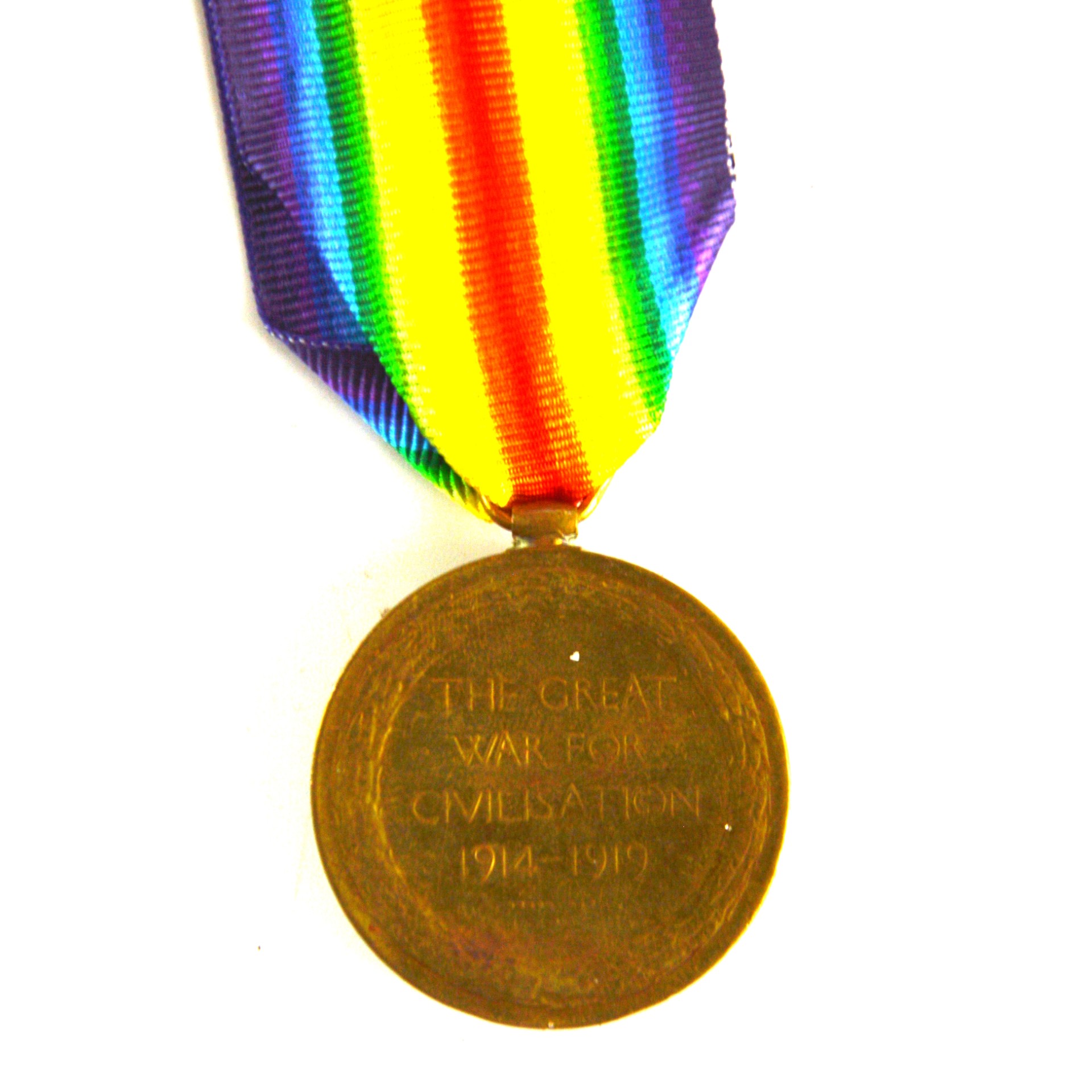
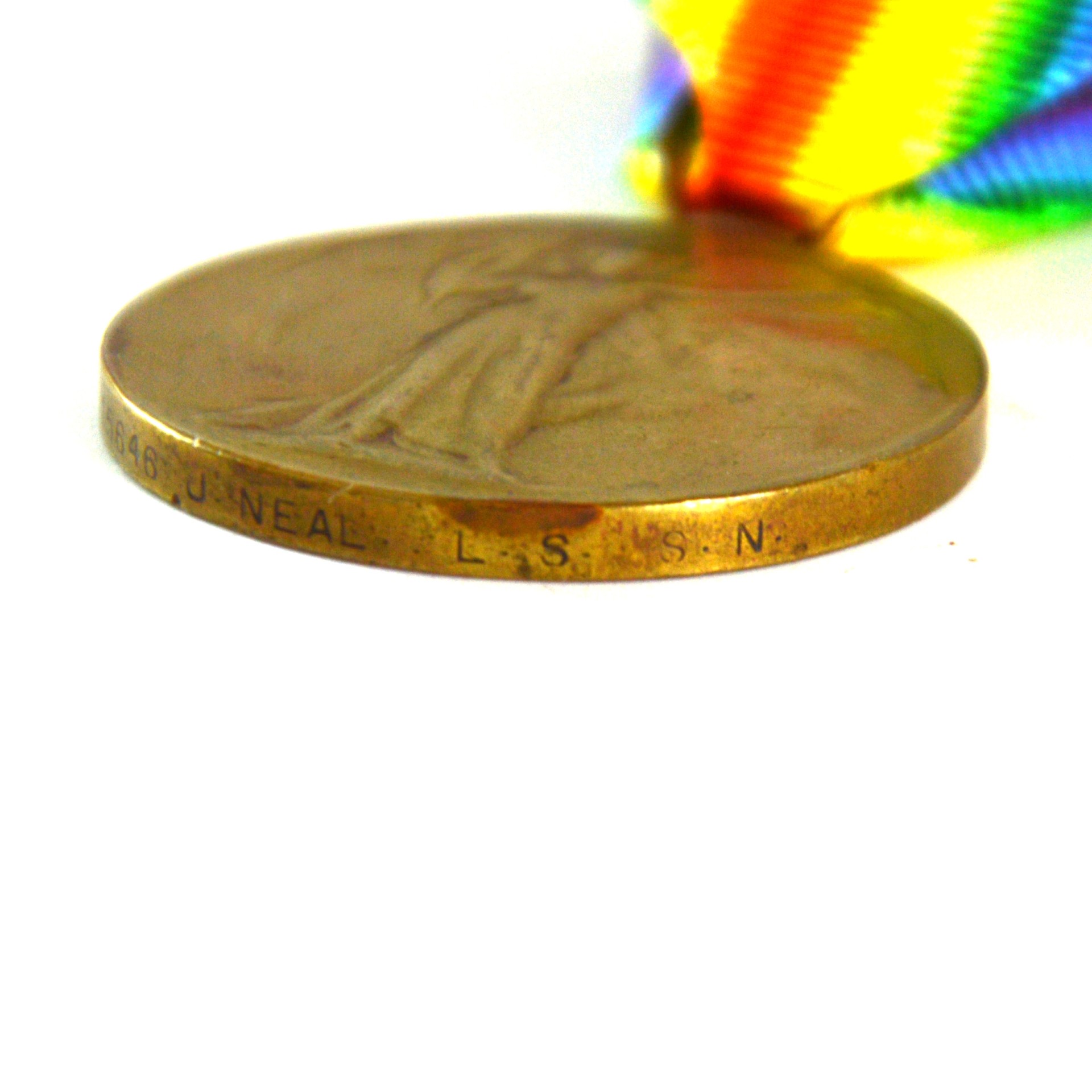
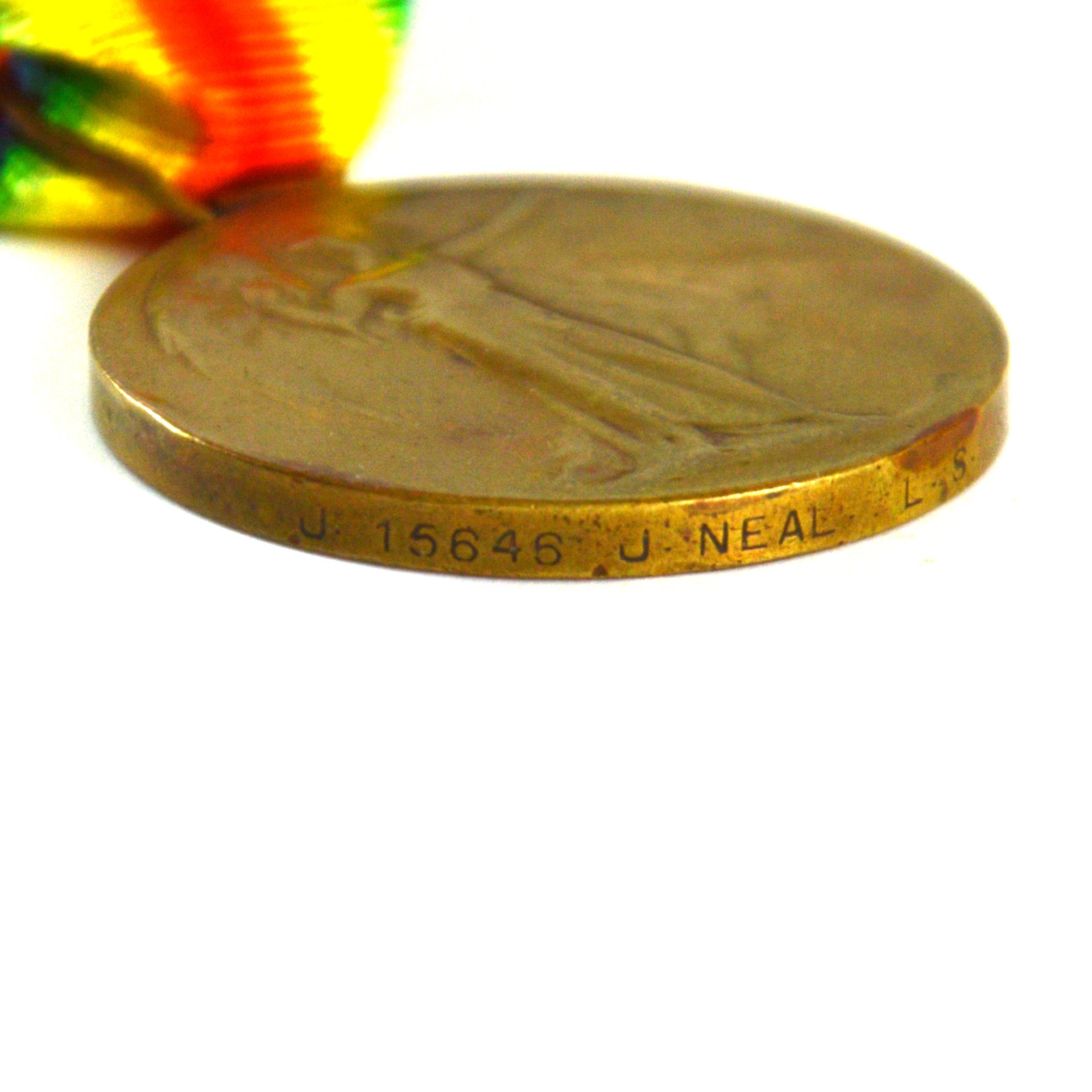
Victory Medal, Leading Seaman John Neal, Royal Navy
Born on the 29th of April, 1894, in Marylebone, London, and worked as a kitchen porter. He entered service in HMS Ganges II as Boy 2nd Class from the 15th of January 1912 until the 8th of April 1912. HMS Ganges II was used as an overflow ship as the number of boys in the establishment increased. He then transferred to the HMS Irresistible (1898), a Formidable-class pre-dreadnought battleship, on the 9th of April, 1912, and was promoted to Boy 1st Class on the 15th of April, 1912, and then to Ordinary Seaman on the 15th of July, 1912. He then served in the HMS Pembroke (Royal Naval Barracks, Chatham, or the Medina-class gunboat, formally named the HMS Trent) from the 25th of August, 1912, to the 6th of September, 1912. He then served on the HMS Vanguard, one of three St Vincent-class dreadnought battleships built for the Royal Navy in the first decade of the 20th century, from the 7th of September 1912 to the 15th of October 1913. This ship would take part in the Battle of Jutland and would be sunk in the attack at Scapa Flow. While serving on the HMS Vanguard, he was promoted to Able Seaman on the 14th of February, 1914. He then transferred to HMS Pembroke I, Royal Naval Barracks, Chatham, from the 31st of March to the 27th of July, 1914.
He then transferred to the HMS Actaeon II, a naval pay office, from the 28th of July 1914 to the 25th of January 1915, meaning he was serving here during the outbreak of the Great War. He returned to HMS Pembroke I, Royal Naval Barracks, Chatham, from the 26th of January to the 22nd of April, 1915, and transferred to the HMS Tyne, a depot ship for the 8th Flotilla, Sheerness, Kent, from the 23rd of April 1915 to the 11th of January, 1916. He then returned to HMS Pembroke I, Royal Naval Barracks, Chatham, from the 12th of January 1916 to the 14th of February 1916. He returned to the HMS Tyne II (presumably a shore establishment) on the 15th of February 1916 and was promoted to Leading Seaman on the 19th of January, 1918 and remained on the HMS Tyne until the 9th of February 1919.
He transferred to the HMS Ursula, a modified Admiralty R-class destroyer that served in the Home Fleet of the Royal Navy from the 10th of February to the 28th of February, 1919. He then served on HMS Prince George from the 1st of March to the 21st of October 1919, a Majestic-class pre-dreadnought battleship launched in 1895, which served as a depot ship at this time. His documents are relatively illegible until the 9th of December, 1919, when he served on the HMS Wanderer, an Admiralty-modified W-class destroyer built for the Royal Navy, where he received his 1914 Star and British War Medal. He would be promoted to Petty Officer on the 1st of November 1921. He returned to HMS Pembroke I, Royal Naval Barracks, Chatham, from the 16th of November to the 12th of December, 1921, then to HMS Pembroke I (Gannett) from the 13th of December 1921 to the 31st of March 1922. He then served on the HMS Erin, a dreadnought battleship of the Royal Navy, from the 1st of April 1922 to the 30th of April 1922, originally ordered by the Ottoman government from the British Vickers Company. He returned to the Chatham Royal Naval Barracks, HMS Pembroke I and II, from the 1st of May, 1922, to the 18th of September, 1922. He served on the Royal Navy C-class light cruiser HMS Ceres (D59) in the Mediterranean from the 19th of September, 1922, to the 19th of March, 1925. He then returned to HMS Pembroke I, Royal Naval Barracks, Chatham from the 20th of March to the 25th of May, 1925. From the 26th of May until the 16th of November 1925, he served on HMS Blenheim, a Blake-class first class protected cruiser in the Royal Navy which was in service from 1890 until 1926. From the 17th of November 1925 to the 19th of January 1926, he served on the HMS Ark Royal (1914), the first ship to be designed and built as a seaplane carrier – and was on reserve at the time. He returned to HMS Pembroke I, Royal Naval Barracks, Chatham, from the 20th of January to the 2nd of February, 1926. He served on HMS Dragon (D46), a D or Danae-class cruiser built for the Royal Navy from the 3rd of February 1926 to the 20th of December 1928. This ship later served under the Polish Navy and was scuttled on the 20th of July 1944. He then served at HMS Vivid I, a seamanship, signalling & telegraphy school in Devonport, from the 21st of December 1928 to the 3rd of May, 1929. He then served on HMS Defiance (1861) from the 4th of May 1929, the last wooden line-of-battle ship launched for the Royal Navy, which served as a school ship at the time.
He returned to HMS Vivid I from the 30th of March 1929 to the 5th of March 1930. He served in HMS Vindictive (1918) from the 6th of March to the 11th of May, 1930, while the HMS Vindictive was still on reserve. She was originally built for the Royal Navy during the First World War, designed as a Hawkins-class heavy cruiser, and laid down under the name “Cavendish”; she was converted to an aircraft carrier while still being built. Served on the HMS Petersfield from the 12th of May 1930 to the 14th of February 1931, used to tender the HMS Kent (54), a County-class heavy cruiser built for the Royal Navy in the late 1920s. HMS Petersfield ran aground on the night of Wednesday, 11th of November, 1931, on the north side of Tungyung Island while on a passage from Shanghai to Fuzhou; it was a total loss. He went on to serve on HMS Suffolk (55), a County-class heavy cruiser of the Royal Navy, Kent subclass, from the 15th of February 1931 to the 21st of May 1933, meaning he would have likely helped to rescue men from the Petersfield after it sank. He returned to HMS Vivid I on the 22nd of May 1933 to the 31st of December 1933, renamed HMS Drake, Fleet Accommodation Centre; on the 1st of January 1934, he would be pensioned on the 12th of May 1934.
He was remobilised on the HMS Drake I on the 28th of September 1938, around the time of the Sudeten Crisis, but was demobilised on the 2nd of October 1938.
Shortly after the outbreak of the Second World War, he served again on HMS Drake I, starting on the 16th of October, 1939. He served on the SS Edinburgh Castle from the 9th of January 1940, a Union-Castle Line steamship and refrigerated cargo carrier launched in 1910, moored at Freetown, Sierra Leone, to accommodate survivors from sunken ships. She was considered uneconomical to bring back to the UK after the war. Sunk as a target west of Freetown 25 Sep 1945
He was released from service on the 21st of October, 1945, aged 51 years old at the rank of Petty Officer
Correctly impressed: J. 15646. J. NEAL. L.S. S.N.
Condition: Acceptable, heavily polished