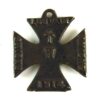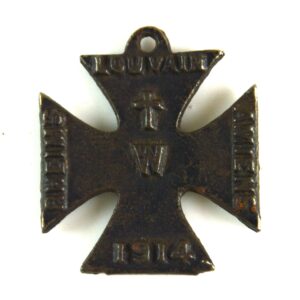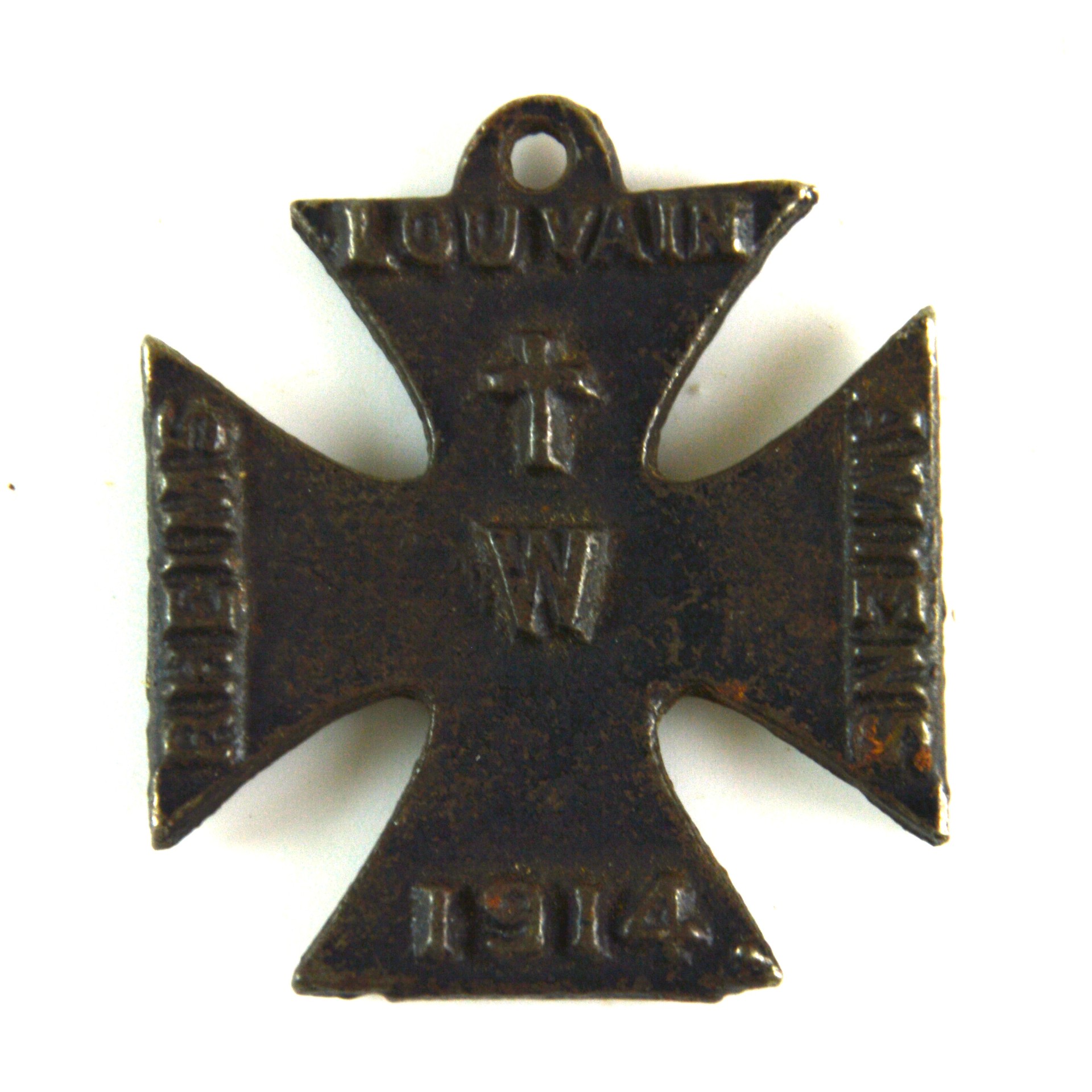
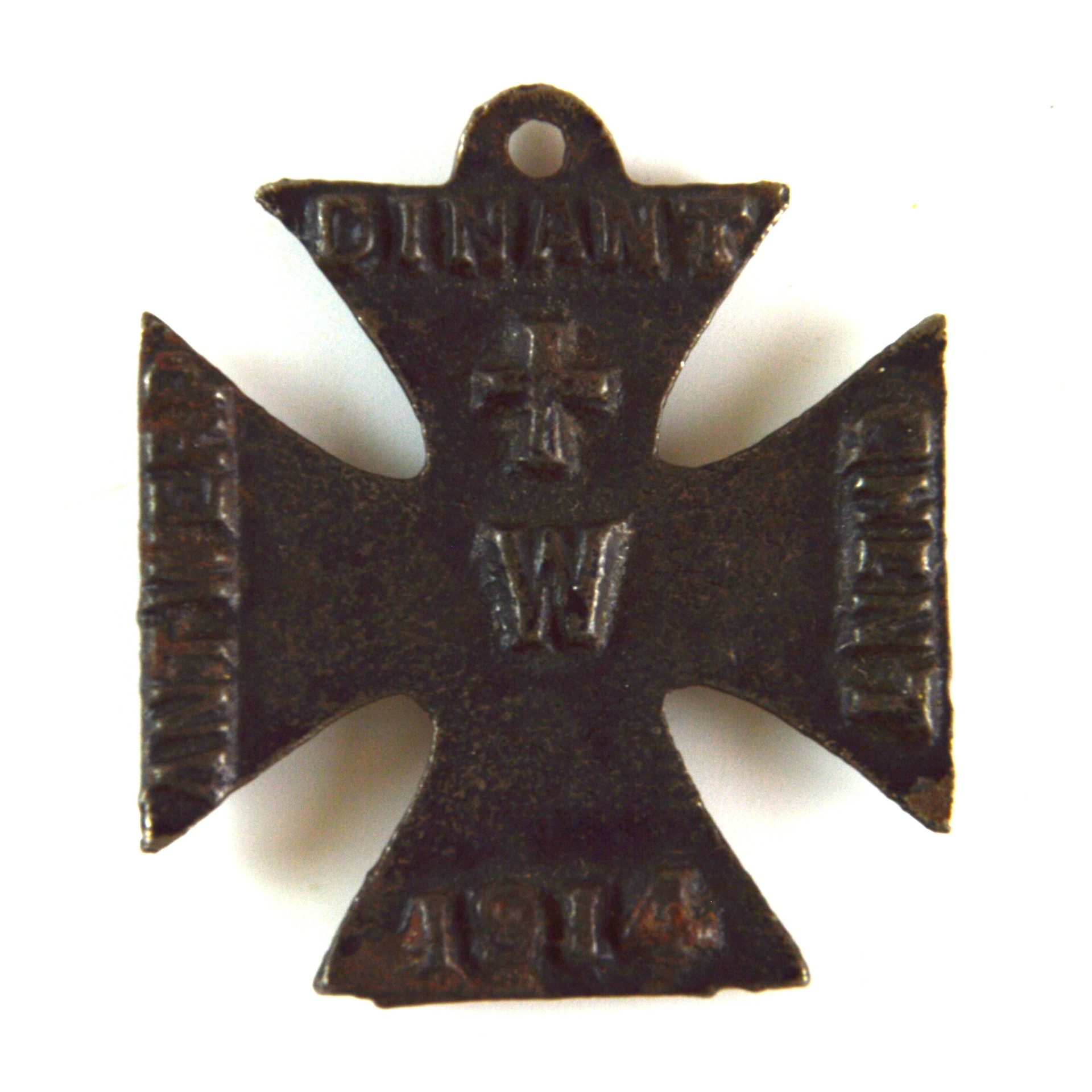
British First World War anti-German propaganda Iron Cross in crudely cast blackened iron, produced in Britain during the early war period of 1914 to 1915 as a commercially sold charitable fundraising item exploiting public outrage over reported German atrocities against the civilian populations of Belgium and northern France during the German western offensive of August to October 1914. This propaganda souvenir is formed in the shape of a cross pattée — the same form as the German Iron Cross military decoration — with a small suspension ring cast at the tip of the upper vertical arm, the device deliberately mimicking the appearance of the German decoration to mock the Imperial German Army by ironically attributing its “battle honours” not to military victories but to the destruction and massacre of civilian towns. The obverse face bears the initial “W” in embossed relief at the centre – for Kaiser Wilhelm II – surmounted by a small Latin cross, with the names of devastated towns inscribed at the tips of each arm: “DINANT” on the upper arm, “GHENT” on the right arm, “1914” on the lower arm, and “ANTWERP” on the left arm. The reverse face repeats the same central device of a Latin cross above the “W” monogram, with “LOUVAIN” on the upper arm, “AMIENS” on the right arm, “1914” on the lower arm, and “RHEIMS” on the left arm. The cross is crudely cast with a rough surface texture consistent with rapid wartime production.
The six towns named across the two faces of this cross were selected to represent the most widely reported acts of destruction carried out by German forces during the opening weeks of the war. The massacre at Dinant on 23 August 1914, in which German troops of the 3rd and 4th armies killed 674 Belgian civilians in reprisal for alleged civilian sniping — the single largest civilian massacre of the Western Front — was one of the first atrocity reports to reach the British press. The burning of Louvain between 25 and 30 August 1914, in which German forces destroyed the mediaeval library of the Catholic University of Leuven along with over 1,100 buildings and killed 248 civilians, became the most internationally condemned act of cultural destruction of the war, producing outrage across the neutral United States as well as in Britain and France. The bombardment and partial occupation of Rheims, Amiens, Antwerp, and Ghent followed in September and October 1914, each producing its own wave of British press coverage and public anger. The propaganda Iron Cross was produced to capitalise on this outrage, sold at a low price to raise funds for Belgian refugee relief and other wartime charities, and worn as a lapel or chain pendant to demonstrate public condemnation of German conduct. The IWM holds examples of this cross in its collection, catalogued as British Home Front anti-German propaganda of the 1914–1915 period.
Manufactured in cast iron with a blackened finish consistent with British wartime propaganda souvenir production of 1914 to 1915, this example provides an unaltered representation of the propaganda iron cross as sold and worn on the British Home Front during the earliest months of the First World War. British propaganda iron crosses of the Louvain and Dinant pattern are collected as examples of First World War British Home Front propaganda material, anti-German satirical souvenirs of the 1914 atrocity reports, and early-war civilian fundraising memorabilia of the Belgian refugee crisis.
Dimensions
Approx. 51mm x 43mm.
Condition
Good. With expected wear and minor corrosion