- Why Button Authentication Matters
- A Brief History of British Military Buttons
- 17th and 18th Century
- The Napoleonic Period (1799–1815)
- Victorian Era (1837–1901)
- 20th Century
- Anatomy of a Military Button
- Front Face
- Rim
- Back
- Shank
- How to Authenticate a Button
- Step 1: Examine the Back
- Step 2: Check the Maker’s Mark
- Step 3: Examine the Crown
- Step 4: Assess the Metal and Finish
- Step 5: Use Reference Books
- Common Fakes and Reproductions
- Cast Reproductions
- Re-strikes
- Ground-Dug Forgeries
- Fantasy Buttons
- Collecting by Period
- Georgian and Napoleonic Buttons (pre-1837)
- Victorian Buttons (1837–1901)
- Edwardian and World War I (1901–1918)
- World War II and Post-War (1939–present)
- Price Guide for Genuine Buttons
- Tips for New Collectors
- Specialist Collecting Areas
- Regimental Buttons of the British Army
- Naval and Marine Buttons
- Volunteer, Militia, and Territorial Force Buttons
- Button Backs: An Overlooked Authentication Tool
- Building a Research Library
- The Future of Button Collecting
Why Button Authentication Matters
British military buttons are among the most commonly discovered — and commonly misidentified — items in militaria collecting. Since the 17th century, every British regiment, corps, department, and colonial unit has worn distinctive buttons bearing regimental devices, numbers, or Royal cyphers. Today, these buttons turn up at metal-detecting rallies, in antique shops, at car boot sales, and on online auction sites. But how can you tell if a button is a genuine period piece or a later reproduction? [1]
The stakes are not trivial. A genuine Georgian-era officer’s button from a rare regiment can be worth £50–£200; an identical-looking reproduction is worth pennies. At the top end, pre-1855 buttons from disbanded regiments or colonial units can reach £300–£500. Authentication is therefore both a practical skill and a financial necessity for any serious collector.
A Brief History of British Military Buttons
17th and 18th Century
The earliest British military buttons were plain pewter or brass discs, sometimes bearing a regimental number stamped or engraved by hand. From the mid-18th century, buttons became more standardised, with cast or die-struck designs showing regimental devices. Officers’ buttons were typically gilt (gold-washed brass) or silver-plated; other ranks wore pewter or plain brass. [2]
The Napoleonic Period (1799–1815)
The Napoleonic era saw a proliferation of button designs as the army expanded rapidly. Militia, Fencible, and Volunteer buttons from this period are among the rarest and most sought-after. Designs became more elaborate, incorporating crowns, laurel wreaths, national emblems, and even battle honours.
Victorian Era (1837–1901)
The introduction of the Queen’s crown in 1837, replacing the King’s crown, provides an immediate dating aid. The Victorian era also saw the transition from flat-backed buttons (where the shank is soldered directly to a flat back) to the modern “brazed” construction with a separate backplate. The adoption of the Cardwell Reforms (1881) merged many regiments, creating new combined-arms buttons and rendering pre-1881 patterns obsolete — and therefore collectable. [1]
20th Century
World War I and II buttons are common survivors. The introduction of Staybrite (anodised aluminium) buttons from the 1950s provides a clear dividing line between traditional gilt and modern finishes. Post-1953 buttons bear Elizabeth II’s crown — the St Edward’s Crown — which differs from the Victorian and Georgian crowns in specific ways.
Anatomy of a Military Button
Front Face
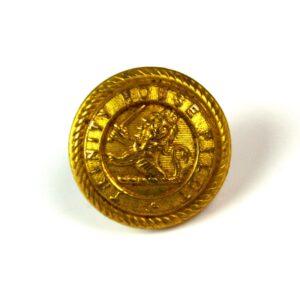
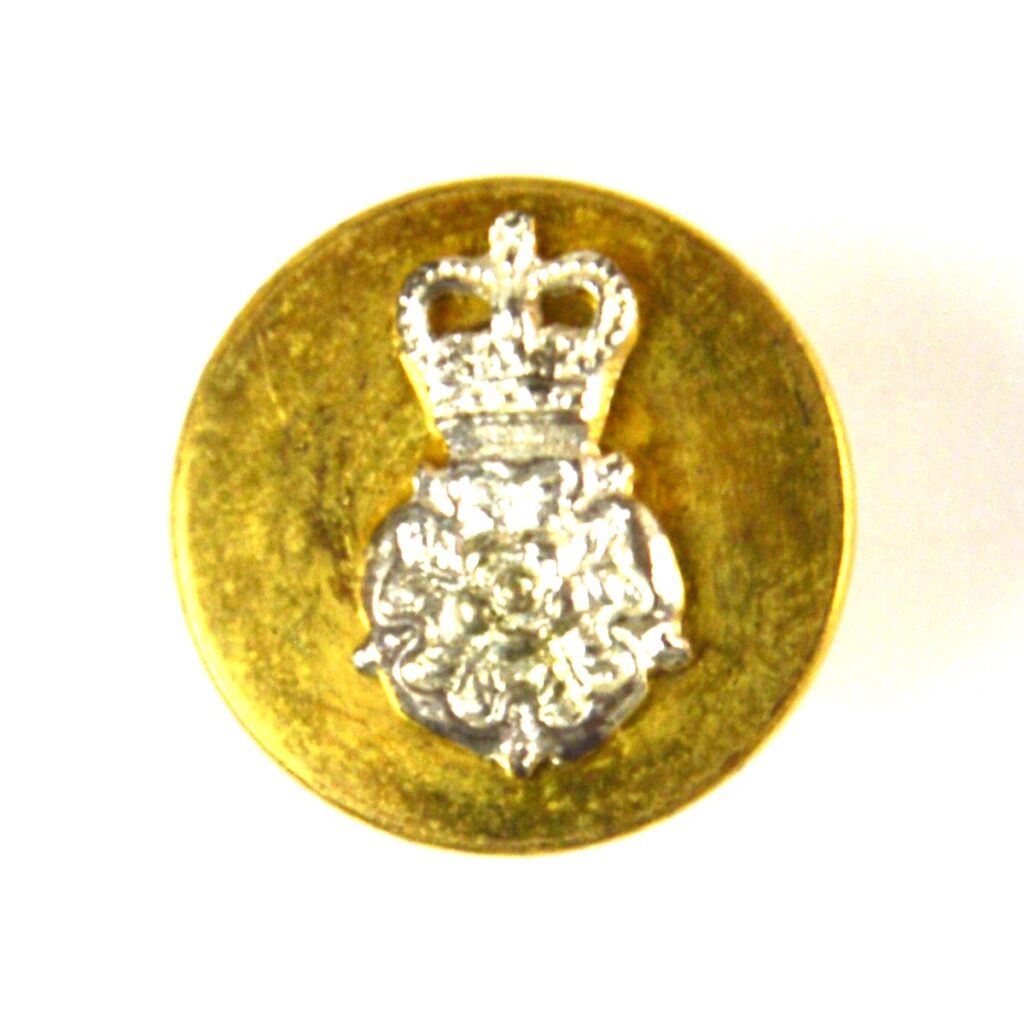
The face bears the regimental or corps device: this might be a number (e.g., “42” for the 42nd Foot / Black Watch), a badge (such as the Royal Artillery’s cannon and crown), a cypher (GR, VR, EIIR), or a combined device incorporating all of these. The design is raised (in relief) against a flat or textured background. [2]
Rim
Originally separate pieces, the rim and face were pressed together. Officers’ buttons often have a wider, higher rim than other ranks. The rim finish can indicate period and quality.
Back
The back is the most informative part of a button for authentication. It carries the maker’s mark (stamped into the backplate), construction details that indicate period, and wear patterns that indicate use. Understanding button backs is the single most important authentication skill. [1]
Shank
The shank (loop for sewing onto the garment) evolved over time. Early buttons have shanks soldered or cast as part of the button; later buttons have wire shanks inserted through a backplate. The shank style is a key dating indicator.
How to Authenticate a Button
Step 1: Examine the Back
Turn the button over immediately. A genuine period button’s back tells a story: [2]
- Flat back (pre-circa 1800): The shank is attached directly to a flat disc. These buttons often show file marks or hammer marks from manufacture. Genuine Georgian flat-backs have a rough, hand-finished quality.
- Convex back with maker’s mark (circa 1800–1855): Buttons from this period have a domed back with the manufacturer’s name stamped or impressed. Key makers include Firmin and Sons, Jennens and Co., Nutting and Sons, and numerous smaller firms. The makers mark should be clear and period-correct.
- Backplate and brazed construction (post-1855): A separate thin backplate is crimped over the button body. This is the standard construction through to the present day. Maker marks on the backplate identify the manufacturer and provide dating evidence.
Step 2: Check the Maker’s Mark
The maker’s mark is crucial. Known makers operated during specific date ranges. For example:
| Maker | Active Dates | Notes |
|---|---|---|
| Firmin and Sons | 1677 – present | The premier military button maker; many variants over 340+ years |
| Jennens and Co. | c.1800 – 1870s | Common Napoleonic-era maker |
| Nutting and Son | c.1800 – 1860s | London-based |
| Smith and Wright | c.1825 – 1870s | Birmingham |
| Buttons Ltd | 1900s – 1960s | Common 20th-century maker |
| Gaunt and Son | 1884 – present | High-quality military buttons |
| Pitt and Co. | c.1830 – 1880s | London |
A button bearing a “Firmin and Sons / 153 Strand” backmark dates to circa 1830–1855 (that was their address during that period). The specificity of maker addresses is an important dating tool. [1]
Step 3: Examine the Crown
If the button bears a Royal crown, its design immediately narrows the date range:
- Hanoverian crown (pre-1837): Flat-topped, with visible band of jewels
- Victorian / Queen’s crown (1837–1901): Arched appearance, with a distinctive cross pattee on top
- King’s crown / Tudor crown (1901–1952): Flat appearance, more geometric. Used by Edward VII, George V, Edward VIII, George VI
- St Edward’s crown (1952–present): Similar to King’s crown but with slight differences in arch and cross design
Step 4: Assess the Metal and Finish
Genuine period buttons display materials and finishes consistent with their era: [2]
- Pewter (18th century other ranks): Heavy, soft grey metal, often pitted
- Gilt brass (officers, all periods): Warm gold colour, often with wear showing brass beneath
- White metal / silver-plate (certain regiments): Bright silvery finish, tarnished with age
- Copper (certain period-specific types)
- Staybrite (post-1950s): Bright anodised aluminium, lightweight
Modern reproductions often use a bright, unnaturally shiny brass or a suspiciously uniform “aged” finish. The weight, feel, and colour of authentic period metals are distinctive and become familiar with handling experience.
Step 5: Use Reference Books
Cross-reference the button against published references. Essential works include:
- Howard Ripley’s Buttons of the British Army 1855–1970 — the standard reference for post-Crimean buttons
- Parkyn’s Shoulder Belt Plates and Buttons — the classic reference for earlier periods
- Ray Westlake’s Collecting Metal Shoulder Titles — useful cross-reference for later periods
- Brian Robson’s works — covering dress regulations in context
Common Fakes and Reproductions
Cast Reproductions
The most common fakes are made by casting from original buttons. Cast copies can be identified by: [1]
- Slightly soft or “mushy” detail compared to die-struck originals
- Casting pits or porosity visible under magnification
- Incorrect weight (cast copies are often lighter)
- Mismatched back (modern backplate on period-style front)
- No maker’s mark, or an unconvincingly shallow mark
Re-strikes
Some buttons have been re-struck from original dies that survived into the modern era. These are harder to detect but may show: incorrect metal colour or alloy, modern solder, or back construction inconsistent with the period suggested by the front design.
Ground-Dug Forgeries
An increasingly common trick involves burying modern reproductions in acidic soil for several months to create artificial patina and “ground dug” appearance. These can be detected by experienced collectors: genuine ground-dug buttons show consistent corrosion patterns, while artificially aged buttons often have suspiciously even patina. [2]
Fantasy Buttons
Some reproductions depict units or designs that never actually existed. These are typically produced for the re-enactment market and are not intended to deceive, but they can confuse inexperienced buyers who mistake them for genuine items from obscure units. Always verify that a button’s design matches published references for the alleged unit.
Collecting by Period
Georgian and Napoleonic Buttons (pre-1837)
The earliest and rarest. Metal-detectorists find Georgian buttons regularly, but they are often in poor condition. Clean, identifiable examples with clear regimental devices are highly sought after. Militia and volunteer buttons from the Napoleonic emergency are particularly prized. [1]
Victorian Buttons (1837–1901)
The golden age of button collecting. The Cardwell Reforms of 1881 created a dividing line: pre-1881 numbered regiment buttons versus post-1881 territorial regiment buttons. Many collectors focus exclusively on this transition period.
Edwardian and World War I (1901–1918)
Common and affordable — an excellent starting point for new collectors. Kitchener’s New Army battalions of 1914–1916 created enormous numbers of buttons, many from units that existed for only a few years.
World War II and Post-War (1939–present)
The most affordable period, with most buttons available for a few pounds. Specialist collectors focus on wartime-specific units, Women’s services, and Commonwealth forces.
Price Guide for Genuine Buttons
| Period / Type | Common Regiment | Rare Regiment |
|---|---|---|
| Georgian officer gilt (pre-1830) | £30 – £80 | £100 – £200+ |
| Georgian other ranks pewter | £15 – £40 | £60 – £120 |
| Napoleonic Militia/Volunteer | £20 – £60 | £100 – £500+ |
| Victorian officer gilt | £10 – £30 | £50 – £100 |
| Victorian other ranks brass | £3 – £10 | £15 – £30 |
| Edwardian – WW1 brass | £2 – £8 | £10 – £25 |
| WW2 and post-war | £1 – £5 | £5 – £15 |
Tips for New Collectors
Start with what you can verify. Buy a reference book before you buy a button. Handle as many genuine buttons as possible — attend militaria fairs, visit museum collections, and join the Military Historical Society, which has members with deep expertise in buttons and insignia. The cost of a wrong purchase is usually small — a few pounds — but cultivating expertise will save money in the long run and make collecting far more rewarding. [1]
Consider specialising early: by regiment, by period, by maker, or by type (officers vs other ranks). A focused collection with a clear theme is more satisfying and more valuable than a random accumulation. Join online forums and social media groups where experienced collectors share identifications, discuss fakes, and offer pieces for sale. The British button-collecting community is welcoming and generous with knowledge.
Specialist Collecting Areas
While some collectors aim for a broad survey of military buttons, others focus on specific sub-categories that offer particular depth and challenge. These specialist areas include:
Regimental Buttons of the British Army
The line infantry regiments of the British Army each had their own distinctive button designs, and these changed with every major restructuring — providing a rich field for the specialist. The Childers Reforms of 1881, which amalgamated numbered regiments into territorial county regiments, produced an entirely new set of button designs. Collectors of regimental buttons can therefore distinguish between the pre-1881 numbered regiment patterns and the post-1881 territorial patterns, as well as the many variations within each period. [1]
The Guards regiments present a particularly elegant collecting area. The five regiments of Foot Guards (Grenadier, Coldstream, Scots, Irish, and Welsh) are distinguished by the spacing of their tunic buttons — singles, pairs, threes, fours, and fives respectively — but the buttons themselves also differ. Each regiment uses the Royal cypher surrounded by a specific arrangement of elements: the Grenadier Guards use a grenade, the Coldstream a Garter star, and so on. Variations across reign periods (Victoria, Edward VII, George V, George VI, Elizabeth II, Charles III) multiply the possibilities. [1]
Naval and Marine Buttons
Royal Navy buttons have their own distinct history. The standard naval button bears a fouled anchor surmounted by the crown, but variations exist for specific branches, ranks, and establishments. Royal Marines buttons — bearing the globe and laurel wreath — are a popular sub-category, with distinct patterns for the Royal Marines Light Infantry (RMLI) and the Royal Marine Artillery (RMA) before their merger in 1923. [2]
Merchant Navy and shipping line buttons form an overlapping collecting area. Many shipping companies produced distinctive buttons bearing their house flag or company cipher, and these can be found at general militaria fairs at modest prices. The great liner companies — Cunard, White Star, P&O, Union-Castle — produced particularly attractive designs. [2]
Volunteer, Militia, and Territorial Force Buttons
The 19th-century Volunteer movement produced an extraordinary profusion of button designs. Each Volunteer Rifle Corps, Artillery Volunteer unit, and Engineer Volunteer company adopted its own button, frequently incorporating the county coat of arms or local civic symbols. Many of these units were short-lived, and their buttons survive in very small numbers — making them highly sought after by specialist collectors. [2]
The Territorial Force (established 1908) and its successor, the Territorial Army (1921), introduced further patterns. TF buttons often combine the parent regiment’s design with a “T” marking, while some territorial battalions adopted entirely distinctive designs. The complexity of TF and TA button patterns is such that no complete reference work yet covers the entire field. [2]
Button Backs: An Overlooked Authentication Tool
Experienced collectors pay as much attention to the reverse of a button as to its face. Button backs carry maker’s marks, patent numbers, and construction details that are among the most reliable indicators of date and genuineness. Key features include:
- Backmark type: Cast marks (“FIRMIN & SONS LONDON”), stamped marks, or paper/card inserts behind the face plate
- Shank style: The attachment loop evolved from hand-soldered wire shanks (pre-1830) to machine-attached Alpha-type shanks (post-1870s) to modern screw-back fittings. The shank style alone can narrow the date to within a decade or two.
- Construction method: Two-piece construction (a die-struck face plate crimped onto a back plate) became standard from the 1830s. Earlier one-piece cast buttons are heavier and have a distinctly different feel.
- Sanders patent: Aaron Sanders patented an improved two-piece button in 1855 — buttons bearing “SANDERS” on the back post-date this patent and are mid-Victorian or later.
Reproductions frequently fail at the back: modern casting alloys, wrong shank types, anachronistic backmarks, or suspiciously clean and unworn backs are all red flags. Always examine the back carefully before purchasing. [3]
Building a Research Library
The serious button collector benefits enormously from a good reference library. Essential works include:
- British Military Buttons by Howard Ripley — the standard modern reference, covering hundreds of patterns with detailed photographs
- Buttons of the British Army 1855–1970 by Howard Ripley — companion volume covering the later period
- Button Rebacked by David Hartill — focuses on button construction and back marks
- The Military Historical Society publications — regular articles on buttons appear in the Society’s journals
Online resources have expanded rapidly. Specialist forums, auction archives (particularly those of Bosleys, Dix Noonan Webb, and Warwick & Warwick), and dedicated button-collecting websites provide thousands of reference photographs. Building a personal photographic archive of verified genuine examples is one of the best investments a collector can make. [3]
The Future of Button Collecting
Military button collecting is experiencing a quiet renaissance. A new generation of collectors, attracted by the accessibility, affordability, and research potential of buttons, is entering the field — often through metal detecting, which produces a steady stream of military buttons from former camp sites, training grounds, and battlefields. Metal-detected buttons, even when in poor condition, can provide valuable research data about the units that were present at a specific location. [3]
The growth of online communities has transformed the way button collectors share knowledge. Specialised forums, Facebook groups, and Instagram accounts dedicated to military buttons provide instant access to thousands of reference photographs and the collective expertise of hundreds of fellow enthusiasts. A button that might have puzzled a collector for years can now be identified within hours by posting a clear photograph to the right online group. This democratisation of expertise has made the hobby more accessible than ever before. [3]
For new collectors considering military buttons as a collecting area, the advice is simple: start with what interests you, buy the book before the button, and never stop asking questions. Buttons are among the most affordable categories of military collectible — a genuine Victorian regimental button can be acquired for less than the price of a cup of coffee — but the knowledge and research they inspire is priceless. Each button, however small and seemingly insignificant, represents a soldier, a regiment, a period of history, and a story waiting to be told. [3]
Frequently Asked Questions
How do I identify old military buttons?
Examine the button face for regimental devices, the back for maker marks (Firmin, Jennens, etc.), the shank style (hand-soldered wire pre-1830, machine-attached Alpha post-1870s), and construction method (one-piece cast or two-piece die-struck). The back often reveals more than the front.
What are military buttons worth?
Common Victorian brass regimental buttons sell for £3–£15. Scarcer patterns — volunteer, militia, or short-lived units — can reach £20–£80. Rare pre-1855 or silver officer buttons command £50–£200+. Most military buttons remain highly affordable for new collectors.
How can I spot a fake military button?
Reproductions often use modern casting alloys (wrong weight and colour), incorrect shank types for the claimed period, anachronistic backmarks, or suspiciously clean and unworn backs. Compare against verified genuine examples in reference books or specialist forums.
What reference books cover military buttons?
The standard references are "British Military Buttons" and "Buttons of the British Army 1855–1970" by Howard Ripley. For construction details, "Button Rebacked" by David Hartill is essential. The Military Historical Society journals also publish regular articles.
Sources & References
- Ripley, H. — *Buttons of the British Army 1855–1970* (1971)
- Squire, G. — *Buttons: A Guide for Collectors* (1972)
- Parkyn, H.G. — *Shoulder-Belt Plates and Buttons* (1956)

Related Items in Our Collection8 items