Per Mare, Per Terram
The Royal Marines are Britain’s commando force — amphibious infantry capable of operating in the most demanding environments on Earth, from the Arctic to the jungle. Founded in 1664 as the Duke of York and Albany’s Maritime Regiment of Foot, the Royal Marines have fought in virtually every British conflict for over 350 years. Their dual identity — soldiers who serve at sea — makes Royal Marines militaria uniquely interesting to collectors, combining naval and military traditions in distinctive ways.
Historical Overview
Foundation and Early Service (1664–1800)
Marines were first raised in 1664, disbanded, and re-raised several times before being permanently established in 1755. Their role was to provide shipboard firepower (fighting from the tops in sailing ship actions), to form landing parties, and to maintain discipline aboard ship. During the American War of Independence and the Revolutionary and Napoleonic Wars, marines were present on every major warship.
The Napoleonic Era
By 1805, the Corps comprised the Royal Marines (infantry) and the Royal Marine Artillery (RMA), the latter crewing the bomb vessels and providing specialist gunnery. Marines served at Trafalgar — they fired the musketry that swept the decks of enemy ships during boarding actions. Nelson was fatally shot by a French marine firing from the rigging of the Redoutable.
Victorian Campaigns
Royal Marines served in the Crimea (including the naval brigade ashore at Sevastopol), the Indian Mutiny, China Wars, Egypt, and numerous colonial expeditions. The Victorian period also saw the amalgamation of the Royal Marine Light Infantry (RMLI) and Royal Marine Artillery (RMA) into a single Corps in 1923.
World War I
The Royal Marines’ most dramatic WWI contribution was the Zeebrugge Raid (23 April 1918) — a daring attack on the German-occupied Belgian port to block the canal exit used by U-boats. The 4th Battalion RM stormed the heavily defended mole under intense fire. The raid won two VCs for the Marines. Marines also served at Gallipoli (the Royal Naval Division included RM battalions), Jutland (manning gun turrets), and on the Western Front in the Royal Naval Division.
World War II
WWII transformed the Royal Marines. Commando training was adopted, and RM Commandos fought with distinction:
- Dieppe (1942): 40 RM Commando in the disastrous raid, suffering heavy casualties.
- D-Day (6 June 1944): 41, 46, 47, and 48 RM Commandos landed on D-Day itself, fighting their way inland from Sword and Juno beaches.
- Walcheren (1944): 41 and 48 RM Commando assaulted the heavily fortified island guarding the Scheldt estuary — one of the fiercest amphibious operations of the war.
- Burma: 42 and 44 RM Commando served in the Arakan campaign and the assault on Akyab.
Post-War to Present
Post-war, the Royal Marines became Britain’s specialist amphibious and cold-weather warfare force:
- Korea (1950–53): 41 Independent Commando RM fought alongside US Marines at Chosin Reservoir.
- Suez (1956): 40 and 42 Commando conducted the UK’s first helicopter-borne assault at Port Said.
- Aden/Borneo (1960s): Jungle and urban operations.
- Northern Ireland (1969–2007): Multiple tours.
- Falklands (1982): 40, 42, and 45 Commando yomped and fought their way across East Falkland — 42 Commando took Mount Harriet, 45 Commando took Two Sisters. The Mountain and Arctic Warfare Cadre fought the legendary action at Top Malo House.
- Iraq (2003): 3 Commando Brigade spearheaded the assault on the al-Faw peninsula.
- Afghanistan (2001–2014): Repeated Helmand tours.
Organisation
Today the Royal Marines comprise 3 Commando Brigade:
- 40 Commando RM — Norton Manor Camp, Taunton
- 42 Commando RM — Bickleigh, Plymouth
- 45 Commando RM — RM Condor, Arbroath (Scotland)
- Commando Logistic Regiment RM
- 30 Commando IX Group RM — Information exploitation
- 1 Assault Group RM — Landing craft and maritime operations
- Special Boat Service (SBS) — Tier 1 special forces, part of UKSF
All ranks undergo the All Arms Commando Course (AACC) at the Commando Training Centre Royal Marines (CTCRM), Lympstone, Devon — one of the longest and toughest basic training courses in the world (32 weeks).
Collecting Royal Marines Militaria
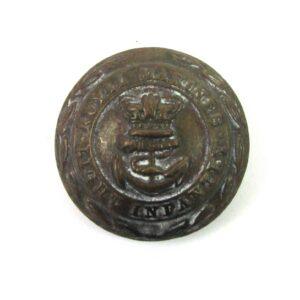
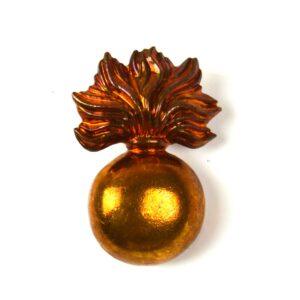
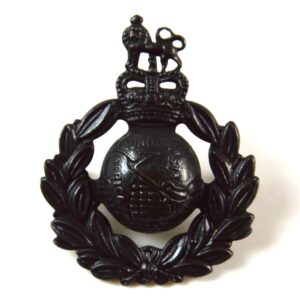
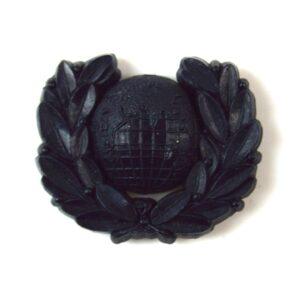
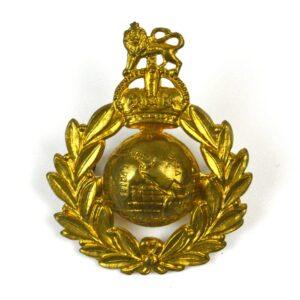
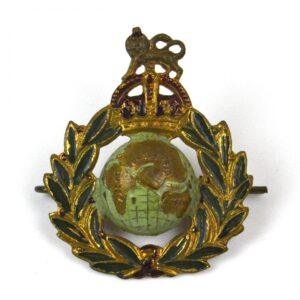
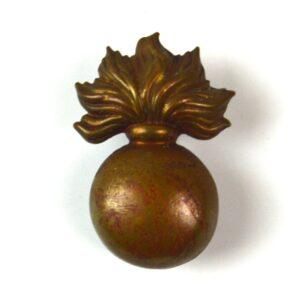
Cap Badges and Insignia
| Badge Type | Approximate Price Range (2026) |
|---|---|
| RMLI cap badge (Victorian/Edwardian) | £40–£120 |
| RMA cap badge (pre-1923) | £50–£150 |
| King’s Crown RM badge (1923–1952) | £20–£60 |
| Queen’s Crown RM badge (1952–2022) | £15–£40 |
| King’s Crown RM badge (2022–present) | £10–£30 |
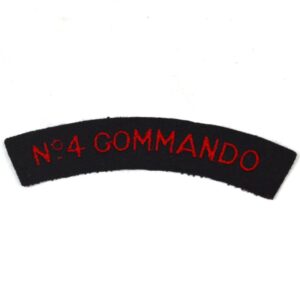
| RM Commando shoulder title (WWII) | £30–£80 |
| Green beret (issued example) | £30–£80 |
| Commando dagger cloth badge | £10–£30 |
The Green Beret
The green beret is the most iconic symbol of the Royal Marines and the wider commando family. Adopted in 1942, it was personally authorised by Lord Mountbatten. Only those who pass the commando course are entitled to wear it. Genuine WWII-era green berets are uncommon and command good prices (£80–£200). Post-war examples are more readily available.
Medals
- Pre-1914 RM groups: Groups to China Wars, Egypt, Boer War campaigns — £200–£1,000+.
- WWI Zeebrugge: Groups confirmed to the Zeebrugge Raid carry a significant premium — £500–£2,000 for other ranks, substantially more for gallantry awards.
- WWII Commando groups: A WWII group to a named RM Commando, especially with a D-Day or Walcheren connection — £300–£1,000.
- Falklands SAM to RM: £3,000–£8,000 depending on unit.
- Gallantry awards (MC/MM/DSO to RM): £2,000–£20,000+.
Equipment
- Fairbairn-Sykes commando dagger: The iconic FS fighting knife is synonymous with commando forces. WWII 1st/2nd/3rd pattern daggers: £200–£800. Post-war: £50–£150.
- Commando toggle rope: A short rope with loop and toggle, used for river crossings and climbing. WWII: £30–£80.
- Landing craft items: Compasses, instruments, nameplates from landing craft — niche but historically rich.
Documents and Ephemera
RM service certificates, commando course certificates, group photographs, and ship/unit magazines all have collector value. Original WWII commando training documentation — detailing the revolutionary commando course syllabus — is particularly prized by military historians.
Frequently Asked Questions
What Royal Marines collectables are most sought after?
WWII Commando items (Fairbairn-Sykes daggers, green berets, Commando shoulder titles), Falklands SAM groups (u00a33,000-u00a38,000), Zeebrugge-confirmed WWI medals, and Victorian RMLI/RMA cap badges.
How do I identify Royal Marines items?
Look for the Globe and Laurel badge (the RM emblem since 1827), RMLI/RMA markings on pre-1923 items, and the distinctive green beret post-1942. Service numbers and RM/PLY/PO/CH (Plymouth/Portsmouth/Chatham) divisional markings help date and attribute items.
Sources & References
- Thompson, J., The Royal Marines
- Ladd, J., Royal Marine Commando
- Brooks, R., The Royal Marines 1664 to the Present

Related Items in Our Collection8 items