- Introduction
- The Five Regiments of Foot Guards
- Origins: The English Civil War and Restoration
- The Napoleonic Wars
- The Crimean War and Victorian Campaigns
- World War I: The Guards Division
- World War II: The Guards Armoured Division
- Post-War Service
- Cap Badges and Insignia
- The Bearskin
- Ceremonial Duties
- Collector’s Corner: Guards Militaria
- The Guards Today
- Sources
- Introduction
- The Five Regiments of Foot Guards
- Origins: The English Civil War and Restoration
- The Napoleonic Wars
- The Crimean War and Victorian Campaigns
- World War I: The Guards Division
- World War II: The Guards Armoured Division
- Post-War Service
- Cap Badges and Insignia
- The Bearskin
- Ceremonial Duties
- Collector’s Corner: Guards Militaria
- The Guards Today
- Sources
Introduction
The Household Division’s infantry component — the five regiments of Foot Guards — is among the most recognisable military forces in the world. Famous for their ceremonial duties at Buckingham Palace, their tall bearskin caps, and their scarlet tunics, they are also formidable fighting soldiers with a combat record stretching from the English Civil War to Afghanistan. [1]
The Guards represent one of the oldest continuous military traditions in the English-speaking world. The Scots Guards trace their origins to 1642, the Coldstream Guards to 1650, and the Grenadier Guards to 1656. The Irish Guards were raised in 1900 and the Welsh Guards in 1915 — yet even the “youngest” regiment has now served for over a century across two world wars and every significant British deployment since. [2]
The Five Regiments of Foot Guards
| Regiment | Founded | Button Spacing | Plume | Motto |
|---|---|---|---|---|
| Grenadier Guards | 1656 | Evenly spaced | White (left) | Honi soit qui mal y pense |
| Coldstream Guards | 1650 | Pairs | Red (right) | Nulli Secundus |
| Scots Guards | 1642 | Threes | None | Nemo me impune lacessit |
| Irish Guards | 1900 | Fours | Blue (right) | Quis separabit? |
| Welsh Guards | 1915 | Fives | White-green-white (left) | Cymru am byth |
The button spacing rule is the classic method for identifying which regiment a Guardsman belongs to — and an essential tip for collectors examining tunics, greatcoats and mess dress. Officers’ buttons are gilt; other ranks’ were historically brass, now anodised aluminium. [1]
Origins: The English Civil War and Restoration
The oldest Foot Guards regiments were forged in the upheavals of the 17th century. The Scots Guards trace their lineage to 1642, when they were raised by the Marquess of Argyll as the Marquess of Argyll’s Royal Regiment — making them the senior regiment by date of formation, though precedence within the Guards follows a different convention. They received the title “Scots Guards” in 1877. [2]
The Coldstream Guards were originally raised by General George Monck in 1650 as part of Cromwell’s New Model Army. In January 1660, Monck marched his regiment from Coldstream on the Scottish border to London, playing a decisive role in the Restoration of Charles II. The regiment’s motto — Nulli Secundus (“Second to None”) — is a pointed refusal to accept the designation “Second” Guards, reflecting a seniority dispute with the Grenadiers that has been a source of good-natured rivalry for over 370 years. [1]
The Grenadier Guards (originally the Royal Regiment of Guards) were formed in 1656 to protect the exiled Charles II in Bruges. Upon the Restoration they became the senior regiment of foot guards by royal decree — a ranking the Coldstream has never formally accepted. [2]
The Irish Guards were raised on 1 April 1900 by order of Queen Victoria, to commemorate the valour of Irish soldiers in the Boer War. Rudyard Kipling wrote the regimental history of the Irish Guards in the Great War, drawing on his grief after his son John was killed serving with the regiment at the Battle of Loos in 1915. [3]
The Welsh Guards, the youngest regiment, were created on 26 February 1915 — the only Foot Guards regiment raised during wartime. Their formation ensured that Wales, like England, Scotland, and Ireland, had its own Guards regiment. Within months of formation, the 1st Battalion was in the trenches on the Western Front. [2]
The Napoleonic Wars
The Guards earned lasting fame at Waterloo (18 June 1815). The Grenadier Guards defeated the French Grenadiers of Napoleon’s Imperial Guard in the climactic attack of the battle — the moment when Wellington reportedly raised his hat as the signal for a general advance. The victory earned the regiment the right to the bearskin cap and the title “Grenadier.” [4]
The Coldstream and Scots Guards held the critical position at Hougoumont farmhouse for an entire day against repeated French attacks. The closing of the north gate of Hougoumont by a small party led by Lieutenant Colonel James Macdonell of the Coldstream Guards — with French soldiers physically inside the courtyard — is one of the most famous small-unit actions in military history. Wellington himself later said that “the success of the battle turned upon the closing of the gates of Hougoumont.” [4]
The defence cost the Guards brigade dearly — the Coldstream alone lost over 300 men killed and wounded at Hougoumont. But the action defined the Guards’ reputation for tenacious defence that has characterised the regiments ever since.
The Crimean War and Victorian Campaigns
The Guards Brigade fought at the Alma (1854), Inkerman (1854), and the Siege of Sevastopol. At Inkerman — the “Soldiers’ Battle,” fought in dense fog that negated generalship — the Guards held the critical Sandbag Battery against overwhelming Russian numbers in close-quarter fighting with bayonet and butt. The Coldstream Guards lost 190 men killed and wounded in a single morning. [2]
After the Crimea, Guards battalions served in Egypt (1882), including the Battle of Tel el-Kebir — a dawn assault that routed Urabi Pasha’s forces in under an hour — and in the Sudan campaigns. The Guards’ consistent presence in Britain’s 19th-century campaigns ensured that the regimental traditions of discipline and bearing under fire were continuously refreshed by operational experience.
World War I: The Guards Division
The Guards Division was formed in August 1915, comprising battalions from all five Foot Guards regiments — the newly raised Welsh Guards joining their four senior partners. The Division was assigned the distinctive “Ever Open Eye” formation sign — a blue eye on a white background — symbolising perpetual vigilance. [3]
The Division fought at Loos (September 1915), where it was committed to exploit a breakthrough that had already stalled, and suffered 4,000 casualties in its first major action. On the Somme (1916), the Guards attacked at Flers-Courcelette and Morval in fighting that epitomised the grinding attritional warfare of the Western Front. At Passchendaele (1917), the Division attacked across the waterlogged moonscape of Flanders. At **Cambrai** (1917), the Guards helped exploit the initial success of the first mass tank attack in history. [3]
The Division sustained over 16,000 casualties during the war. Guards NCOs and officers also served as training cadre for the rapidly expanding Kitchener armies — their standards of drill and discipline disseminated across the entire wartime army. The 3rd Battalion Coldstream Guards lost 22 officers and 560 other ranks killed during the war — a testament to the price the Guards paid. [2]
World War II: The Guards Armoured Division
In 1941, the Guards Armoured Division was formed — an unusual step for infantry regiments, converting Guardsmen to tank crews. After landing in Normandy shortly after D-Day, it fought through France, Belgium and the Netherlands. [5]
The Division’s most famous action was during Operation Market Garden (September 1944), when the Irish Guards Group led XXX Corps up a single highway toward Arnhem — a story immortalised in Cornelius Ryan’s A Bridge Too Far and the 1977 film of the same name. At Nijmegen, the Grenadier Guards captured the vital road bridge in a daring assault, crossing the Waal River in canvas boats under murderous fire, while the Irish Guards fought their way up the highway from the south. The advance ultimately stalled short of Arnhem — the “bridge too far.” [5]
The 6th Guards Tank Brigade served in the Italian campaign, while infantry battalions of the Guards fought throughout North-West Europe. Paddy Mayne‘s SAS recruited heavily from the Guards; G Squadron, 22 SAS, was later formed from the Guards Independent Parachute Company.
Post-War Service
The Guards have served in every significant British deployment since 1945: Malaya, Cyprus, Aden, Northern Ireland (where Guards battalions conducted numerous emergency tours through three decades of the Troubles), the Falklands, Iraq, and Afghanistan. [2]
In the Falklands (1982), the Scots Guards fought the savage night battle for Mount Tumbledown — one of the last and hardest-fought actions of the war, clearing Argentine marine infantry from fortified positions in a bayonet charge across rocky ground in freezing darkness. The Welsh Guards suffered tragically when RFA Sir Galahad was hit by Argentine air attack at Bluff Cove, killing 48 men — one of the worst single losses of the campaign. [5]
In Iraq (2003), Irish Guards were among the first troops into Basra. In Afghanistan (2007–2014), multiple Guards battalions deployed to Helmand Province — 1st Battalion Grenadier Guards, 1st Battalion Welsh Guards, and 1st Battalion Irish Guards all completing operational tours. In 2023, 1st Battalion Coldstream Guards deployed to Estonia as part of NATO’s enhanced Forward Presence.
Cap Badges and Insignia
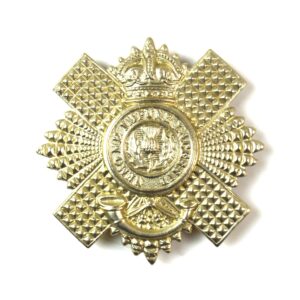
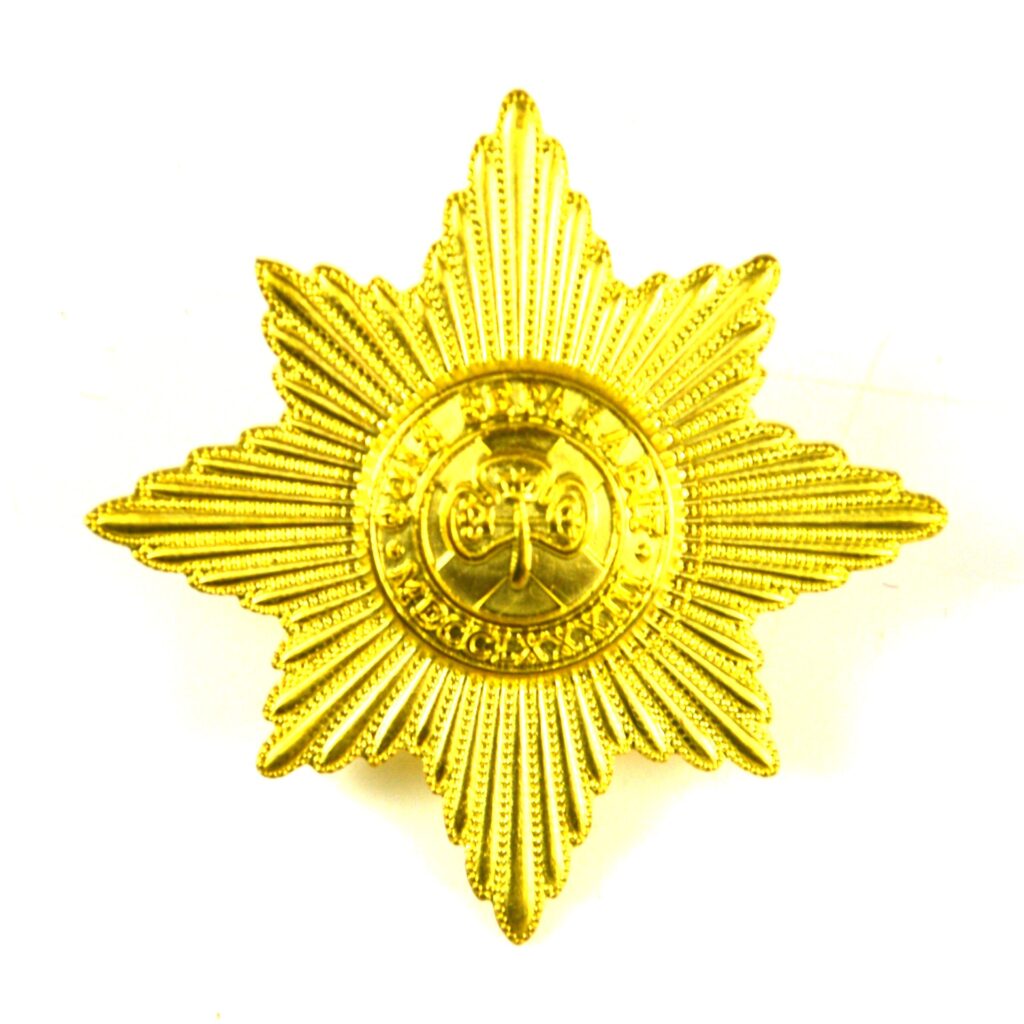
Each regiment has a distinctive cap badge worn on both the bearskin and the forage cap:
- Grenadier Guards — the flaming grenade (the “Grenade Fired Proper”), the most iconic Guards badge. The design has remained essentially unchanged since the 18th century. [1]
- Coldstream Guards — the Star of the Order of the Garter, with the motto Nulli Secundus
- Scots Guards — the Star of the Order of the Thistle, surmounted by the Imperial Crown
- Irish Guards — the Star of the Order of St Patrick, incorporating the shamrock. First issued in 1900.
- Welsh Guards — the leek, surmounted by the Crown. The most austere Guards badge but immediately recognisable.
Victorian and Edwardian-era officers’ cap badges in heavy gilt and silver are particularly sought after. Officers’ forage cap badges differ from the bearskin star and can be harder to find. [1]
The Bearskin
The tall bearskin cap is the most visually striking element of Guards ceremonial dress. Made from the fur of the Canadian black bear, each cap stands approximately 18 inches tall and weighs about 1.5 pounds. The bearskin was originally worn only by grenadier companies as a mark of elite status — after Waterloo, its use was extended to all Guards regiments on ceremonial occasions. [4]
Distinction between regiments on the bearskin is by the plume (colour and side, as per the table above) and the cap star. The Scots Guards wear no plume at all — the easiest identification method at Trooping the Colour. Bearskins are expensive to maintain (each costs approximately £650) and rarely appear on the collectors’ market; when they do, retired examples command significant prices.
Ceremonial Duties
The Guards’ ceremonial role is integral to their identity. Trooping the Colour — the Sovereign’s official birthday parade held in June on Horse Guards Parade — sees all five Foot Guards regiments on display. Each year one regiment’s Colour is “trooped,” paraded slowly before the ranks so that every soldier can recognise it in battle — a practice that was once a vital tactical necessity and is now purely ceremonial. The parade involves approximately 1,400 officers and soldiers, 200 horses, and 400 musicians, and is watched by a global television audience. [2]
Changing the Guard at Buckingham Palace is the daily (or alternate-day) ceremony that makes the Guards internationally famous. The New Guard, marching from Wellington Barracks behind a Guards band, formally replaces the Old Guard. The sentries posted outside the Palace and St James’s Palace are fully armed and operational — this is a working military duty, not merely a tourist spectacle.
Other commitments include the State Opening of Parliament, state funerals, Remembrance Sunday at the Cenotaph, and the Garter Ceremony at Windsor Castle. The dual role — ceremonial excellence combined with genuine combat capability — is the defining characteristic of the Household Division.
Collector’s Corner: Guards Militaria
Guards items are among the most collected categories of British military insignia and material. The regiments’ fame, longevity, and distinctive insignia drive consistent demand.
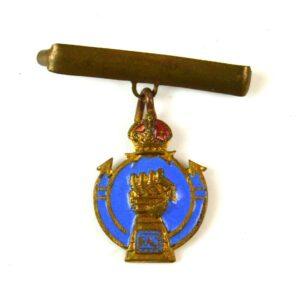
- Cap badges — officer quality (gilt and silver) command premiums over bronze other ranks’ badges. Georgian and early Victorian examples are particularly prized. Complete sets of all five Guards badges are a popular collecting goal.
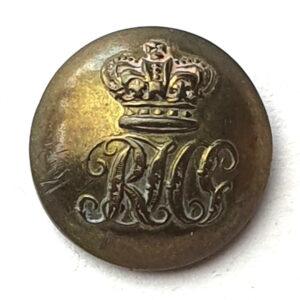
- Buttons — both tunic buttons and shoulder belt plates. Pre-1900 officers’ gilt examples are highly sought after. The button spacing distinction makes complete tunic button sets especially interesting for display. [1]
- Bearskins — rarely available but spectacular display pieces, typically commanding £300–£800 for retired examples.
- Medal groups — groups with Guards service are consistently sought after. A Waterloo Medal to the Grenadier Guards, identifiable by the roll, is among the most valuable British campaign medals. A WWI trio to a Guards Division casualty at the Somme or Passchendaele carries a premium.
- Formation signs — the Guards Division “Ever Open Eye” (a blue eye on white) is a distinctive cloth badge; Guards Armoured Division signs are also collected. [3]
- Shoulder titles — “GRENADIER GUARDS,” “COLDM. GDS.” etc., in brass, bronze and anodised variants.
The Guards’ unbroken 380-year history means material spans from 17th-century gorgets and shoulder belt plates to modern Osprey body armour name tapes. A collector can build a remarkable collection tracing the evolution of a single regiment across four centuries.
The Guards Today
In the modern British Army, the five Foot Guards regiments each maintain a single battalion, part of the London District and 11th Security Force Assistance Brigade. They continue to serve in both ceremonial and operational roles, deploying on exercises and operations worldwide. Recent deployments have included NATO’s enhanced Forward Presence in the Baltic states, training missions in Africa, and domestic resilience operations. [2]
The Guards’ recruiting pipeline draws from across the United Kingdom, though each regiment retains its historical connection — the Irish Guards recruit from Ireland, the Welsh Guards from Wales, the Scots Guards from Scotland. The standard of discipline, turnout, and professionalism expected of a Guardsman remains the benchmark against which the entire British Army measures itself.
Sources
- Fletcher, Ian. Guards! Guards! British Guards Regiments from the Stuarts to the Present Day. Barnsley: Pen & Sword, 2012. ISBN 978-1-84884-362-0.
- The Guards Museum, Wellington Barracks, London. theguardsmuseum.com.
- Kipling, Rudyard. The Irish Guards in the Great War. London: Macmillan, 1923. (2 vols.)
- Adkin, Mark. The Waterloo Companion. London: Aurum Press, 2001. ISBN 978-1-85410-764-0.
- Fraser, David. And We Shall Shock Them: The British Army in the Second World War. London: Hodder & Stoughton, 1983. ISBN 978-0-340-33612-3.
- Ryan, Cornelius. A Bridge Too Far. London: Hamish Hamilton, 1974. ISBN 978-0-241-89076-4.
Frequently Asked Questions
What regiments make up the Guards Division?
The Guards Division comprises the five regiments of Foot Guards — Grenadier Guards, Coldstream Guards, Scots Guards, Irish Guards, and Welsh Guards — plus the Household Cavalry (Life Guards and Blues and Royals). The Foot Guards are distinguished by their button spacing and plume colours, which allow identification at a distance.
How do you tell Guards regiments apart by their buttons?
Each Guards regiment has a distinctive button pattern: Grenadier Guards wear evenly spaced buttons, Coldstream Guards in pairs, Scots Guards in threes, Irish Guards in fours, and Welsh Guards in fives. This system was established to allow officers to identify regiments during inspections and parades, and remains in use today.
What is the role of the Household Division?
The Household Division performs the dual role of guarding the Sovereign and the Royal Palaces (ceremonial duties) while also serving as front-line combat troops. They have fought in every major British campaign from the English Civil War to Afghanistan, making them one of the most battle-experienced formations in the British Army.
Sources & References
- Mead, R. — *The Guards: Britain's Household Division* (2019)
- Fletcher, I. — *Guards! Guards!: The Household Division in War and Peace* (2012)
- Household Division website — householddivision.org.uk

Related Items in Our Collection8 items