- Introduction
- A Brief History of Campaign Medals
- The Anatomy of a Medal
- Naming and Engraving
- The Victorian Era: Medals of Empire
- The First World War
- The Second World War
- Post-1945 Campaign Medals
- Stars, Clasps, and Mentions in Despatches
- Researching a Named Medal
- Forgeries and Reproductions
- Collector’s Corner: Building a Medal Collection
- Sources
- Introduction
- A Brief History of Campaign Medals
- The Anatomy of a Medal
- Naming and Engraving
- The Victorian Era: Medals of Empire
- The First World War
- The Second World War
- Post-1945 Campaign Medals
- Stars, Clasps, and Mentions in Despatches
- Researching a Named Medal
- Forgeries and Reproductions
- Collector’s Corner: Building a Medal Collection
- Sources
Introduction
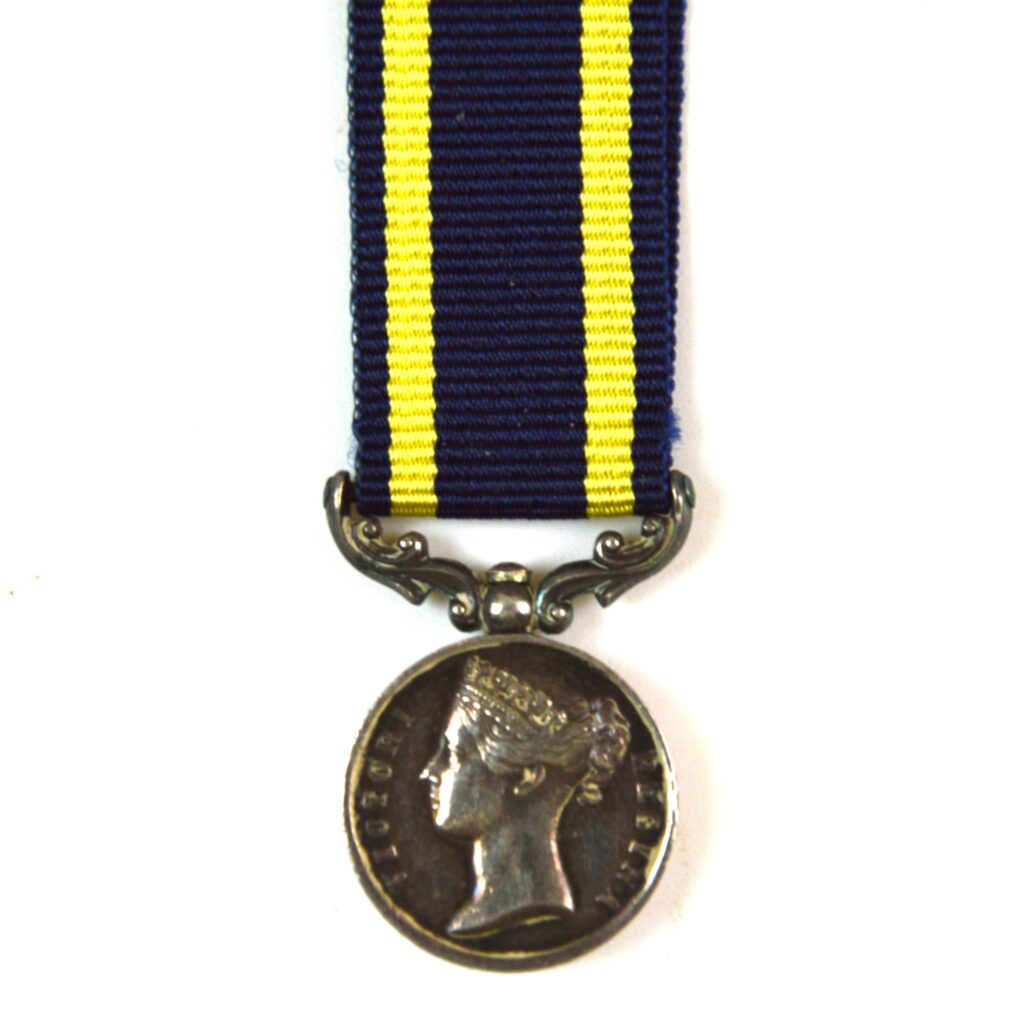
British campaign medals are among the most personal and evocative objects in the world of militaria. Each one was physically issued to a named individual in recognition of service in a specific campaign or theatre of war. Unlike cap badges or buttons, a campaign medal is unique to the man who wore it — it carries his name, his regiment, and his service number, stamped or engraved into the rim. It is, in essence, a small biographical document in silver or bronze. [1]
From the Waterloo Medal of 1815 — the first British medal issued to all ranks with the recipient’s name — to the Operational Service Medals of Afghanistan and Iraq, campaign medals tell the story of the British soldier across two centuries of warfare. They are also the backbone of British militaria collecting: more people collect medals than any other category of military antiques, and the research possibilities — tracing a named man through muster rolls, war diaries, and pension records — provide an intellectual dimension that few other collecting fields can match.
A Brief History of Campaign Medals
The practice of awarding medals for campaign service evolved gradually. Before the 19th century, medals were rare and typically reserved for officers or senior commanders. The Dunbar Medal (1650) and the Waterloo Medal (1815) are landmarks: the Dunbar Medal was one of the earliest British medals struck for distribution to all ranks (Cromwell’s army), while the Waterloo Medal — designed by Thomas Wyon Jr. and struck at the Royal Mint — established the template that every subsequent British campaign medal has followed: a silver disc, a suspension bar, a ribbon, and the recipient’s name impressed on the rim. [1]
The East India Company issued its own series of medals for campaigns in India from 1801 (the Seringapatam Medal) onwards. The Military General Service Medal (MGSM, 1847) retrospectively recognised service in the Napoleonic Wars with clasps for individual battles — but was awarded only to survivors still alive to claim it, making it inherently rare. Its naval counterpart, the Naval General Service Medal (1847), follows the same principle. [2]
From the Crimea (1854) onwards, campaign medals were awarded during or shortly after each conflict as a matter of routine. The British medal system then proliferated through dozens of Victorian colonial wars, two World Wars, and the post-1945 age of decolonisation and Cold War deployments. Understanding the chronological sequence of these awards is the first step to understanding any medal group.
The Anatomy of a Medal
Every British campaign medal shares a common structure:
- Obverse — typically bears the effigy of the reigning sovereign. Identifying the monarch’s portrait is often the fastest way to date a medal. Victoria (young head, veiled head, old head), Edward VII, George V, George VI, Elizabeth II — each has distinct effigy versions.
- Reverse — depicts a design specific to the campaign or award. Britannia, Victory figures, military trophies, and scenes of battle are common motifs.
- Rim (or edge) — where the recipient’s details are named (see below).
- Suspension — the ring, claw, or bar connecting the medal to the ribbon. Straight bar suspensions replaced the earlier ring suspensions in most Victorian-era medals.
- Ribbon — each medal has a unique ribbon pattern. The Waterloo ribbon is crimson with blue edges; the Military Cross ribbon is white with a central purple stripe. Learning ribbon patterns is essential for identifying medals at a glance.
- Clasp(s) — metal bars attached to the ribbon above the medal, denoting specific battles or operations within a campaign. A single medal can bear multiple clasps (the MGSM can have up to 15). Clasps dramatically affect value and research potential.
Naming and Engraving
The naming on a medal’s rim is the collector’s primary tool for identification and research. British campaign medals use several naming methods, each characteristic of a specific period:
| Method | Period | Description |
|---|---|---|
| Impressed (large serif) | 1815–c. 1870 | Deeply struck into the rim with serif-font punches; clear and robust |
| Engraved (running script) | Various | Hand-engraved in script; common on EIC medals and some Victorian awards |
| Impressed (small block) | c. 1870–1902 | Smaller, non-serif impressed capitals; standard for most Victorian campaign medals |
| Impressed (thin serif) | 1914–18 (BWM/VM) | Characteristic WWI naming on the British War Medal and Victory Medal |
| Unnamed | 1939–45 | WWII campaign stars and medals were issued unnamed (though many were privately engraved) |
| Impressed or laser-engraved | Post-1945 | Modern medals named by machine; GSM, OSM patterns |
Naming convention typically follows: number, rank, name, regiment. The exact format varies by period — Waterloo medals give rank and name in full with regiment; WWI medals use abbreviated forms (“PTE. J. SMITH. R. FUS.”). Variations in naming style — letter size, spacing, font — can help identify replacement medals, renamed medals, or forgeries. [2]
A correctly named medal is the collector’s Holy Grail. It means the medal can be verified against official medal rolls (held at The National Archives) and the man’s service can be traced through muster rolls, pension records, casualty returns, and unit war diaries. An unnamed WWII medal, by contrast, is essentially an orphan — impossible to attribute without separate documentation.
The Victorian Era: Medals of Empire
The Victorian period produced the most diverse range of British campaign medals. Victoria reigned for over 63 years (1837–1901) during which the British Army fought campaigns on every inhabited continent. The major Victorian campaign medals include:
- Crimea Medal (1854–56) — with clasps for Alma, Balaklava, Inkerman, and Sebastopol. Often found paired with the Turkish Crimea Medal.
- Indian Mutiny Medal (1857–58) — with clasps for Delhi, Lucknow, Relief of Lucknow, and Central India. Groups to the 24th Foot, for example, are particularly prized.
- Abyssinian Medal (1868) — a scarce medal struck in silver for the Napier expedition to rescue British hostages.
- Ashanti Medal (1874) and Star — awarded for Wolseley’s brilliant jungle campaign against the Ashanti kingdom.
- South Africa Medal 1877–79 — the Zulu War medal, with “1879” clasp. Among the most sought-after of all Victorian campaign medals.
- Egypt Medal (1882–89) and Khedive’s Star — for the campaigns in Egypt and Sudan, including Tel-el-Kebir and the failed Gordon relief expedition.
- Queen’s South Africa Medal (1899–1902) — the Boer War medal, commonly seen with multiple clasps. Extremely common in the market but endlessly researchable.
- King’s South Africa Medal (1901–02) — awarded alongside the QSA for service in the final phase of the Boer War.
Victorian medals are the traditional heart of the British medal collecting hobby. They are beautifully struck, named to identifiable men, and associated with campaigns that produced rich archival documentation. A well-researched Victorian medal group — with the recipient’s service record, a photograph, and a documented battle history — is the zenith of medal collecting. [3]
The First World War
The Great War produced medals on an industrial scale. The three principal awards — universally known as “Pip, Squeak, and Wilfred” — formed the basic entitlement for long-serving soldiers:
| Medal | Nickname | Awarded For |
|---|---|---|
| 1914 Star / 1914–15 Star | “Pip” | Service in a theatre of war by 22 Nov 1914 (Star) or 31 Dec 1915 (Star with clasp) |
| British War Medal (BWM) | “Squeak” | Entry into a theatre of war between 1914 and 1920 |
| Victory Medal (VM) | “Wilfred” | Service in an operational theatre (almost always paired with the BWM) |
The 1914 Star — commonly called the “Mons Star” — was awarded to members of the original BEF who served in France and Belgium between 5 August and 22 November 1914. It is one of the most highly prized WWI medals: recipients were the first to face the German onslaught, and their casualty rate was extraordinary. A Mons Star to an identified man who served at Mons, Le Cateau, or First Ypres is a premium item. [1]
The 1914–15 Star extended eligibility to those who served in a theatre of war by 31 December 1915. Together with the BWM and VM, it forms the standard “trio” for early-war volunteers — the men of Kitchener’s Army who answered the call in 1914–15. [1]
The Memorial Plaque (the “Dead Man’s Penny”) — a large bronze disc bearing the name of a soldier who died in service — was issued to the next of kin of every man who died during or as a result of the war. Over 1.3 million were produced. They are commonly found alongside named medal groups and add enormous poignancy.
For the collector, WWI medals are the most accessible entry point. A named BWM/VM pair to a private soldier in a line regiment can be purchased for £30–£60. The research potential is immense: medal index cards (available online at The National Archives), war diaries, and the Soldiers Died in the Great War database allow most recipients to be traced in detail. [3]
The Second World War
WWII campaign medals are fundamentally different from their predecessors because they were issued unnamed. The sheer scale of the war — over 5 million men and women served in British forces — made individual naming impractical. The result is that WWII campaign stars and medals, unless privately engraved or found with documented provenance, cannot be attributed to a specific individual. [2]
The main WWII awards are:
- 1939–45 Star — basic qualification for operational service.
- Atlantic Star — for service in the Battle of the Atlantic afloat.
- Africa Star — for North African campaigns (El Alamein, Tunisia, etc.).
- Pacific Star — for the Far East and Pacific theatres.
- Burma Star — for service in the Burma campaign.
- Italy Star — for the Italian campaign.
- France and Germany Star — for operations from D-Day to VE-Day in North-West Europe.
- Defence Medal — for service in the UK during the Blitz, Home Guard, fire watching, etc.
- War Medal 1939–45 — the basic service qualification medal, equivalent to the BWM of WWI.
Because they are unnamed, WWII medals are far less valuable individually than their WWI equivalents. Un-named groups sell for modest sums. However, a WWII group with documented provenance — a named soldier’s service book, photographs, letters, and medals together — transforms the collection’s value and historical significance immeasurably. Collectors who find such documented groups should preserve the paperwork as carefully as the medals themselves. [3]
Post-1945 Campaign Medals
The post-war era produced a series of campaign medals reflecting Britain’s retreat from empire and its NATO commitments: the General Service Medal 1918–62 (with clasps for Palestine, Malaya, Cyprus, and others), its replacement the General Service Medal 1962 (with clasps for Borneo, Radfan, South Arabia, Northern Ireland, and more), and recent awards including the South Atlantic Medal (Falklands 1982), the Gulf Medal (1991), and the family of Operational Service Medals for Iraq (Telic) and Afghanistan (Herrick). [2]
Post-1945 medals are named (unlike WWII stars), making them fully researchable. The General Service Medal with “NORTHERN IRELAND” clasp, issued in enormous numbers between 1969 and 2007, is one of the most common post-war medals and — despite its ubiquity — documents one of the longest campaigns in British military history.
The South Atlantic Medal is particularly collectable. Issued to the relatively small force that fought in the Falklands, every recipient can be identified and many can be cross-referenced with published unit histories. Named to specific ships or commands — “HMS Sheffield,” “2 PARA,” “3 Cdo Bde” — these medals carry instant recognition and strong market demand.
Stars, Clasps, and Mentions in Despatches
Understanding the hierarchy of awards within a medal group is essential. British medal groups are worn in a strict order of precedence, with gallantry awards first, followed by campaign medals in order of campaign date. Common additions include:
- Clasps — metal bars on the ribbon denoting specific battles or operations. A medal with a rare clasp can be worth many times more than one without. A Queen’s South Africa Medal with the “Defence of Mafeking” clasp, for instance, is exponentially rarer and more valuable than the common “Cape Colony” clasp.
- Mentions in Despatches (MiD) — denoted by a bronze oak leaf on the ribbon of the relevant campaign medal. An MiD adds both historical interest and value.
- Rosettes — a small bronze rosette worn on the ribbon of the 1914 Star denotes service under fire (the “Mons” rosette). A key identifier for BEF veterans.
Researching a Named Medal
The ability to research a named medal is what sets medal collecting apart from all other areas of militaria. A named medal is the starting point for reconstructing a soldier’s life story. Key research sources include:
- Medal rolls — held at The National Archives (WO 100 for Victorian/Edwardian, WO 329 for WWI). These confirm entitlement and often record unit, rank, and clasps.
- Service records — WWI soldiers’ service records (WO 363 and WO 364) are available online via Ancestry and FindMyPast. Approximately 60% survive (the rest were destroyed by a Luftwaffe incendiary bomb in 1940).
- War diaries — WO 95 (WWI) and WO 166/WO 169 (WWII) record daily unit activities. Cross-referencing a soldier’s posting with his unit’s war diary can place him at specific battles.
- Soldiers Died in the Great War — the complete casualty database for WWI, now available digitally.
- Commonwealth War Graves Commission — records every identified grave and memorial commemoration.
- Regimental museums and associations — often hold additional records, photographs, and muster rolls not available at TNA.
The satisfaction of researching a named medal — tracing the man from enlistment through training, to his unit’s battles, perhaps to a wound or a death — is unmatched. A fully researched medal group, documented with copies of the service record, war diary extracts, and perhaps a photograph, becomes a genuine historical artefact rather than merely a piece of metal. [3]
Forgeries and Reproductions
Forgery is a persistent problem in medal collecting. High-value medals — Victoria Crosses, rare Victorian pairs, Mons Stars to identified casualties — attract sophisticated fakers. Common warning signs include:
- Incorrect naming style — wrong font, spacing, or abbreviation for the claimed period. Study correct naming styles before buying expensive medals.
- Re-named medals — an original medal with the genuine naming erased and new details engraved. Check for traces of the original naming under magnification, and for thinning of the rim where erasure has occurred.
- Copy medals — struck from replica dies, often in the wrong alloy or weight. Weigh medals — a genuine Queen’s South Africa Medal should weigh approximately 36 grams.
- Added clasps — a genuine medal with a fake rare clasp added to inflate value. Check that the clasp is correctly styled, correctly riveted, and that the naming is consistent with entitlement shown on the medal roll.
- Unverified groups — medals grouped together that were never issued to the same man. Always verify against medal rolls before purchasing a “group.”
The best defence against forgery is knowledge. Study naming conventions, handle genuine medals, buy from established dealers with guarantees, and always check the medal rolls before making a significant purchase. Any reputable dealer will provide a full refund if a medal is subsequently proved to be fake or misattributed. [1]
Collector’s Corner: Building a Medal Collection
Medal collecting offers something at every budget level:
- Entry level (under £50) — WWI BWM/VM pairs to identified soldiers. Research potential is immense; the cost is modest. An ideal starting point.
- Intermediate (£50–£300) — Victorian campaign medals (QSA, India medals), named WWI trios, post-1945 GSMs with interesting clasps. Research becomes more challenging and rewarding.
- Advanced (£300+) — Zulu War medals, Mons Stars to identified casualties, SAS or airborne groups, gallantry awards. Requires deep knowledge and trusted dealer relationships.
Tips for new collectors:
- Always buy named medals — unnamed WWII medals are decorative; named medals are historical.
- Verify before buying — check medal rolls (many are now online) to confirm the recipient was entitled to what you’re being offered.
- Buy quality over quantity — one well-researched group tells a richer story than a drawer full of unchecked singles.
- Preserve provenance — if a medal comes with letters, photographs, a service book, or family documentation, keep everything together. Provenance is irreplaceable.
- Join the Orders and Medals Research Society (OMRS) — the leading British medal collecting society, with an excellent journal and access to specialist knowledge.
Display and care: medals should be stored in acid-free conditions, ideally in individual compartments. Silver medals develop a natural tarnish that most collectors prefer to leave untouched — aggressive cleaning destroys original patina and reduces value. If cleaning is necessary, use a specialist silver dip (never abrasive polish) and rinse thoroughly. Ribbons should be kept dry and out of sunlight to prevent fading. Replacement ribbons in correct patterns are readily available from specialist suppliers. [3]
Sources
- Joslin, E.C., Litherland, A.R. and Simpkin, B.T. British Battles and Medals. 7th edn. London: Spink, 2001. ISBN 978-1-902040-46-2.
- Williamson, Howard. The Collector and Researchers Guide to the Great War. Harwich: Anne Williamson, 2003. ISBN 978-0-9544259-0-4.
- Fevyer, W.H. and Wilson, J.W. The Queen’s South Africa Medal to the Royal Navy and Royal Marines. London: Hayward, 1983. ISBN 978-0-903754-14-7.
- Duckers, Peter. British Campaign Medals: Waterloo to the Gulf. Oxford: Shire Publications, 2006. ISBN 978-0-7478-0651-0.
Frequently Asked Questions
What are British campaign medals?
British campaign medals are decorations awarded to military personnel for service in specific military campaigns or theatres of war. They were first systematically issued from the Waterloo Medal of 1815 onwards. Each medal typically features the sovereign's portrait on the obverse and a campaign-specific design on the reverse, with the recipient's details impressed or engraved on the rim.
How do I research a named medal?
Start with the details on the medal rim — the recipient's name, rank, number, and regiment. Cross-reference these with the Medal Roll held at The National Archives (WO 100 series for Victorian campaigns, WO 329 for WW1). Online resources such as Forces War Records and the Long, Long Trail can help trace a soldier's service history and verify entitlement.
What is a medal group?
A medal group is a set of medals awarded to the same individual, mounted together in the order of precedence. Groups are more valuable than individual medals because they tell a complete story of a soldier's service. The most common WW1 group is the '1914-15 Star Trio' — the 1914-15 Star, British War Medal, and Victory Medal.
Are replica medals legal to own?
Yes, replica medals are legal to own and collect in the United Kingdom. However, it is an offence under the Army Act to wear medals or decorations to which you are not entitled with intent to deceive. Reputable dealers always clearly label replicas, and collectors should learn to distinguish originals from copies.
Sources & References
- Ninnes, G. — *British Campaign Medals* (2024)
- Joslin, E.C., Litherland, A.R., Simpkin, B.T. — *British Battles and Medals* (7th edition)
- Medal Yearbook 2026 — Token Publishing

Related Items in Our Collection8 items