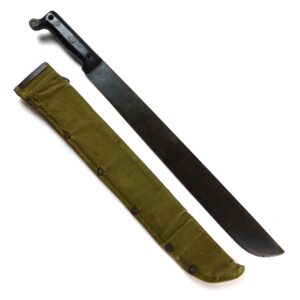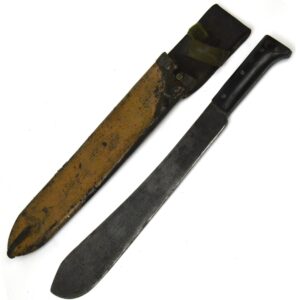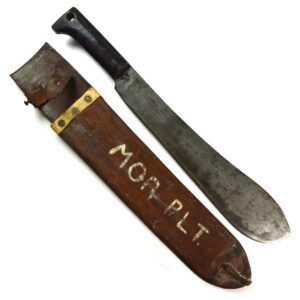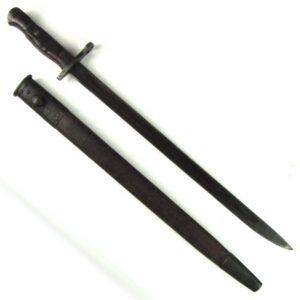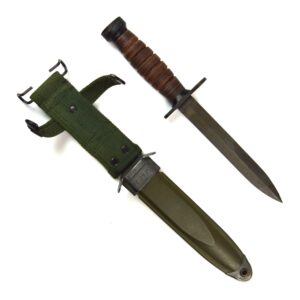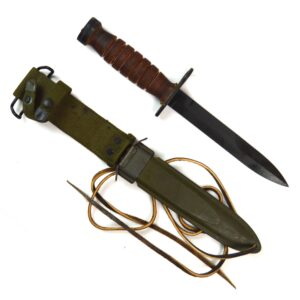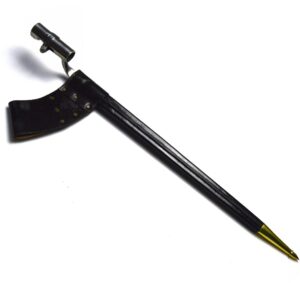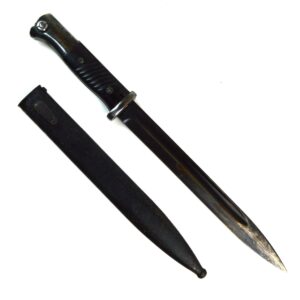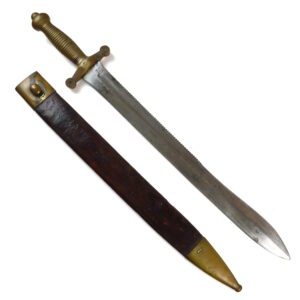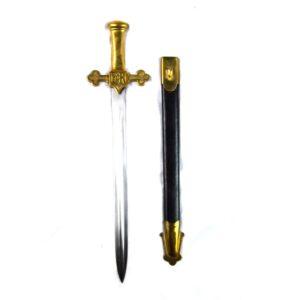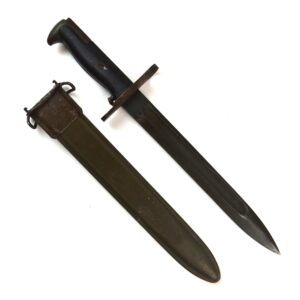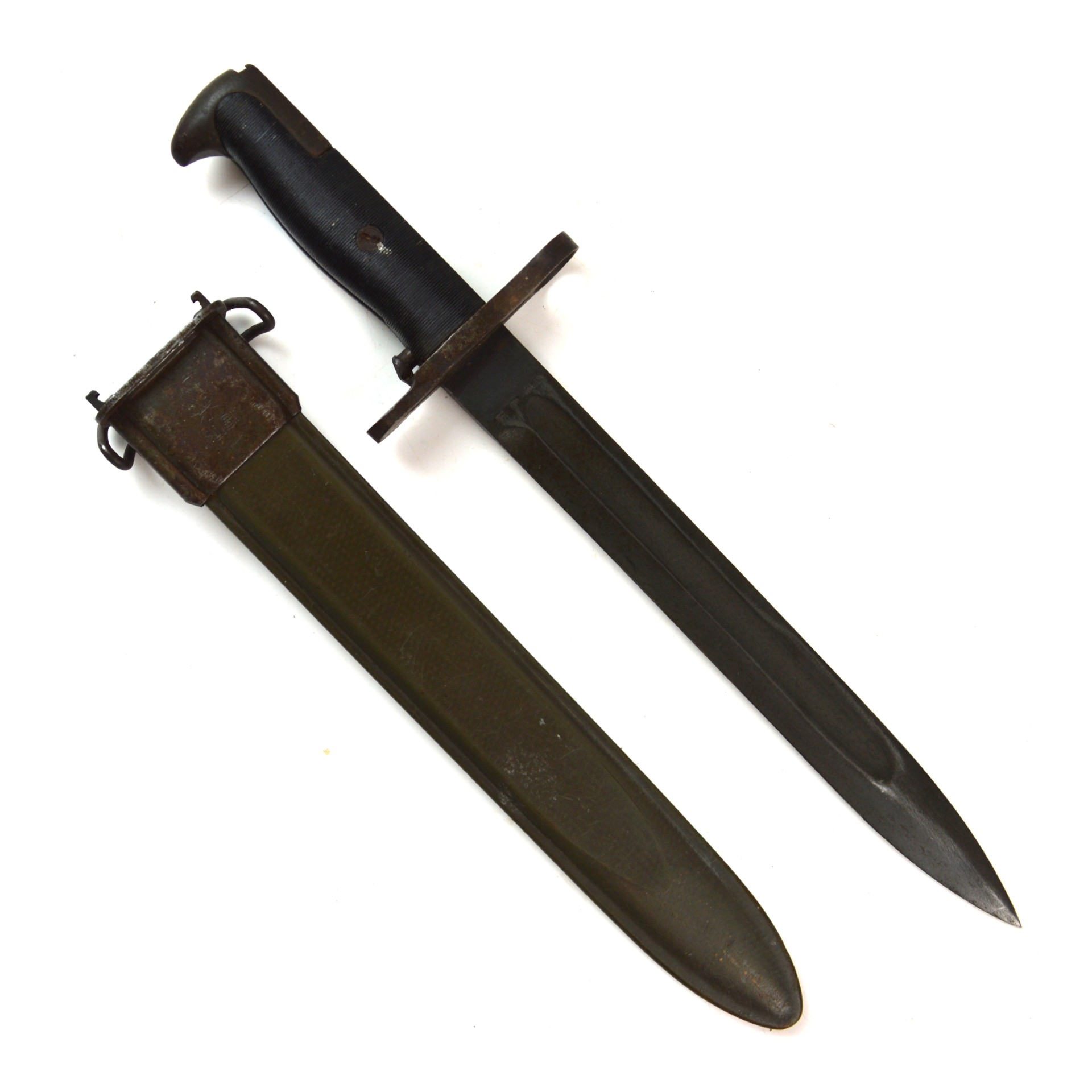
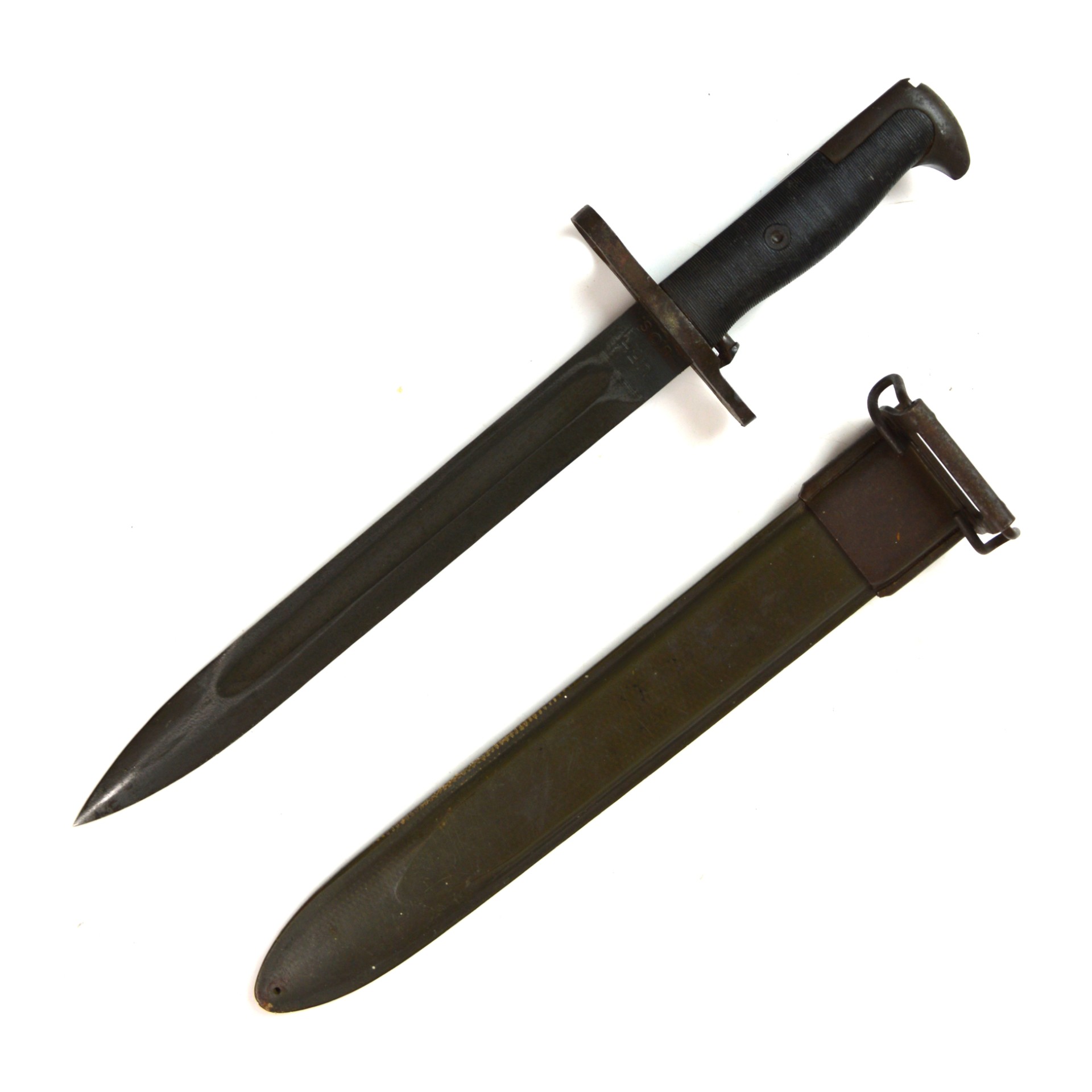
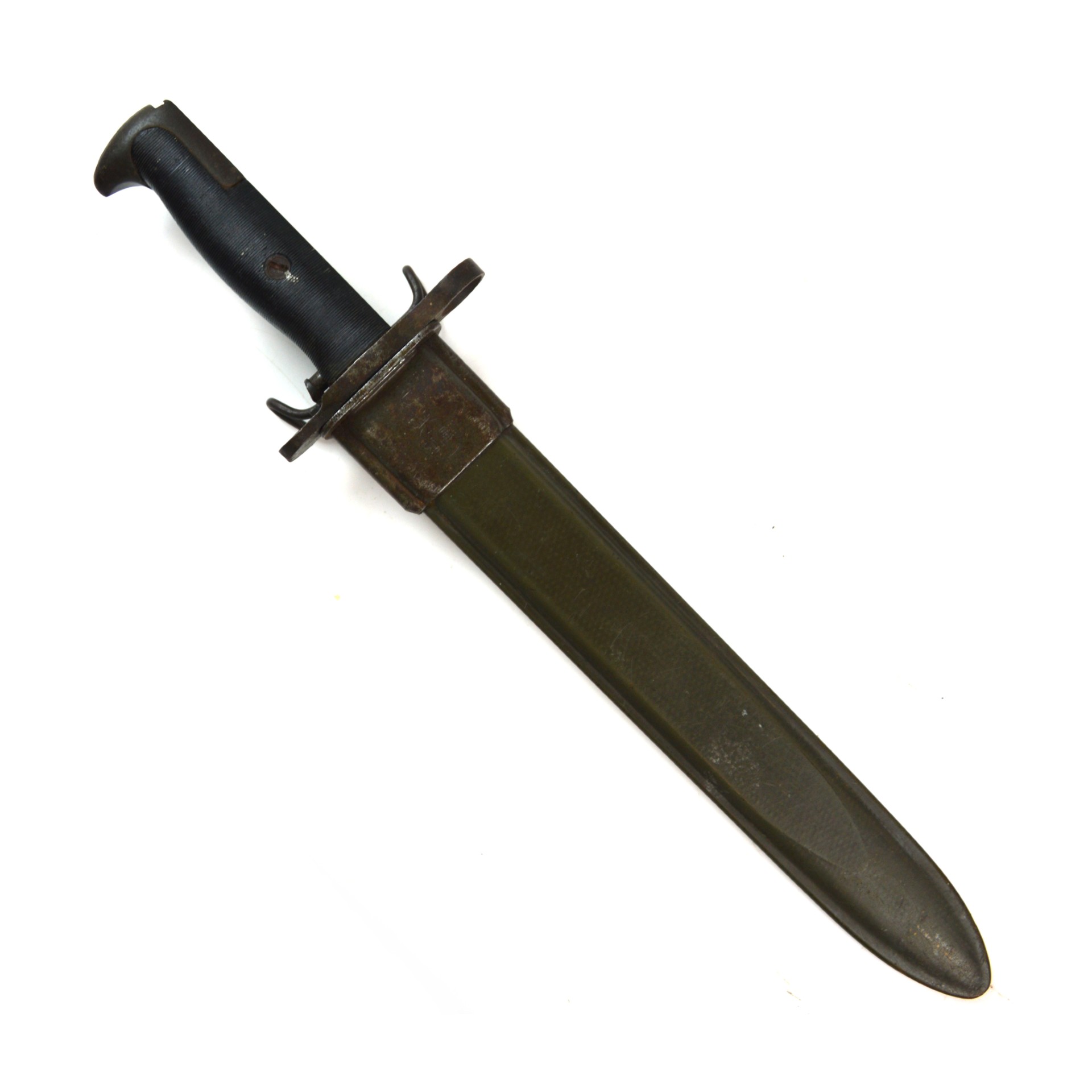
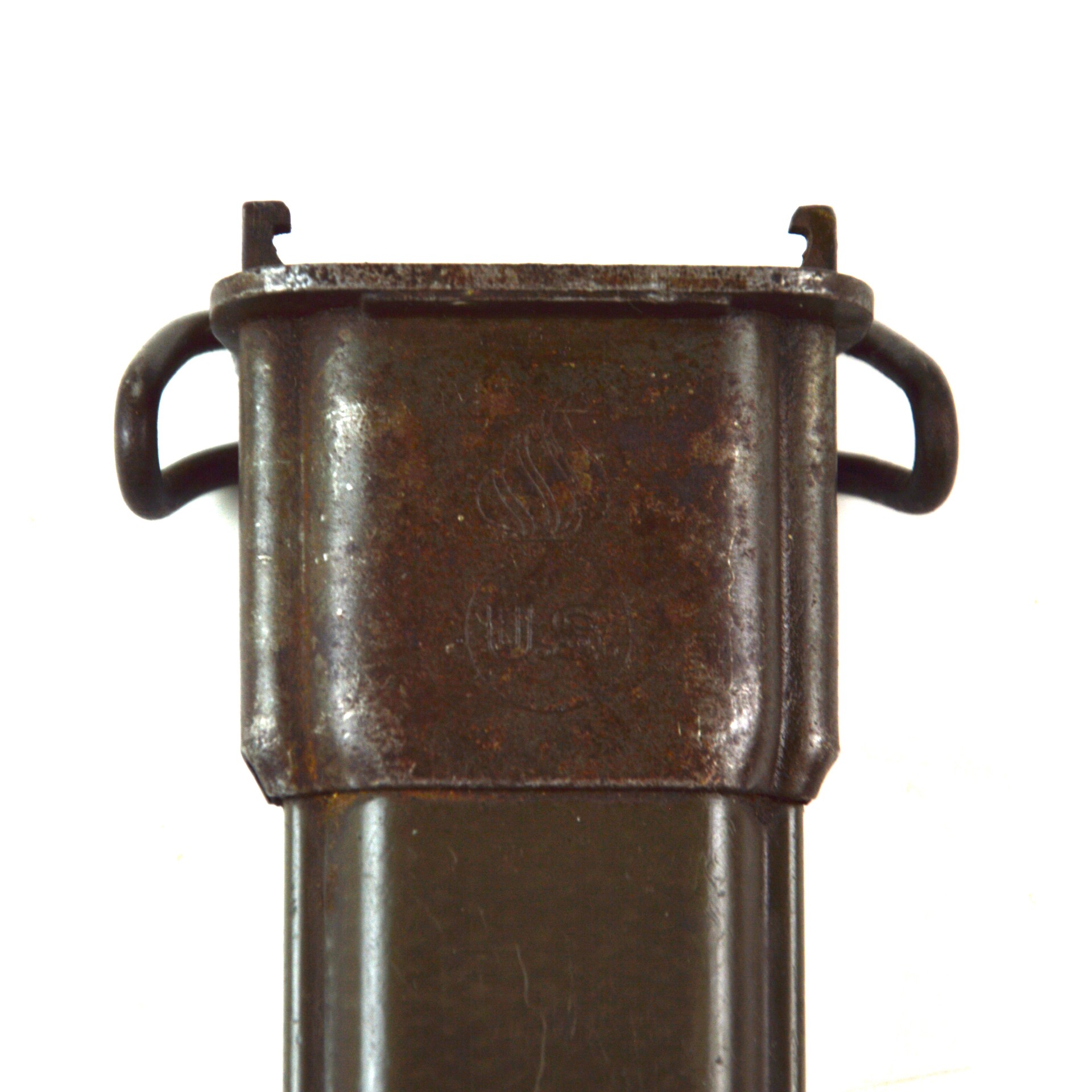
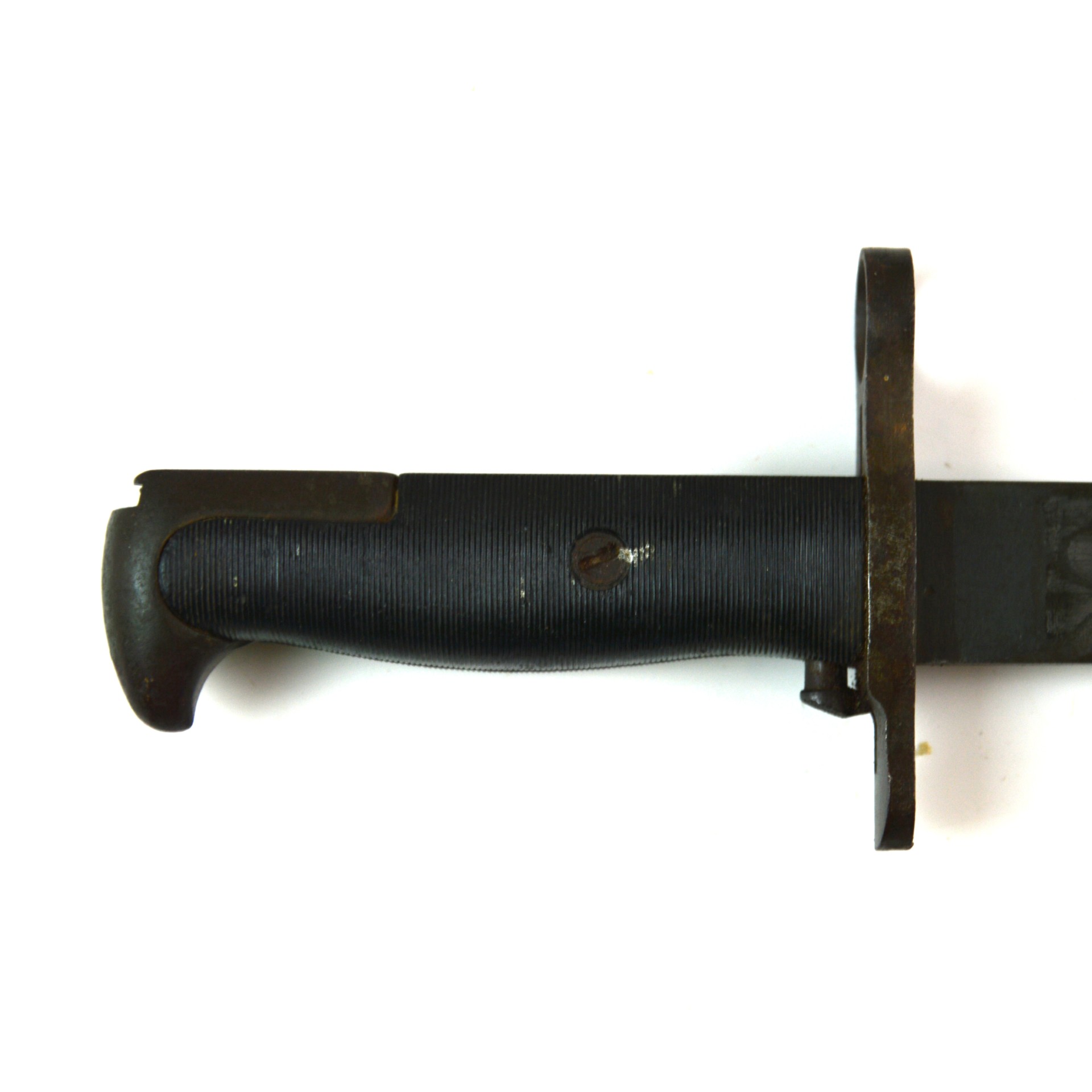
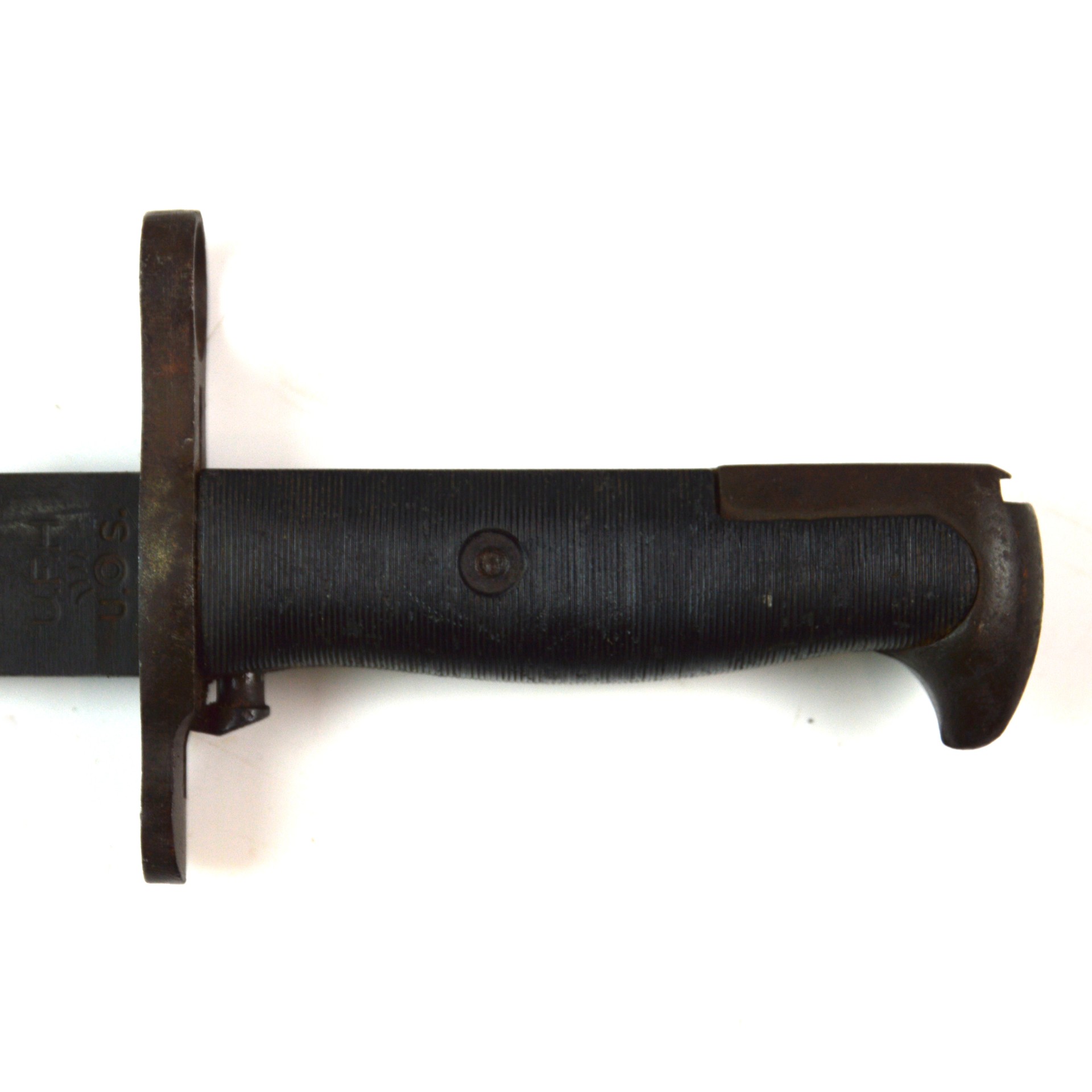
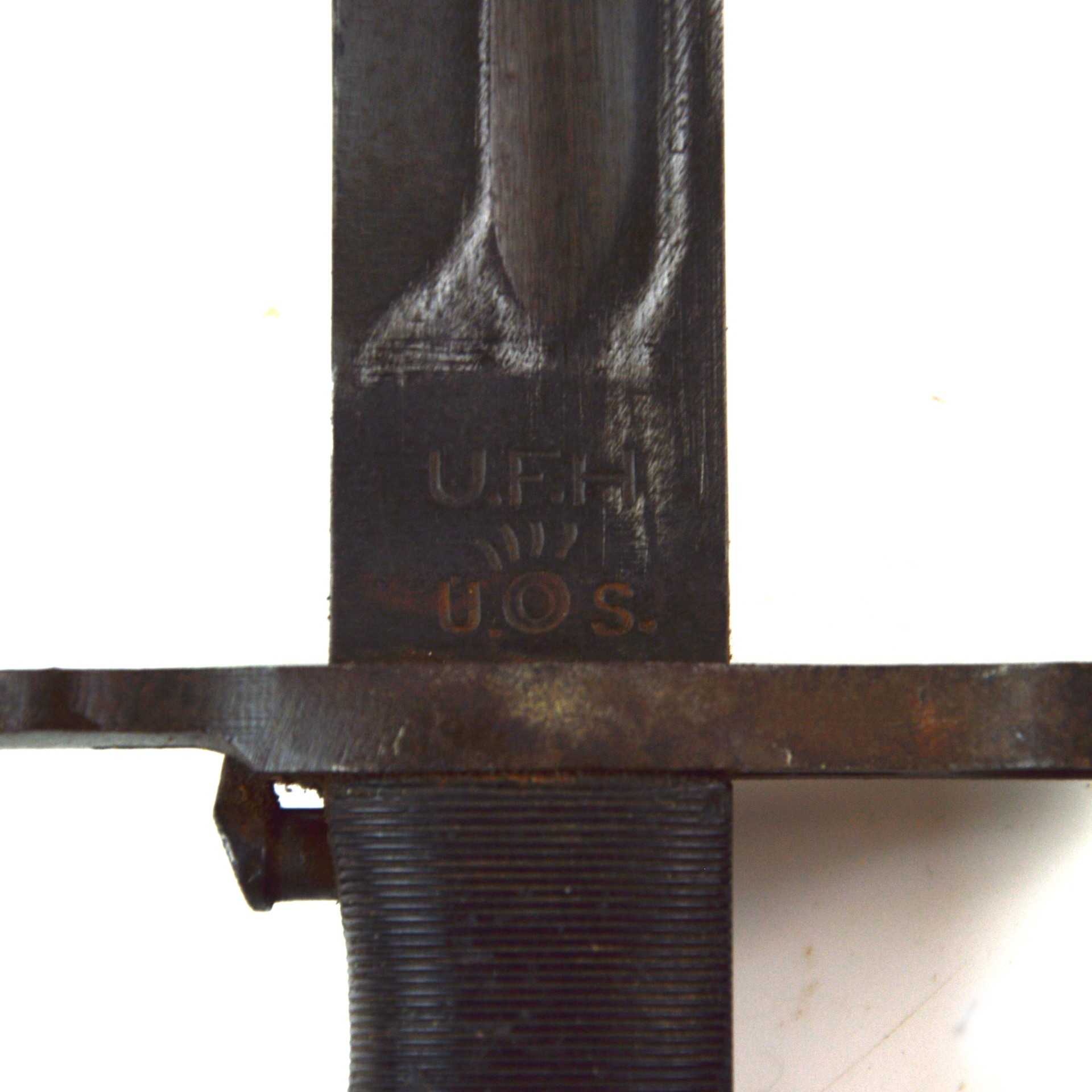
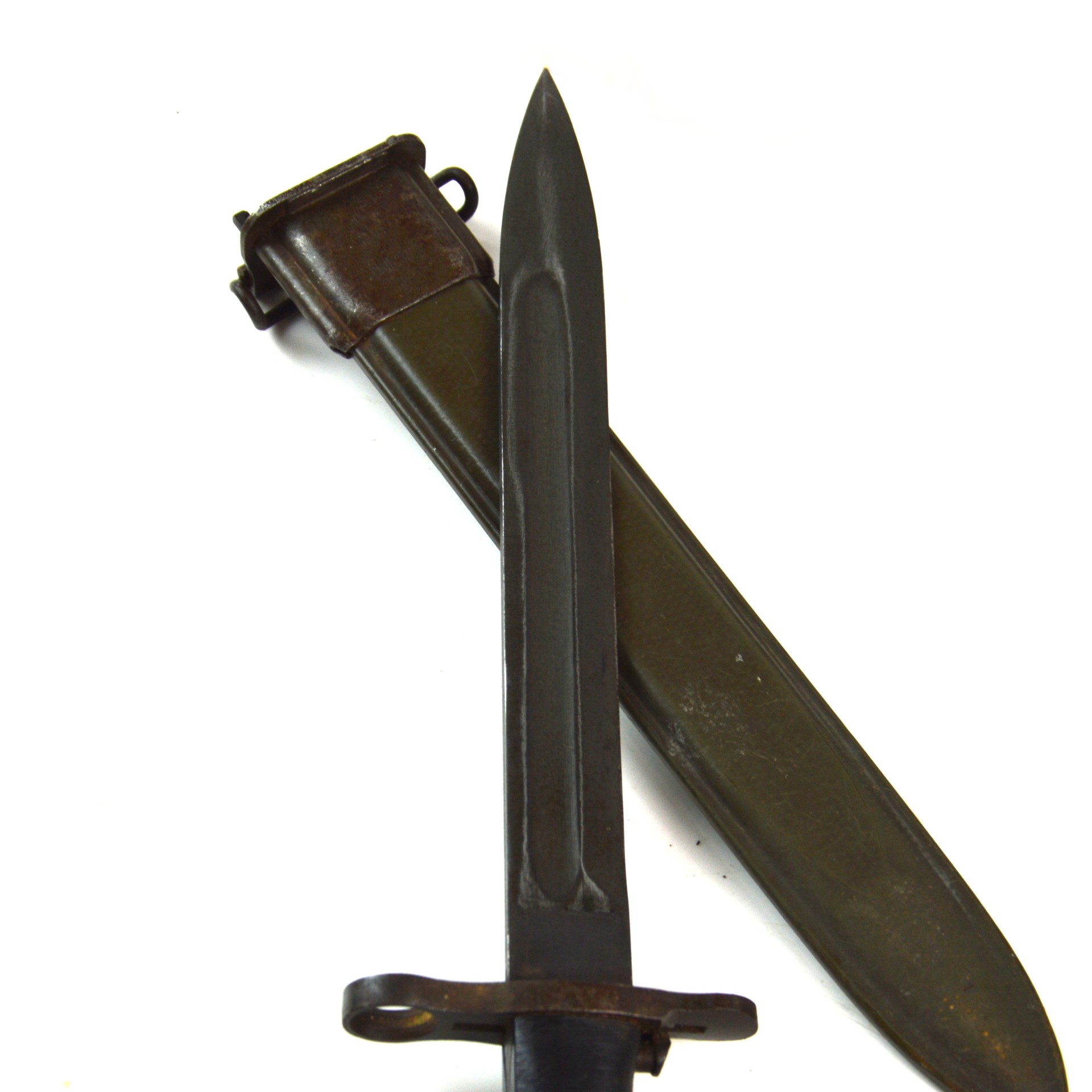
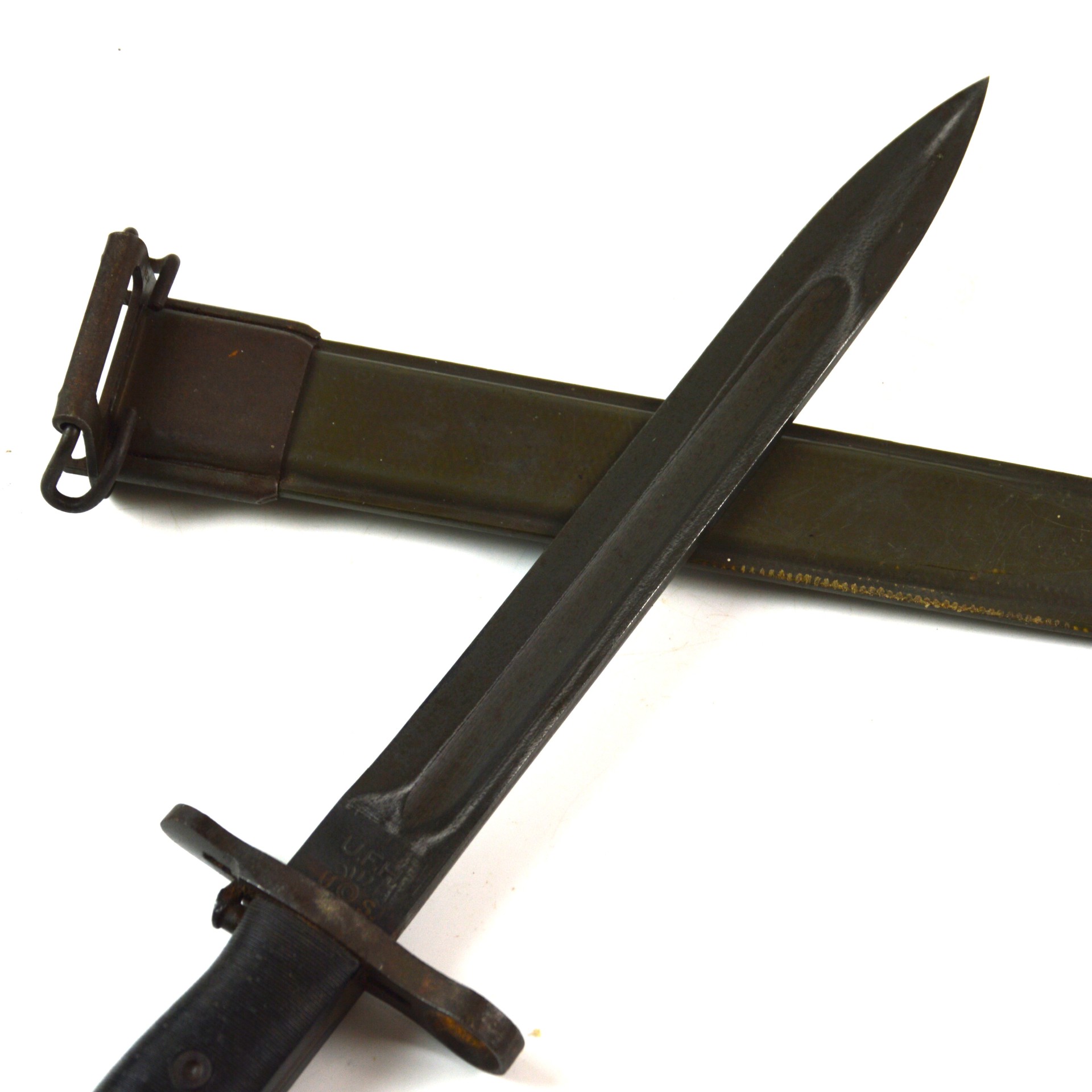
WWII US M1 bayonet in M7 scabbard, manufactured by the Union Fork & Hoe Company of Columbus, Ohio, produced between 1943 and 1945 for issue with the M1 Garand rifle of the United States Army and United States Marine Corps during the Second World War. The bayonet presents a single-edged, single-fullered blade with a spear point, a blade fuller running from the ricasso toward the tip, and ribbed black handle resin grip scales, a steel crossguard with a bayonet lug slot, and a pommel incorporating the locking catch mechanism for mounting to the Garand’s bayonet lug as well as removing the scabbard. The blade ricasso is stamped with the maker’s mark “UFH” above “U.S.” with the Ordnance Corps flaming bomb acceptance stamp, consistent with Union Fork & Hoe production. The M7 scabbard is constructed with a resin-impregnated cotton duck canvas body and a parkerised steel throat stamped “U.S.” over the Ordnance flaming bomb, with spring steel retention plates in the throat securing the blade in place, and a wire hook hanger for attachment to the cartridge belt.
The M1 bayonet was introduced in 1943 in response to a United States Army decision to reduce the blade length of the standard issue bayonet from the sixteen-inch blade of the M1905 to a more practical ten-inch blade better suited to the conditions of the Second World War. Union Fork & Hoe was by far the largest single producer of M1 bayonets across the entire war programme, manufacturing in excess of one million examples, with the UFH maker’s stamp among the most commonly encountered on surviving examples. The M7 scabbard, all produced by Victory Plastics, was introduced alongside the M1 bayonet programme, replacing the earlier M3 scabbard by substituting the M3’s moulded interior retention ribs with spring steel plates in the throat for improved blade retention. The shorter bayonets served throughout the European and Pacific theatres; in the Pacific, many US troops elected to retain the longer unmodified M1905 bayonet, as the ten-inch blade compared unfavourably in reach against the fifteen-and-three-quarter-inch blade of the Japanese Type 30 sword bayonet fitted to the Arisaka rifle. These remained in use during the Korean War and into the Vietnam War.
The bayonet and scabbard are offered together as a matched pair in the configuration in which they were issued. US M1 bayonets by Union Fork & Hoe in M7 scabbard are collected as examples of Second World War United States Army edged weapons and field equipment, small arms accessories of the M1 Garand rifle, and militaria of the principal American infantry weapon of the Second World War.
Dimensions Blade length approx. 251mm) / Overall length (out of scabbard) approx. 370mm
Condition Very good, the blade is only bears some light wear from the scabbard. The exterior metalwork has little parkerisation remaining; however, it shows no sign of pitting.