- Introduction
- Background: Britain and the Boer Republics
- The First Boer War (1880–1881)
- The Road to the Second Boer War
- Black Week and the Conventional Phase
- Roberts’s Advance and the Fall of Pretoria
- The Guerrilla War
- The Concentration Camps
- Key Personalities
- British Commanders
- Boer Leaders
- Imperial and Colonial Troops
- The Human Cost and Lessons Learned
- Collector’s Corner: Boer War Militaria
- Medals
- Equipment and Ephemera
- Reference Works
- Sources
- Introduction
- Background: Britain and the Boer Republics
- The First Boer War (1880–1881)
- The Road to the Second Boer War
- Black Week and the Conventional Phase
- Roberts’s Advance and the Fall of Pretoria
- The Guerrilla War
- The Concentration Camps
- Key Personalities
- Imperial and Colonial Troops
- The Human Cost and Lessons Learned
- Collector’s Corner: Boer War Militaria
- Sources
Introduction
The Boer Wars — the First (1880–81) and the far larger Second (1899–1902) — were fought between the British Empire and the Boer republics of the Transvaal (South African Republic) and the Orange Free State in southern Africa. They remain among the most significant conflicts in British military history: the Second Boer War was the largest imperial war between the Napoleonic era and the Great War, mobilising nearly 450,000 troops from across the Empire and exposing fundamental weaknesses in the British Army that drove the sweeping reforms making possible the British Expeditionary Force of 1914. [1]
The wars also raised profound moral questions — the use of concentration camps, scorched-earth tactics, and the subjugation of civilian populations — that resonated far beyond South Africa and continue to be debated today.
Background: Britain and the Boer Republics
The Boers (from the Dutch word for “farmer”) were descendants of Dutch, German and French Huguenot settlers who had colonised the Cape of Good Hope from the 17th century onwards. When Britain acquired the Cape Colony in 1806, many Boers migrated north in the Great Trek (1835–46), establishing the independent republics of the Transvaal and the Orange Free State beyond British control. [1]
The discovery of diamonds at Kimberley (1867) and gold on the Witwatersrand in the Transvaal (1886) transformed the political landscape. The Transvaal’s goldfields became the richest in the world, attracting tens of thousands of British and foreign miners (Uitlanders) whose demands for political rights — and whose economic value — made conflict between the Boer republics and the British Empire increasingly likely. [2]
The First Boer War (1880–1881)
Britain had annexed the Transvaal in 1877, ostensibly to stabilise the republic’s finances and protect it from Zulu and other threats. The annexation was deeply resented, and in December 1880 the Boers rose in rebellion. [1]
The war lasted barely three months but delivered a series of humiliating British defeats. At Laing’s Nek (28 January 1881), British infantry advanced uphill in close formation against Boer marksmen in prepared positions and were driven back with heavy losses. At Majuba Hill (27 February 1881), Boer sharpshooters stormed the summit held by a British force under Major General Sir George Pomeroy Colley, killing Colley himself and routing his command. The British lost 92 killed, 134 wounded and 59 captured from a force of fewer than 400. [2]
The defeat at Majuba was a profound shock. Gladstone’s government, unwilling to commit to a prolonged war in a remote colony, agreed to the Pretoria Convention (1881), restoring Transvaal self-government under nominal British suzerainty. The Boers remembered Majuba as a glorious victory; the British remembered it as an unavenged humiliation. The phrase “Remember Majuba!” became a rallying cry in 1899. [1]
The Road to the Second Boer War
The gold rush transformed the Transvaal from a pastoral backwater into the wealthiest state in Africa. President Paul Kruger’s government denied the vote and civil rights to the growing Uitlander population, whose taxes funded the republic’s treasury. British imperialists — principally Cecil Rhodes, Prime Minister of the Cape Colony, and Sir Alfred Milner, the High Commissioner — agitated for intervention. [1]
The Jameson Raid (December 1895 – January 1896), an attempt by Rhodes’s associate Dr Leander Starr Jameson to trigger an Uitlander uprising in Johannesburg, was a spectacular failure that embarrassed Britain and hardened Boer resolve. Kruger armed the Transvaal with modern Mauser rifles and Krupp artillery purchased from Germany. By October 1899, negotiations had broken down and both sides were mobilising. The Transvaal and Orange Free State issued an ultimatum demanding British withdrawal — and when it expired on 11 October 1899, the Second Boer War began. [2]
Black Week and the Conventional Phase
The Boers struck first, invading Natal and the Cape Colony and laying siege to Ladysmith, Kimberley and Mafeking. The British commander, General Sir Redvers Buller VC, launched relief operations that met with catastrophic failure in “Black Week” (10–15 December 1899) — three successive defeats at Stormberg, Magersfontein and Colenso that cost over 2,700 casualties and stunned the Empire. [1]
At Magersfontein, the Highland Brigade — advancing in close formation at dawn in blinding rain — walked into Boer trenches at the base of the hills rather than on the crests. The Boers had revolutionised defensive tactics. The Highlanders were pinned in the open for an entire day; the Black Watch alone lost 303 killed and wounded. At Colenso, Buller’s attempt to force a crossing of the Tugela River ended in confused defeat, with Colonel Long’s artillery overrun and twelve guns lost — ten of them subsequently rescued by a suicidal volunteer action that earned three Victoria Crosses. [3]
Buller’s subsequent attempt at Spion Kop (23–24 January 1900) was an even greater disaster. British troops seized the summit of the kop in darkness but at dawn found themselves enfiladed on a plateau barely 400 yards across, unable to dig in or withdraw. Casualties exceeded 1,700 — the Boers lost 335. A young journalist named Winston Churchill covered the battle and barely escaped capture. [1]
Roberts’s Advance and the Fall of Pretoria
Field Marshal Lord Roberts VC replaced Buller in January 1900, with Lord Kitchener as his chief of staff. Roberts adopted a strategy of outflanking the Boer positions rather than attacking them head-on. A massive cavalry sweep under General John French relieved Kimberley (15 February), and General Cronjé’s Boer force was surrounded and forced to surrender at Paardeberg (27 February) — the first major British victory of the war, deliberately announced on the anniversary of Majuba. [2]
Roberts advanced rapidly, occupying Bloemfontein (capital of the Free State) on 13 March, Johannesburg on 31 May, and Pretoria (capital of the Transvaal) on 5 June 1900. The three besieged towns were relieved. Mafeking’s relief (17 May) — after a 217-day siege defended by Colonel Robert Baden-Powell — triggered the most extravagant celebrations in London since Waterloo. Roberts declared the war “practically over” and sailed for home. He was profoundly wrong. [1]
The Guerrilla War
Far from accepting defeat, the Boer commandos — under leaders including Louis Botha, Jan Smuts, Christiaan de Wet and Koos de la Rey — dispersed into the veldt and waged a guerrilla campaign that lasted another two years and proved far more difficult to suppress than the conventional war. [3]
The commandos were superb horsemen and marksmen, knew the terrain intimately, and could concentrate for a strike then melt back into the civilian population. They attacked supply lines, ambushed British columns, and raided deep into the Cape Colony. De Wet became the most elusive commando leader — British columns chased him across thousands of miles of veldt without ever catching him. Smuts, at just 29, led a raid that penetrated to within 50 miles of Cape Town. [1]
Kitchener, now in command, responded with the grim calculus of attrition. He built a network of 8,000 blockhouses connected by barbed wire, dividing the country into sectors that could be swept by mounted columns driving the commandos against the wire. The scorched-earth policy — burning Boer farms, destroying crops and livestock, and removing the civilian population into camps — aimed to deny the guerrillas their support base. It worked militarily. Its human cost was another matter. [2]
The Concentration Camps
The concentration camps became the war’s most enduring controversy. Established by Kitchener to house the families displaced by the scorched-earth campaign, they were so poorly administered that mortality rates — particularly among children — were appalling. The camps held approximately 116,000 Boer civilians and an estimated 120,000 Black Africans (in separate camps). [1]
An estimated 26,000 Boer civilians — the majority of them children under 16 — and approximately 20,000 Black Africans died in the camps, primarily from measles, typhoid, and dysentery compounded by inadequate food, overcrowding, and almost non-existent medical provision. [3]
Emily Hobhouse, a British welfare campaigner, visited the camps in early 1901 and published a devastating report exposing the conditions. Her testimony shocked the British public and forced the government to appoint the Fawcett Commission under Millicent Fawcett, which confirmed the criticisms and recommended urgent improvements. Conditions gradually improved — but the damage to Britain’s international reputation was permanent. The term “concentration camp” itself acquired its pejorative modern meaning from the Boer War. [1]
Key Personalities
British Commanders
- Field Marshal Lord Roberts VC — replaced Buller and conducted the conventional phase that captured the Boer capitals. “Bobs” was enormously popular with the troops but left South Africa prematurely.
- Lord Kitchener — succeeded Roberts and fought the guerrilla phase. His scorched-earth and camp policies won the war but damaged Britain’s reputation permanently. [2]
- General Sir Redvers Buller VC — the initial commander, blamed for Black Week and the disasters at Colenso and Spion Kop.
Boer Leaders
- Paul Kruger — President of the Transvaal, the symbolic figurehead of Boer resistance. Fled to Europe in 1900 and died in exile in 1904.
- Louis Botha — the most talented Boer general, later the first Prime Minister of the Union of South Africa (1910). Fought for Britain in WWI. [1]
- Jan Smuts — commando leader who raided deep into the Cape Colony. Later served as a British Field Marshal in both World Wars and helped draft the preamble to the United Nations Charter.
- Christiaan de Wet — the guerrilla commander who repeatedly evaded British capture. His memoir, Three Years War, is a classic of guerrilla literature. [3]
Imperial and Colonial Troops
The Second Boer War was the first major conflict in which the self-governing colonies sent significant contingents to fight alongside British regulars. Australia contributed approximately 16,175 men, Canada sent 8,372, and New Zealand dispatched over 6,500. For Australia and New Zealand in particular, the Boer War was a formative national military experience — a precursor to the ANZAC legend of 1915. [2]
The colonial contingents brought mounted infantry skills that proved far more effective against the Boers than traditional British infantry tactics. The Australians were noted for their horsemanship and bush marksmanship — skills that adapted perfectly to the South African veldt. The Canadian Royal Dragoons won fame at the Battle of Leliefontein (7 November 1900), where three Victoria Crosses were won in a rearguard action. At home, the war stimulated the creation of unified national defence forces — the Australian Commonwealth military was established in 1901. [1]
The Human Cost and Lessons Learned
British forces suffered approximately 7,792 killed in action and a further 13,250 dead from disease — typhoid was the principal killer, revealing catastrophic deficiencies in army medical services and sanitation that provoked public outrage. Total British casualties including wounded exceeded 40,000 from a mobilised force of 450,000. Boer combat deaths are estimated at around 6,000. [1]
| Category | Approximate Figures |
|---|---|
| British killed in action | 7,792 |
| British died of disease | 13,250 |
| British total casualties (incl. wounded) | ~40,000+ |
| Boer combat deaths | ~6,000 |
| Boer civilians died in camps | ~26,000 |
| Black Africans died in camps | ~20,000 |
| Total British & Colonial mobilised | ~450,000 |
The reforms that followed were sweeping. The Haldane Reforms of 1906–1912 reorganised the army’s reserve forces, creating the Territorial Force and the British Expeditionary Force (BEF) — the small but highly professional army that deployed to France in August 1914. Improvements in musketry training meant the BEF’s rate of aimed rifle fire at Mons astonished the Germans, who believed they faced machine guns. Cavalry doctrine was revised; medical services were overhauled; the Royal Army Medical Corps was expanded. Intelligence operations were reformed, contributing directly to the formation of MI5 and MI6 in 1909. [2]
The Lee-Enfield rifle — adopted partly in response to the performance of the Boer Mauser — and the abandonment of close-order formation tactics were direct military legacies. In South Africa itself, the war’s political legacy was complex: the Union of South Africa (1910) brought Boer and British colonists together, but the racial segregation formalised during and after the war laid foundations for what would eventually become apartheid. [3]
Collector’s Corner: Boer War Militaria
The Boer Wars produced a rich variety of collectables. The wars sit at a fascinating transitional point — late-Victorian military material culture meeting the first “modern” war of the 20th century.
Medals
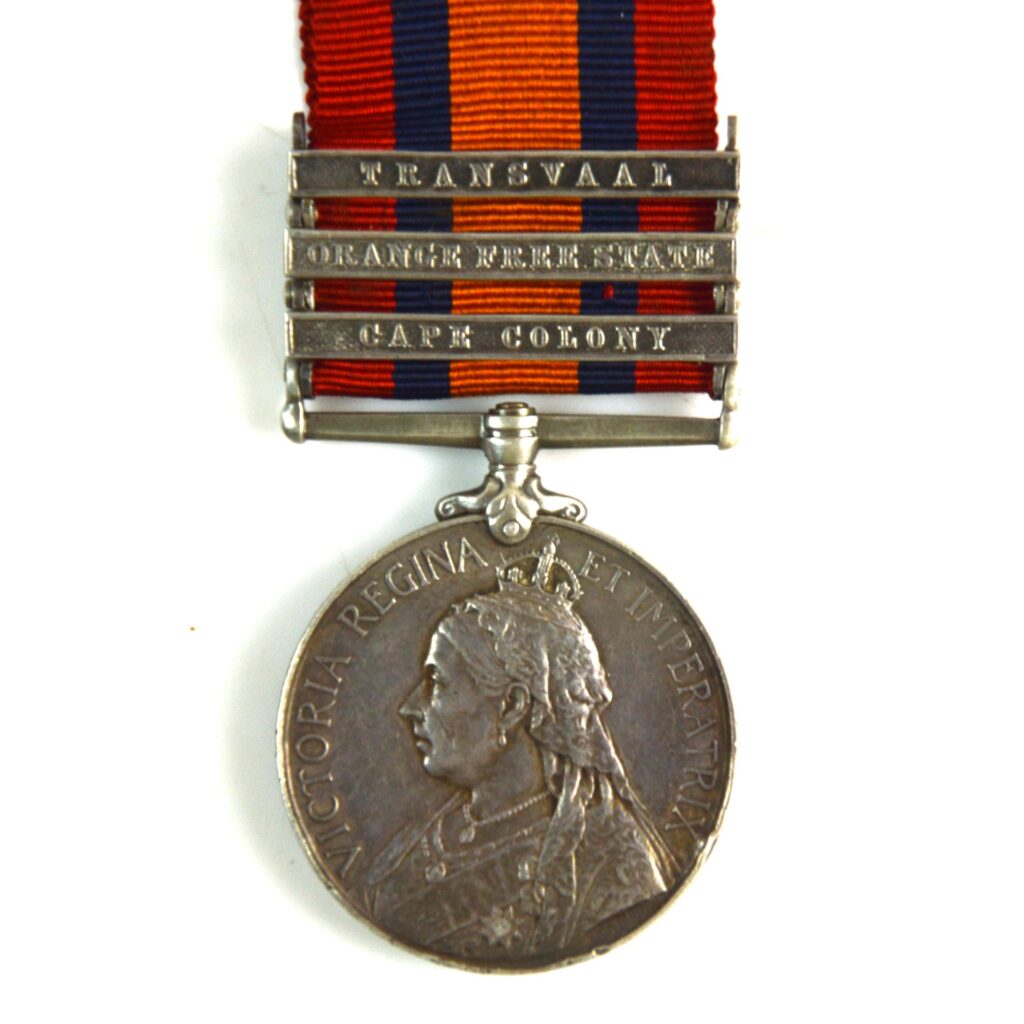
The Queen’s South Africa Medal (QSA) with its 26 possible clasps and the King’s South Africa Medal (KSA) with two clasps form the core of any Boer War medal collection. Named medals can be researched through the Medal Rolls (WO 100 at The National Archives) and published nominal rolls. Casualty medals — especially to men killed at well-known engagements like Spion Kop, Colenso, or Paardeberg — command substantial premiums, typically 3–5 times the price of a survivor’s medal. [4]
Equipment and Ephemera
- Queen Victoria’s chocolate tins — distributed to troops at Christmas 1899, these embossed brass tins survive in large numbers and are a popular entry point for new collectors (typically £30–£80).
- Boer Mauser rifles — model 1895 and 1896 patterns, bandoliers, and ammunition pouches appear regularly on the market.
- Photographs, postcards and letter cards — campaign photography was widespread during the Boer War. Original images are invaluable primary sources and often more affordable than physical militaria.
- Pith helmets — the white foreign-service helmet worn during the early stages of the war, before the adoption of khaki covers and slouch hats.
Reference Works
Thomas Pakenham’s The Boer War remains the standard single-volume history and is essential background for any collector of the period. The Anglo-Boer War Museum in Bloemfontein is the principal museum dedicated to the conflict.
Sources
- Pakenham, Thomas. The Boer War. London: Weidenfeld & Nicolson, 1979. ISBN 978-0-297-77395-4.
- Judd, Denis and Surridge, Keith. The Boer War: A History. London: I.B. Tauris, 2013. ISBN 978-1-78076-373-0.
- Nasson, Bill. The South African War 1899–1902. London: Arnold, 1999. ISBN 978-0-340-74111-2.
- The National Archives. Boer War records (WO 100, WO 108). nationalarchives.gov.uk.
Frequently Asked Questions
What were the Boer Wars?
The Boer Wars were two conflicts fought between the British Empire and the Dutch-descended Boer settlers in South Africa: the First Boer War (1880–1881) and the Second Boer War (1899–1902). The Second Boer War was a major conflict involving nearly half a million British and Empire troops, and it fundamentally changed British military tactics and organisation.
What medals were awarded for the Boer Wars?
The main campaign medals are the Queen's South Africa Medal (QSA) with up to 26 different clasps denoting specific actions, and the King's South Africa Medal (KSA) with two date clasps. For the First Boer War, the Cape of Good Hope General Service Medal was awarded. Named and clasped QSA medals to scarce regiments are highly collectible.
Why are Boer War medals collectible?
Boer War medals are popular because they are named to the individual recipient, allowing detailed research into a soldier's service. The QSA's extensive clasp system means every medal tells a unique story. They also represent the last great colonial campaign and the birth of modern warfare, making them historically significant.
Sources & References
- Pakenham, T. — *The Boer War* (1979)
- Knight, I. — *The National Army Museum Book of the Zulu War* (2003)
- Nasson, B. — *The War for South Africa* (2010)

Related Items in Our Collection8 items