- Introduction
- Origins and the Board of Ordnance
- Organisation and Structure
- The Napoleonic Wars
- Victorian Campaigns
- World War I: The Artillery’s War
- World War II
- Post-War to the Present
- Guns and Equipment Through the Ages
- Notable Battles and Actions
- Waterloo, 1815
- The Somme, 1916
- El Alamein, 1942
- The Falklands, 1982
- Cap Badge and Insignia
- The RA Today
- Collector’s Corner: Royal Artillery Militaria
- Sources
- Introduction
- Origins and the Board of Ordnance
- Organisation and Structure
- The Napoleonic Wars
- Victorian Campaigns
- World War I: The Artillery’s War
- World War II
- Post-War to the Present
- Guns and Equipment Through the Ages
- Notable Battles and Actions
- Cap Badge and Insignia
- The RA Today
- Collector’s Corner: Royal Artillery Militaria
- Sources
Introduction
The Royal Regiment of Artillery — universally known as “the Gunners” — is the largest regiment in the British Army and one of the oldest. Its motto, Ubique (“Everywhere”), was granted by King William IV in 1833, reflecting the fact that the RA has served in virtually every British campaign since its founding. Uniquely among British military units, the RA has no battle honours — because Ubique encompasses them all. [1]
From the smooth-bore cannon of Waterloo to the precision-guided munitions of Afghanistan, the Royal Artillery has evolved continuously while maintaining a fierce institutional identity. For collectors, the RA’s sheer size and three centuries of continuous service create one of the richest and most varied collecting fields in British militaria — from shell case trench art to named medal groups spanning half a dozen theatres of war.
Origins and the Board of Ordnance
The Royal Artillery was established on 26 May 1716 by Royal Warrant at Woolwich, with two companies of artillery under the command of Colonel Albert Borgard. The Board of Ordnance — not the Army — controlled the artillery, giving the Gunners a distinctive administrative identity that persisted until the Board’s abolition in 1855. Woolwich remained the spiritual home of the RA for nearly 300 years, housing the Royal Military Academy (“The Shop”), the Royal Arsenal, and the Rotunda museum. [1]
This unique governance had significant practical consequences: artillery officers were commissioned by the Board rather than purchasing their commissions (as was standard in the infantry and cavalry), meaning the RA attracted a more technically competent and often less aristocratic officer corps. The Royal Military Academy at Woolwich provided mathematical and scientific training of a standard far above anything available at Sandhurst. The Gunners were, from their inception, a scientific arm built on technical expertise rather than social privilege — a distinction they have never lost. [2]
By the mid-18th century the RA had grown to include both field artillery and garrison artillery. The regiment served in every major British campaign of the Georgian era — Blenheim, Dettingen, Minden, the American War of Independence, and the long struggle against Revolutionary and Napoleonic France.
Organisation and Structure
The Royal Artillery has always been organised differently from the infantry and cavalry. Instead of regiments in the traditional sense, the RA uses a hierarchy of batteries, troops, and regiments that reflects the arm’s technical nature and the need for centralised command of fire.
A battery is the basic tactical unit — typically six guns with their crews, vehicles, and associated personnel. Batteries have their own identities, histories, and traditions stretching back centuries. Some, like 7 (Sphinx) Commando Battery, carry battle honours from the Egyptian campaign of 1801. Batteries are grouped into regiments (typically three batteries), which form the operational units commanded by a lieutenant colonel. [1]
| Sub-arm | Founded | Role |
|---|---|---|
| Royal Horse Artillery (RHA) | 1793 | Mobile fire support for cavalry and armoured formations |
| Royal Field Artillery (RFA) | 1899 | Close support field artillery (merged into RA, 1924) |
| Royal Garrison Artillery (RGA) | 1899 | Heavy, siege, and coastal artillery (merged into RA, 1924) |
| Anti-Aircraft Command | 1938 | Air defence of Great Britain (disbanded 1955) |
The distinction between Royal Horse Artillery and Royal Artillery is significant and enduring. The RHA, formed in 1793, was the elite mobile arm — its crews mounted and trained to gallop into action alongside cavalry. RHA batteries maintain a fierce pride in their identity. At formal occasions, RHA officers still take precedence over their RA counterparts — a tradition that has survived every reorganisation. The RHA’s distinctive badge and uniforms mark them as one of the most prestigious units in the British Army. [2]
The Napoleonic Wars
The Napoleonic Wars established the RA’s reputation as a battle-winning arm. The Royal Horse Artillery, founded just six years before the wars began in earnest, provided the mobile fire support that Wellington’s cavalry formations desperately needed. Throughout the Peninsular War (1808–14), RHA troops accompanied the cavalry columns on forced marches across Spain and Portugal, unlimbering at a gallop to deliver devastating fire at critical moments. [3]
Major Norman Ramsay’s famous charge through French cavalry with his RHA troop at Fuentes de Oñoro (1811) remains one of the regiment’s most celebrated incidents — the guns burst through the encircling horsemen at full gallop, the drivers using their swords to cut a path. Wellington himself watched from a hillside and later said it was “the finest thing I ever witnessed.” [3]
At Waterloo (18 June 1815), the Royal Artillery played a decisive role. Bull’s battery of the RHA sustained heavy casualties holding the centre-right of Wellington’s line, while Captain Cavalié Mercer’s troop (then G Troop RHA, now G Battery) famously held the ridge against massed French cavalry despite received orders to retire into the infantry squares. Firing double-shotted canister at point-blank range into the charging cuirassiers, Mercer’s guns stopped wave after wave of French cavalry. His journal — published as Journal of the Waterloo Campaign — is one of the great primary sources of the battle and one of the finest descriptions of artillery in action ever written. [3]
Victorian Campaigns
The Victorian era saw the RA engaged across the globe in almost continuous campaigning. In the Crimea (1854–56), the siege of Sevastopol demanded sustained heavy bombardment, and the performance of the artillery — though hampered by logistical failures — confirmed the arm’s central role in modern warfare. During the Indian Mutiny of 1857, RA batteries were at the forefront of the relief of Lucknow and the recapture of Delhi, where the Gunners’ fire breached the Kashmir Gate. [1]
In the colonial wars of Africa — the Zulu War, the Sudan campaigns, the Ashanti expeditions — the RA provided the firepower superiority that underpinned British tactical dominance. The rocket batteries, armed with Congreve and later Hale rockets, added a weapon of psychological as much as physical effect.
The Boer Wars (1899–1902) exposed critical weaknesses: the obsolescent guns proved outranged by the Boers’ modern Krupp and Creusot artillery, and the traditional tactic of bringing guns into the open at close range proved suicidal against accurate Mauser rifle fire. The disaster at Colenso, where Colonel Long’s batteries were overrun, shocked the regiment. The resulting modernisation programme transformed British artillery doctrine and led directly to the adoption of the quick-firing 18-pounder that would dominate the Western Front. [2]
World War I: The Artillery’s War
The Great War was the artillery’s war. By 1918, the RA comprised roughly one-third of the entire British Army — over 500,000 men serving in field, horse, garrison, anti-aircraft, and trench mortar batteries. The barrage — creeping, standing, counter-battery, and box — became the dominant tactical instrument of the Western Front. [4]
At the Somme (1916), the preliminary bombardment fired 1.5 million shells over seven days — yet the barrage failed to destroy the deep German dugouts or cut the wire effectively. The infantrymen of 1 July 1916 paid the price. The catastrophic losses that followed — nearly 60,000 casualties on the first day — forced a fundamental revolution in artillery tactics: the creeping barrage (a moving curtain of fire that advanced just ahead of the infantry); sound ranging and flash spotting (to locate enemy batteries without registration fire); predicted fire (eliminating the need to range, preserving surprise); and the counter-battery group (dedicated units tasked with suppressing enemy guns). [4]
By the battles of the Hundred Days in 1918, British artillery had reached a level of devastating sophistication. At the Battle of Amiens (8 August 1918) — Ludendorff’s “black day of the German Army” — predicted fire, smoke, counter-battery suppression, and infantry-artillery cooperation combined to shatter the German line without the lengthy preliminary bombardment that had previously forfeited surprise.
The RA suffered approximately 50,000 casualties in the Great War. Gunner officers had a particularly high casualty rate, serving as forward observation officers (FOOs) in the front-line trenches — crawling with telephone wire through no man’s land to direct fire from exposed observation posts. [1]
World War II
The RA adapted rapidly to the demands of a mechanised, three-dimensional war. Anti-Aircraft Command defended Britain during the Blitz, operating thousands of heavy and light AA guns that, together with the RAF’s fighters, formed the nation’s shield against the Luftwaffe. Anti-tank regiments — equipped first with the inadequate 2-pounder, then the 6-pounder and the superb 17-pounder — fought in the desert and in Normandy. Field regiments equipped with the 25-pounder gun-howitzer supported every major operation from North Africa to the Rhine. [2]
The opening barrage at El Alamein on 23 October 1942 was the largest British artillery bombardment since 1918. Over 800 guns fired simultaneously in Operation Lightfoot — demonstrating that the fire-plan lessons of WWI had been absorbed and refined into a new level of sophistication. In Normandy, the massed fire of naval guns, field artillery, and rocket batteries — particularly the “Moaning Minnies” of the RA’s rocket regiments — provided overwhelming firepower support for the breakout. [4]
Post-War to the Present
Korea, Aden, Northern Ireland, the Falklands, the Gulf, Iraq, and Afghanistan — the RA has served in every post-1945 British operation. In the Falklands (1982), 29 Commando Regiment RA supported the Royal Marines with 105mm Light Guns manhandled into position on the mountains of East Falkland in appalling weather and at extreme range — a physical feat that proved modern gunners retained the determination of their Napoleonic forebears. [1]
In Iraq (Operation Telic, 2003) and Afghanistan (Operation Herrick, 2001–14), the RA provided fire support with the AS-90 155mm self-propelled gun, the 105mm Light Gun, and mortars, as well as target acquisition through unmanned aerial vehicles and reconnaissance assets. The Gunners also increasingly served in the dismounted infantry role — a testament to the regiment’s adaptability.
Guns and Equipment Through the Ages
The evolution of artillery equipment mirrors the broader story of military technology. The smooth-bore muzzle-loading cannon of Waterloo was recognisably descended from medieval bombards. Rifled barrels appeared in the Crimea. The breech-loading revolution of the 1870s–80s transformed rate of fire, and the introduction of the recoil mechanism — perfected in the French 75mm gun of 1897 — allowed guns to fire without being relaid after each shot. [3]
| Gun | Era | Calibre | Notes |
|---|---|---|---|
| 9-pounder smooth-bore | Napoleonic | 3.66 in | Standard field piece at Waterloo |
| Armstrong RBL | 1860s | Various | First British rifled breech-loader |
| 18-pounder QF | WWI | 3.3 in | Principal British field gun 1914–18 |
| 25-pounder | WWII–Korea | 3.45 in | One of the finest field guns ever designed |
| 105mm Light Gun | 1974–present | 105 mm | Towed; Falklands to Afghanistan; helicopter-portable |
| AS-90 | 1993–present | 155 mm | Self-propelled gun; Iraq and exercises |
The 25-pounder deserves special mention. Introduced in the late 1930s, its combination of range (13,400 yards), accuracy, high rate of fire (up to 5 rounds per minute in experienced hands), and extraordinary reliability earned it a reputation as perhaps the finest field gun of the Second World War. It served through Korea and beyond, and examples remain in ceremonial use today. [2]
Notable Battles and Actions
Waterloo, 1815
Mercer’s G Troop RHA held the ridge against the massed cavalry charges of Marshal Ney, firing double-shotted canister at point-blank range. The troop lost most of its horses and many of its gunners but never abandoned its position. [3]
The Somme, 1916
Over 1.7 million shells were fired during the seven-day preliminary bombardment. The failure of the barrage led directly to the tactical revolution — creeping barrage, predicted fire, sound and flash ranging — that culminated in the devastating firepower of the Hundred Days. [4]
El Alamein, 1942
The 800-gun opening barrage marked the beginning of the end for Rommel’s Afrika Korps. Concentrated fire plans, counter-battery work, and infantry-artillery cooperation had reached a new level. [4]
The Falklands, 1982
29 Commando Regiment RA’s 105mm Light Guns fired at extreme range in appalling weather, often with ammunition hand-carried to gun positions on the mountains of East Falkland. The fire support they provided was critical to every infantry assault. [1]
Cap Badge and Insignia
The Royal Artillery cap badge features a nine-pounder muzzle-loading gun surmounted by a crown, with the motto “Ubique” above and “Quo Fas et Gloria Ducunt” (“Where Right and Glory Lead”) below. The badge has evolved through several distinct patterns:
- Victorian — larger, more ornate, often with VR cypher
- Edwardian/WWI — simplified, with King’s Crown
- WWII/Post-war — standard brass, King’s Crown until 1953, then Queen’s Crown (EIIR)
- Current — anodised aluminium (“staybrite”), same basic design with King’s Crown (CIIIR)
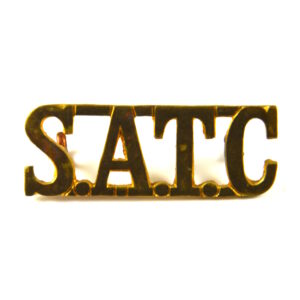
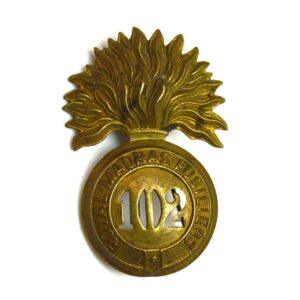
Collar badges, shoulder titles (“R.A.” in brass or anodised), and formation signs are all collectable. The shoulder titles “R.F.A.” (Royal Field Artillery, pre-1924), “R.G.A.” (Royal Garrison Artillery), and “R.H.A.” (Royal Horse Artillery) denote the pre-amalgamation sub-arms and are particularly sought after by specialists. The “Bursting Grenade” pattern used by certain RA units is a distinctive variant. [5]
The RA Today
The modern Royal Artillery encompasses far more than traditional tube artillery. Air defence (Starstreak and Sky Sabre missile systems), surveillance and target acquisition (unmanned aerial vehicles, radar, and electronic warfare), and close fire support remain core roles. The regiment’s adaptability — from 18th-century smoothbores to 21st-century precision munitions and drone warfare — is perhaps its most remarkable characteristic. The motto Ubique remains as accurate today as when it was first granted nearly two centuries ago. [1]
Collector’s Corner: Royal Artillery Militaria
The RA’s long history and enormous size produce a vast range of collectable material:
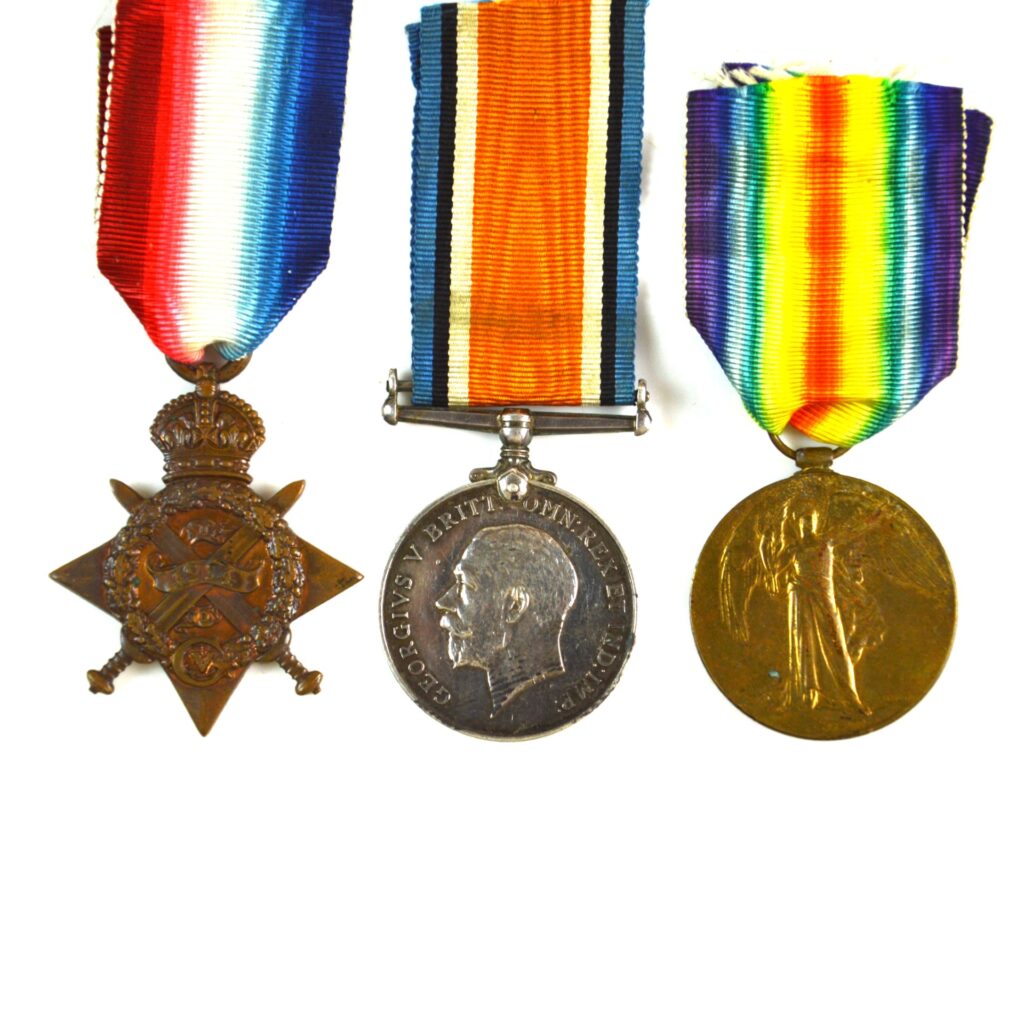
- Medals — RA medal groups span every conflict since the 18th century. Named WWI groups to identified gunners can be researched through battery war diaries (WO 95 at The National Archives). Because the RA was so large, gunner groups are often more affordable than infantry equivalents, offering superb research potential at modest cost.
- Cap badges — dozens of variants over 300 years. Pre-1900 examples (particularly Victorian shako plates), officer-quality silver pieces, and sub-arm variants (RFA, RGA, RHA) all command premiums.
- Shoulder titles — brass “R.A.”, “R.F.A.”, “R.G.A.”, “R.H.A.” — each marking a distinct chapter of RA history. Pre-1924 sub-arm titles are scarcer than the generic “R.A.”
- Shell cases and trench art — perhaps the most distinctive RA collectable. Engraved and decorated shell cases given as presentations, mess ornaments, or converted into umbrella stands are a quintessentially British militaria item. RA markings add provenance. Dedicated collectors focus on identified battery presentation pieces.
- Buttons — RA buttons feature the royal arms with the gun and motto. Officers’ gilt; other ranks’ brass. Pattern variations follow the usual monarch chronology from George III onwards.
- Books and ephemera — the RA has been exceptionally well served by historians. General Sir Martin Farndale’s multi-volume History of the Royal Regiment of Artillery is the standard work. Battery and regimental histories are plentiful for both World Wars.
The Firepower — Royal Artillery Museum, managed by the Royal Artillery Historical Trust at Larkhill, holds one of the finest artillery collections in the world: guns from the 16th century to the present, uniforms, medals, paintings, and the comprehensive RA Archive — an invaluable research resource for anyone studying the British Army’s largest arm. [5]
Sources
- Farndale, General Sir Martin. History of the Royal Regiment of Artillery. Multiple volumes. London: Royal Artillery Institution, 1986 onwards.
- Hogg, Brigadier O.F.G. The Royal Arsenal: Its Background, Origin, and Subsequent History. Oxford University Press, 1963.
- Mercer, General Cavalié. Journal of the Waterloo Campaign. London: Peter Davies, 1927 (reprint). ISBN 978-0-306-80200-5.
- Bidwell, Shelford and Graham, Dominick. Fire-Power: British Army Weapons and Theories of War 1904–1945. London: Allen & Unwin, 1982. ISBN 978-0-04-355028-2.
- Royal Artillery Historical Trust. Collections and archive, Larkhill. firepower.org.uk.
Frequently Asked Questions
What does 'Ubique' mean?
'Ubique' is Latin for 'Everywhere' and is the motto of the Royal Artillery and the Royal Engineers. It was awarded by King William IV in 1833 to recognise that the Artillery had served in virtually every campaign and theatre of operations. Because of this honour, the Royal Artillery carries no individual battle honours — 'Ubique' covers them all.
What is the Royal Artillery cap badge?
The Royal Artillery cap badge features a field gun above a scroll bearing the motto 'Ubique', beneath a crown. The design has evolved over the centuries but consistently features the cannon motif. Gunner cap badges are among the most common in British militaria collections due to the huge size of the Regiment throughout its history.
How big is the Royal Artillery?
The Royal Artillery is one of the largest corps in the British Army. At its peak during the Second World War, it comprised over 1 million men — roughly one-quarter of the entire British Army. Today it numbers around 7,000 regular soldiers in 13 regiments, operating guns, missiles, unmanned aerial vehicles, and surveillance systems across the globe.
Sources & References
- Farndale, M. — *History of the Royal Regiment of Artillery* (multiple volumes)
- Royal Artillery Museum archives
- Royal Artillery Association — royalartilleryassociation.co.uk

Related Items in Our Collection8 items